0% read
Last updated:
Aurora
Aurora is a decentralized Layer 2 platform built on the NEAR Protocol that provides a fully compatible Ethereum Virtual Machine (EVM) environment. It functions as a scaling solution that allows developers to deploy their existing Ethereum applications in a high-throughput, low-cost environment without modification. [3] [4]

$$ $$
Overview
Aurora was developed to provide a seamless bridge for developers and assets between the Ethereum and NEAR ecosystems. As a decentralized Layer 2 built on the NEAR Protocol, it allows developers to launch their applications on a high-performance platform while retaining full compatibility with the EVM. The core of the Aurora environment consists of two primary components: the Aurora Engine and the Aurora Bridge. The Aurora Engine is the EVM that executes smart contracts, while the Aurora Bridge facilitates the trustless transfer of assets, such as ETH and ERC-20 tokens, between Ethereum and Aurora. This architecture allows decentralized applications (dApps) originally built for Ethereum to be deployed on Aurora without significant code changes, providing users with a familiar experience but with improved performance and lower transaction costs.
To facilitate adoption, particularly for Web2 businesses transitioning to Web3, the project offers Aurora Cloud. This "Blockchain-as-a-Service" platform allows businesses to launch their own dedicated, customizable blockchains, known as "Virtual Chains," which run as smart contracts on NEAR. This model is intended to remove the complexity and cost associated with setting up traditional Layer 2 infrastructure. The project's governance is managed through a hybrid model that combines a Decentralized Autonomous Organization (DAO), known as the AuroraDAO, with a traditional corporate entity. [5] [1] [3]
Technology
Aurora Cloud
Aurora Cloud is an infrastructure-as-a-service (IaaS) platform that enables developers and businesses to launch their own customized EVM-compatible blockchains, referred to as "Virtual Chains." The service is designed to streamline the process of onboarding businesses into Web3 by providing a ready-made, customizable blockchain solution that can be deployed quickly. Users can configure key parameters for their chain, including network permissions and the gas token. Optional integrations like a block explorer, a decentralized exchange (DEX), and oracles can also be included. [5] [3] [2]
Aurora Engine
The Aurora Engine is the core component that provides EVM compatibility. It is a smart contract deployed on the NEAR blockchain that can execute Ethereum smart contracts written in languages like Solidity and Vyper. The engine interprets Ethereum transactions, executes them within the NEAR runtime, and stores the resulting state on the NEAR blockchain. This allows developers to use familiar Ethereum development tools such as Truffle, Hardhat, and MetaMask to build and interact with applications on Aurora. [1]
Aurora Bridge
The Aurora Bridge, built upon the Rainbow Bridge technology, is a trustless and decentralized protocol for transferring assets between the Ethereum, NEAR, and Aurora blockchains. It allows users to move ETH and various ERC-20 tokens from Ethereum to Aurora to be used within its dApp ecosystem. The bridge operates without custodians, relying on a set of independent validators to verify transactions on both chains. This interoperability is crucial for liquidity and enables Aurora to tap into the established user base and asset diversity of the Ethereum network. [2] [5]
Use Cases & Features
- Ecosystem Launchpad: Developers can establish a complete, EVM-compatible environment using familiar Ethereum tooling to build a community-driven network.
- Gas-Free Transactions: Through its native wallet, Aurora Pass, the platform supports meta-transactions, offering users a set number of free transactions each month. This feature abstracts away gas fees to simplify onboarding and create a user experience similar to Web2 applications. [5] [3]
- Product Decentralization: The platform enables the creation of applications with trustless security and transparency by removing single points of failure and supporting open governance models.
- Revenue Generation: Through integrations with NEAR and cross-chain capabilities, projects can access new income streams such as staking, yield farming, and liquidity pooling.
- Custom Gas Tokens: Projects that launch their own Virtual Chain can configure it to use their own native token for transaction fees, embedding the token into the core economy of their ecosystem. [1]
- Customization and Compliance: Developers can select from a range of pre-configured infrastructure components, including gas abstraction, permissioning, decentralized exchange (DEX) integrations, oracles, and fiat on-ramps. The platform also supports the implementation of compliance frameworks like KYC/AML to meet regulatory requirements. [1]
Tokenomics
Aurora's native governance token is $AURORA, an ERC-20 token with a total supply of 1 billion. While the AURORA token is used for governance within the AuroraDAO, the base currency for paying transaction fees on the Aurora network is ETH, providing a familiar experience for users from the Ethereum ecosystem. [4] [7]
Allocation
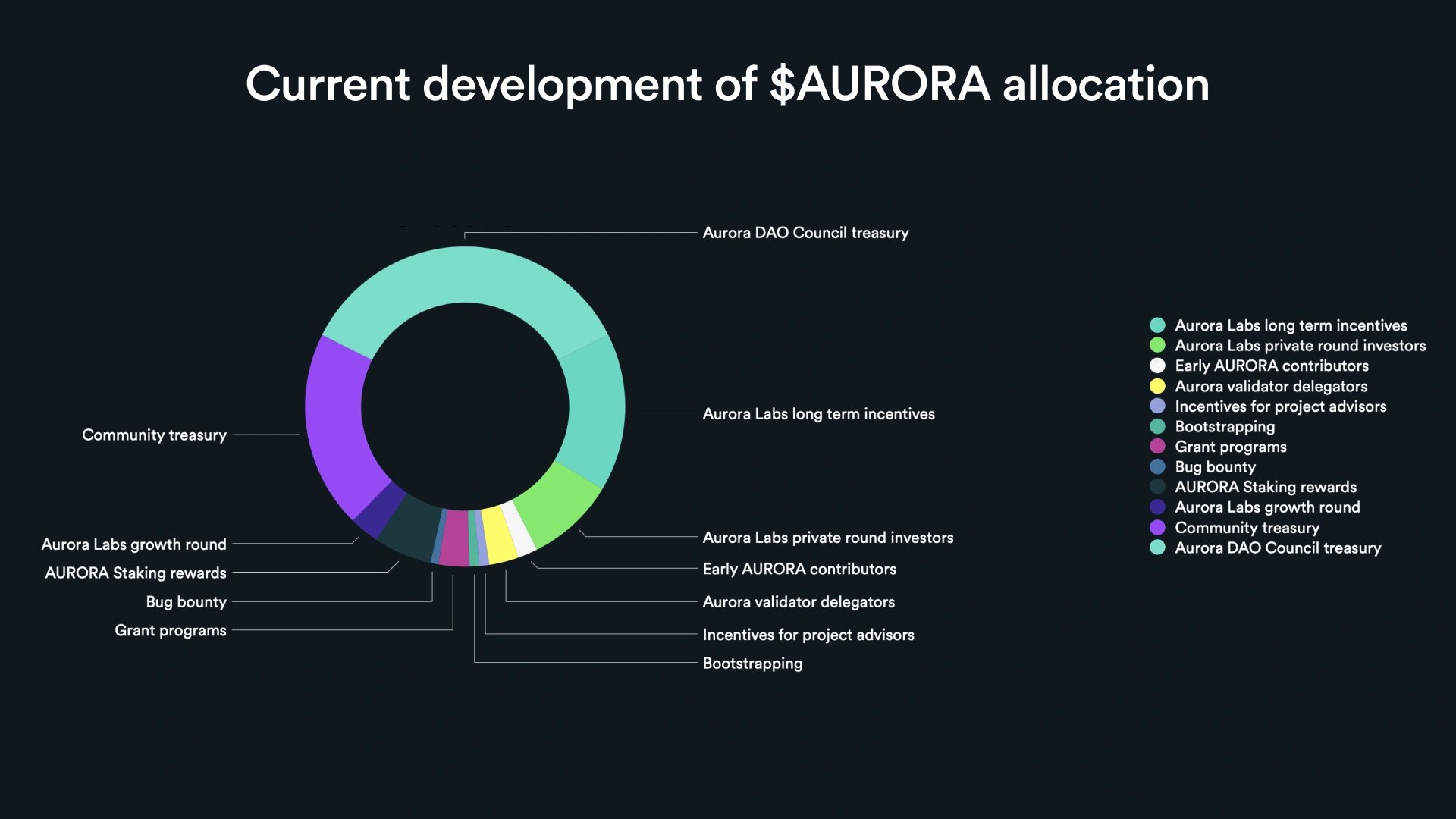
- Aurora DAO Council Treasury — 35.2%
- Community Treasury — 20%
- Aurora Labs Long Term Incentives — 16%
- Aurora Labs Private Round Investors — 9%
- AURORA Staking Rewards — 5.9%
- Ongoing Grant Programs — 3.1%
- Aurora Labs Growth Round — 3%
- Aurora Validator Delegators — 3%
- Early AURORA Contributors — 2%
- Project Advisors — 1%
- Ecosystem Bootstrapping — 1%
- Ongoing Bug Bounty Program — 0.8% [6]
Governance
The governance of the Aurora protocol is structured as a hybrid model. It is primarily managed by the AuroraDAO, a decentralized autonomous organization where token holders can participate in decision-making processes related to the platform's development, treasury management, and strategic direction. This DAO is complemented by a traditional corporate entity, which holds one of the seats in the AuroraDAO. This structure is intended to combine the decentralized ethos of a community-governed project with the operational efficiency of a conventional organization. [1]
Ecosystem & Partnerships
- Covalent
- Curve Finance
- Dega
- Envio
- Gnosis Safe
- The Graph
- LayerZero
- Pyth Network
- Stargate
- Synapse [2]
$$ $$
See something wrong?