0% read
Last updated:
InstaDApp
Instadapp is a decentralized finance infrastructure platform that provides tools for managing assets and interacting with multiple DeFi protocols through a unified interface. The platform developed systems such as DeFi Smart Layer and DeFi Smart Accounts, which support automated transactions, protocol integrations, and customizable asset management across supported networks. [2]
Overview
Instadapp is a decentralized finance (DeFi) asset management platform that provides tools for interacting with multiple lending protocols through a unified interface. The platform was built around the DeFi Smart Layer (DSL) and DeFi Smart Accounts (DSA), which allow users to manage positions across protocols such as MakerDAO, Aave, and Compound without manually managing separate protocol interactions. Instadapp enables users to adjust lending strategies, migrate positions between protocols, and manage collateral and debt positions through automated transactions. The platform has expanded across multiple blockchain networks, including Ethereum, Polygon, Avalanche, Arbitrum, Fantom, and Optimism.
Instadapp was founded by brothers Sowmay Jain and Samyak Jain, who began developing the platform in 2018. The project received early support from investors and blockchain organizations before launching on Ethereum in 2021. The platform introduced the INST governance token, used for protocol governance, with a total supply of 100 million tokens and an initial distribution that included an allocation to users holding positions in supported lending protocols. Instadapp later expanded its infrastructure beyond asset management tools, leading to the development of Fluid, a DeFi liquidity infrastructure protocol built from its experience working with lending and borrowing systems. [3] [4]

Features
DeFi Smart Layer
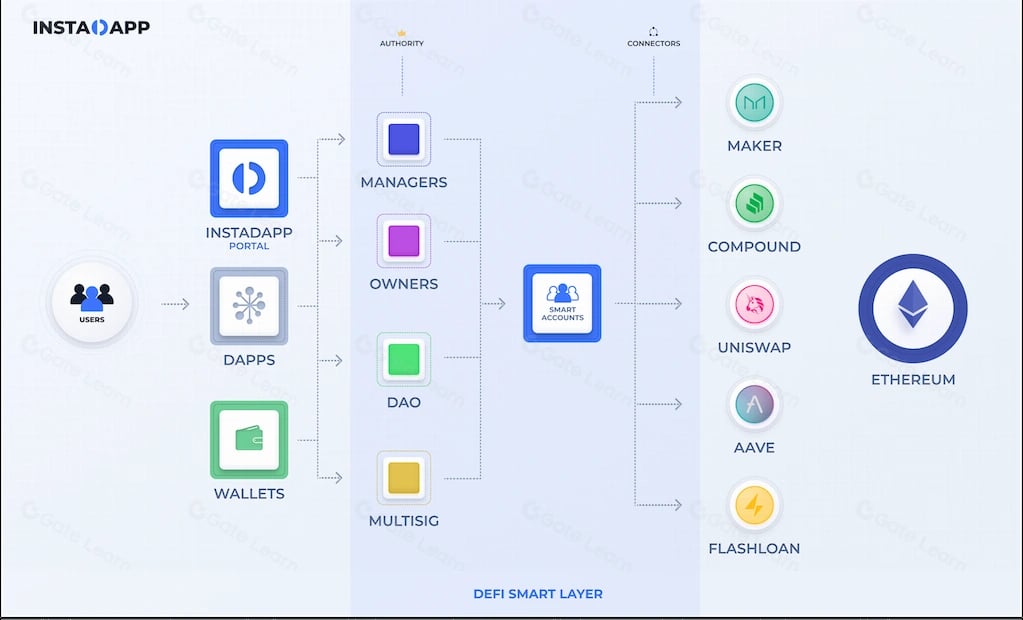
The DeFi Smart Layer (DSL) is the core infrastructure developed by Instadapp to provide a middleware layer for interacting with decentralized finance protocols. The system is designed to allow applications to access multiple DeFi services through a standardized framework rather than requiring separate integrations for each protocol. The DSL consists of three main components: DeFi Smart Accounts (DSA), Connectors, and an Authority Framework. Together, these components enable users and developers to manage DeFi positions, execute cross-protocol transactions, and create customizable permission structures for asset management.
DeFi Smart Accounts (DSA) are upgradeable smart contract accounts that serve as the user-facing account layer within the DSL. Users can create DSAs linked to their wallets, and each account can be controlled by multiple addresses, allowing them to manage positions across supported DeFi protocols. Connectors are standardized contracts that allow DSAs to interact with external protocols by providing reusable integrations for functions such as lending, borrowing, and asset management. The Authority Framework provides customizable access controls, allowing users to assign permissions to guardians, administrators, or automated systems and define which protocols or actions specific addresses can access. This modular structure enables more flexible management of decentralized finance positions while reducing the complexity of interacting with multiple protocols individually. [4]
Products
Instadapp PRO
Instadapp Pro is a DeFi portfolio management platform designed for advanced users who want to manage lending, borrowing, and trading strategies across multiple decentralized finance protocols. The platform integrates with protocols such as Aave, Morpho, Morpho Blue, and Spark, allowing users to access different lending markets and optimize positions through a unified interface. Instadapp Pro provides tools to manage collateral, debt positions, and liquidity strategies, while reducing the complexity of interacting with multiple protocols individually.
The platform includes advanced features such as flashloan-based strategies, refinancing between lending protocols, private transaction execution to reduce exposure to MEV attacks, and simulation tools for testing strategies before deploying them on-chain. Instadapp Pro also integrates with DeFi Smart Accounts (DSAs), enabling features such as multi-owner control, customizable permissions, automated asset management, and connections to decentralized exchanges and bridges. Through these account structures, users can manage more complex DeFi strategies while maintaining control over their assets across supported protocols. [5]
Avocado
Avocado is a non-custodial crypto wallet developed by Instadapp that uses account abstraction to provide a unified interface for managing digital assets, decentralized applications, and DeFi positions across multiple EVM-compatible networks. The wallet supports features such as multi-chain asset management, multisig support, transaction recovery, and two-factor authentication. Avocado enables users to interact with multiple blockchain networks through a single wallet experience, including cross-chain transactions, decentralized exchange integrations, and bridging, all without requiring manual network switching. The wallet includes a unified gas system that allows users to pay transaction fees using USDC across supported networks rather than maintaining separate native gas tokens on each chain. Avocado also provides transaction previews that display asset transfers, approvals, and other execution details before confirmation, improving transparency. For developers, Avocado provides infrastructure to integrate account abstraction features into decentralized applications, including gasless transactions, network abstraction, customizable fee models, and access to prebuilt DeFi strategies through its wallet framework. [6] [7]
Fluid
Fluid is a decentralized finance (DeFi) protocol developed by the Instadapp team that provides shared infrastructure for lending, borrowing, and decentralized exchange applications through a unified Liquidity Layer. Instead of requiring each application to maintain separate liquidity pools, Fluid consolidates liquidity across protocols, allowing applications built on top of the network to share capital while the Liquidity Layer manages deposits, withdrawals, borrowing, utilization rates, and automated risk limits. The protocol consists of three main components: the Lending Protocol, Vault Protocol, and DEX Protocol. The Lending Protocol provides ERC-4626-compatible lending markets, the Vault Protocol enables collateralized borrowing with features such as interest-bearing collateral and optimized liquidation mechanisms, and the DEX Protocol introduces smart collateral and smart debt, allowing users to use collateral and borrowed assets as liquidity within exchange pools. Fluid also includes automated security measures through dynamic borrowing and supply limits, as well as oracle-based price verification using Uniswap and Chainlink data to support liquidations. Governance is managed through the INST token, which is used to determine protocol parameters such as fees, interest rate models, risk limits, and ecosystem configurations. [8]

INST Token
INST is the governance token of the protocol. It was launched on the Ethereum blockchain and has a total supply of 100,000,000 million INST. Instadapp’s governance token INST fulfills the tenet of decentralization. The INST token will align incentives with users, developers, and businesses to provide stewardship of Instadapp's future. The INST token holders will determine the evolution and direction of the Instadapp platform. [4]
INST Allocation
The allocation will be as follows: [4]
- 55% to Instadapp community members
- 23.79% to current team members with 4-year vesting
- 12.07% to investors with 4-year vesting
- 7.85% for future team members and ecosystem partnership
- 1.27% to advisors with 4-year vesting
Partnerships
See something wrong?