0% read
Last updated:
Bart Stephens
P. Bart Stephens is the Co-founder and Managing Partner of Blockchain Capital. The firm is one of the earliest and most established venture capital firms to focus exclusively on the blockchain technology and cryptocurrency industries. A three-time founder, Stephens' career has spanned traditional finance, technology startups, and pioneering investment strategies in both public and private markets. [1] [2]
Education
Stephens attended Princeton University. Sources vary on his exact graduation year and degree, with records indicating his attendance in the early-to-mid 1990s. His degree is cited as a Bachelor of Arts (A.B.) in fields including Political Science, Public Policy, and Public and International Affairs. During his time at Princeton, he played on the varsity football team and his academic studies reportedly focused on areas such as information warfare and national security. [1] [2] [3] [4] [5]
Career
Early Career and Entrepreneurship
Stephens began his career in the 1990s, holding roles in sales, trading, and investment banking at firms including Kidder, Peabody & Co. and Fidelity Investments. He gained significant experience in the emerging fintech sector at ETRADE Financial, where he held several senior executive positions over a period of many years, including roles in product development, corporate development, and at ETRADE Bank. His responsibilities included managing the company's mergers, acquisitions, and strategic investments, which served as a basis for working with digital assets. [1] [3] [5] [6]
Parallel to his corporate career, Stephens engaged in entrepreneurial ventures. He was a co-founder and the Head of Corporate and Business Development for Oncology.com, an internet company that developed a large online network of websites related to cancer. In 2001, the company was successfully acquired by Pharmacia, which was later acquired by Pfizer. [1] [7]
In 2002, Stephens founded Stephens Investment Management (SIM), a family-owned hedge fund and venture capital firm, where he served as Managing Partner alongside his brother, Brad Stephens. At SIM, they pioneered and coined the term for the "Nanocap" investing strategy. This approach applies venture capital-style investment analysis and due diligence to publicly traded, sub-micro-cap equities. Before starting his next major venture, Stephens also served as Executive Vice President of Venture Capital for Ivanhoe Capital Corporation (ICC), the family office of international financier Robert Friedland. [1] [7] [4]
Blockchain Capital
In 2013, Bart Stephens, his brother W. Bradford Stephens, and Brock Pierce co-founded Blockchain Capital. The firm was established as one of the first venture capital firms dedicated exclusively to investing in the Bitcoin, blockchain, and crypto-asset ecosystem. As Managing Partner, Stephens has been the public face of the firm, guiding its investment strategy and overseeing its growth. [2] [3] [7]
The firm's core mission is to invest in entrepreneurs building infrastructure and applications for a decentralized future. Under Stephens' leadership, Blockchain Capital has invested in more than 200 companies, protocols, and crypto assets since its inception. Its portfolio includes foundational companies in the digital asset industry, such as cryptocurrency exchanges Coinbase and Kraken; DeFi protocols like Aave and UMA; NFT marketplace OpenSea; and infrastructure providers including Anchorage Digital, Fireblocks, and Securitize. [2] [3] [5]
Fundraising and Innovations
Blockchain Capital is known for several pioneering achievements in venture financing within the crypto space. In April 2017, the firm conducted the first-ever Security Token Offering (STO) for a venture fund. It raised $10 million in six hours for its Blockchain Capital III Digital Liquid Venture Fund by issuing the BCAP digital token. This tokenized the fund, transforming a traditionally illiquid limited partner interest into a liquid, tradable security. [2] [7] [5]
The firm has conducted numerous successful fundraises, progressively increasing its capital base. In 2021, it raised 580 million for two new funds: a sixth early-stage fund and its first opportunities fund for later-stage investments. This raise brought the firm's total assets under management (AUM) to over $2 billion. At the time, Stephens commented on the market conditions and the firm's long-term conviction, stating, "We feel this is an opportune time to be investing with a multi-decade time horizon. We've weathered multiple crypto cycles, and we believe the next one is on the horizon.” [3] [6]
Investment Philosophy
Stephens is known for a pragmatic and selective investment approach, distinguishing him from investors driven by market hype. He is associated with the "90% rule," expressing his belief that for approximately 90% of business concepts, incorporating blockchain technology is an unnecessary and unsuitable solution. He advises entrepreneurs to use blockchain only when its core features, such as decentralization and tamper-resistance, are fundamental to the business model. The stated goal for tokenizing the firm's own fund was to "democratize access to venture capital" by opening participation to a broader investor base. [8]
Appointments and Board Memberships
Throughout his career, Stephens has held numerous board member and observer positions at portfolio companies and other organizations. Some of his most notable affiliations include:
- Silvergate Capital Corporation: He served as an Independent Director on the board of the crypto-focused bank from September 2017 to January 2023. This role placed him in a governance position at a key institutional player in the crypto ecosystem prior to its collapse and voluntary liquidation in March 2023. [4] [6]
- Bitcoin Foundation: He served as Chairman of the Board of Directors from October 2014 to December 2015. [6]
- Mogo Inc. (NASDAQ: MOGO): He serves on the Board of Directors for the Canadian digital payments and financial technology company. [3]
- Other Directorships: He has served as a director or board observer for portfolio companies including the crypto exchange Deribit, security token platform Securitize, and formerly held a position with the Kraken exchange. [5]
Security Incidents and Challenges
As a high-profile figure in the cryptocurrency industry, Stephens has been the target of multiple sophisticated security attacks.
2017 Identity Hack
In 2017, Stephens was targeted in a personal identity hack involving social engineering and a SIM-swapping (or "porting") attack. The attackers gained control of his personal mobile phone number and used that access to impersonate him on platforms like Slack and email. They then sent phishing messages to members of Blockchain Capital's community and its Limited Partners, attempting to solicit funds for a fraudulent token sale. The firm quickly disclosed the incident, clarifying that Blockchain Capital's internal systems and funds were not compromised and that the attack was isolated to Stephens' personal accounts. [3] [9]
2023 X (Twitter) Account Hack
In October 2023, Stephens' official X (formerly Twitter) account, @pbartstephens, was compromised. The hacker posted malicious links promoting a fraudulent airdrop for a fake token, referred to as "BCAP" or "BLAP," directing followers to a phishing website designed to drain crypto wallets. After regaining control, Stephens issued a public warning: "My account was compromised earlier. Please disregard any tweets about an airdrop; they are not from me. Be safe out there." [2] [6] [5]
2023 Deepfake Attempt
In November 2023, Stephens revealed that Blockchain Capital had thwarted a sophisticated social engineering attempt to fraudulently transfer $6 million. The attackers impersonated the founder of a portfolio company through a convincing series of emails and employed deepfake technology to replicate the founder's voice during a phone call. Stephens described the attempt as "next level" and noted the fabricated voice was a "90% or 95% facsimile" of the real person's voice. The fraud was prevented when a firm associate identified a subtle red flag before the wire transfer was executed. [4]
Public Profile and Media
Stephens is a frequent commentator on cryptocurrency, venture capital trends, and blockchain technology, often speaking at major industry conferences. He has been featured in several media productions discussing the digital asset industry, including an episode of the Netflix original series Explained focused on cryptocurrency and the 2014 documentary The Rise and Rise of Bitcoin. [3] [5]
Interviews
Crypto and Policy Perspectives #01
In an interview published on July 23, 2023, on the YouTube channel PGP (Pretty Good Policy) for Crypto, Bart Stephens, Founder and Managing Partner of Blockchain Capital, discusses his views on the development of the cryptocurrency sector, including regulatory conditions, investment approaches, and industry structure.
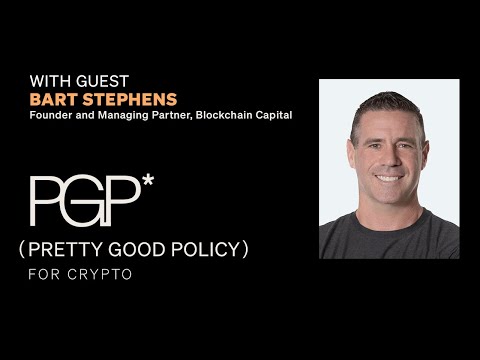
Stephens describes the cryptocurrency ecosystem as involving three concurrent elements: blockchain infrastructure, digital assets with programmable features, and a set of social and political ideas associated with decentralization and transparency. He situates these elements within a broader context of technological and financial change.
He identifies regulatory conditions in the United States as a constraint on industry activity, stating that existing legal frameworks are not fully adapted to blockchain-based systems. According to Stephens, this situation has contributed to some companies establishing operations outside the United States. He refers to ongoing legislative discussions related to digital assets and stablecoins as part of efforts to address these issues.
Stephens also outlines characteristics of development within the crypto sector, including the use of open-source software, distributed participation, and shorter development cycles. He contrasts these processes with those commonly found in traditional financial and technology sectors.
Regarding investment strategy, Stephens states that Blockchain Capital focuses on long-term involvement with portfolio companies. He notes that market downturns tend to reduce participation from short-term investors while maintaining the presence of firms with extended investment horizons.
He comments on the role of regulatory agencies, including the U.S. Securities and Exchange Commission (SEC), and refers to legal proceedings involving crypto-related companies as examples of regulatory interpretation in practice.
Stephens characterizes the crypto sector as involving technological, financial, and institutional dimensions. He also references participation in policy discussions and industry engagement as part of its ongoing development. [10]
See something wrong?