0% read
Last updated:
Edel Finance
Edel Finance is a financial infrastructure project focused on tokenized equities and on-chain financial markets. The project develops products for tokenized stocks and related trading and collateral infrastructure on the Canton Network. [1]
Overview
Edel Finance is developing an on-chain financial infrastructure layer for tokenized equities and related markets on the Canton Network. Its Edel Stocks product provides economic exposure to publicly traded stocks and ETFs through contractual debt instruments issued by Titan Labs, with products such as SPYe and QQQe available on Cantex. The project is also developing Edel Markets, a planned trading venue for spot and derivatives, alongside an On-Chain Margin Layer intended to let eligible tokenized stocks serve as collateral for perpetual contracts. Edel Runway provides a market participation and research layer through features such as Listing Calls and the Demand Index, while EDEL and EDELx serve as separate token layers for the broader ecosystem and Canton-based applications. [4] [5]
Features
Margin Layer
The On-Chain Margin Layer is a planned system connecting Edel Stocks with the proposed Edel Markets trading venue. Under the model, eligible tokenized stock positions could serve as collateral for perpetual futures positions, allowing a stock token to provide both economic exposure to its reference asset and collateral value for another trade. The proposed workflow involves holding eligible Edel Stocks, determining their accepted collateral value, using that value as margin for a perpetual futures position, and monitoring the resulting collateral and trading exposures. The specific eligibility criteria, valuation methods, margin requirements, leverage limits, and liquidation rules have not yet been published, and the Margin Layer is not currently available.
The system is intended to support broader composability between tokenized assets and on-chain financial applications, although current access restrictions for Edel Stocks would continue to apply. Secondary-market trading is available subject to applicable restrictions, while primary issuance and redemption remain limited to approved participants, and holding an Edel Stock would not automatically make it eligible as margin. Using stock tokens as collateral would also introduce additional risks because the collateral's value and the associated perpetual futures position could decline simultaneously. The broader model connects stock issuance and derivatives trading to support an on-chain prime brokerage structure, with the economic model incorporating fees from stock issuance and redemption and perpetual futures trading. [6]
Economic Model
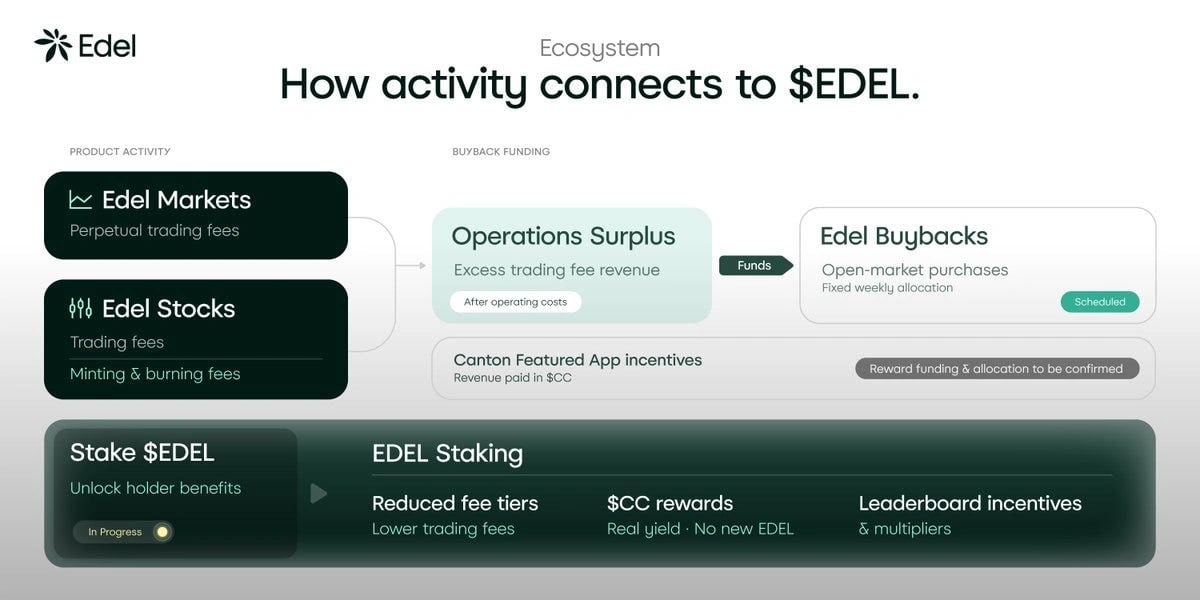
Edel's intended economic model combines two fee sources: fees from the primary minting and redemption of stock tokens and trading fees from perpetual futures on the planned Edel Markets venue. The On-Chain Margin Layer is intended to connect these activities by allowing eligible tokenized stocks to potentially serve as collateral for perpetual futures positions, although it does not introduce a separate margin fee. Stock-side and trading-side fees would arise from their respective activities rather than being charged together on every transaction, and the specific fee rates and terms have not been published. The model therefore describes a planned relationship between product activity and fee generation, not a current fee schedule.
This economic activity is intended to support EDEL token buybacks, with the amount available depending on actual product activity, costs, and the eventual allocation policy. The documentation does not specify a fixed percentage of revenue allocated to buybacks, an execution schedule, minimum amounts, an automation mechanism, or whether repurchased tokens would be held or burned. Edel Markets and stock-backed perpetual futures remain planned, so live Edel Stocks do not confirm that the full fee and buyback model is operational. The broader economic model therefore defines the relationship between stock issuance, derivatives trading, and potential EDEL buybacks while leaving the implementation details to be determined. [7]
Products
Edel Stocks
Edel Stocks are tokenized instruments issued on the Canton Network that provide economic exposure to publicly traded stocks and ETFs. Each Edel Stock is a contractual debt instrument issued by Titan Labs Limited and references a specified stock or ETF, with Titan maintaining 1:1 economic backing for tokens in circulation through either the underlying security or tokenized instruments providing equivalent exposure. SPYe and QQQe are live and trading on Cantex Exchange, although primary minting and redemption remain restricted to approved participants. Tokenholders do not directly own the referenced securities and therefore do not receive shareholder voting, information, or other statutory rights. Instead, their exposure comes through the contractual relationship with Titan, with an internal multiplier determining the amount of underlying exposure each token represents.
Edel Stocks are designed to provide total-return economic exposure, including the economic effects of dividends and corporate actions through adjustments to the internal multiplier rather than additional token issuance. Market participants and liquidity determine secondary-market prices, which can differ from the implied value of the underlying exposure, and approved market makers use primary minting and redemption to support price alignment. Approved redeemers receive cash rather than the underlying securities when tokens are redeemed, while secondary-market trading does not provide access to primary-market redemption. Edel plans to expand primary-market access and introduce an API for minting, redemption, and price verification, but these features remain part of its future scope. The broader product plans also include using eligible Edel Stocks as collateral for perpetual futures through a planned On-Chain Margin Layer connecting Edel Stocks with Edel Markets. [8]
Edel Markets
Edel Markets is a planned trading venue on the Canton Network covering spot and derivatives markets for cryptoassets, equities, and commodities. Perpetual futures are central to its planned integration with Edel Stocks, with the proposed On-Chain Margin Layer allowing eligible tokenized stock positions to be used as collateral for perpetual futures positions. The planned venue is designed around Canton's selective disclosure model, which makes transaction information visible to relevant counterparties and authorized participants rather than making all activity publicly accessible. Edel Markets is intended to support continuous trading, although it has not published specific operating hours, performance commitments, instruments, or launch listings.
The proposed stock-collateral system would allow eligible Edel Stocks to support perpetual futures positions while retaining exposure to the referenced stocks, subject to future valuation, margin, and liquidation rules. This structure would introduce additional risk because declines in stock collateral value could occur alongside losses on a derivatives position, potentially resulting in liquidation. Edel Markets is not yet live, and details including contracts, settlement assets, funding mechanisms, leverage limits, margin requirements, fees, access requirements, and a launch date remain unpublished. The planned economic model includes perpetual futures trading fees alongside the minting and redemption fees associated with Edel Stocks, with connected activity intended to contribute to EDEL token buybacks. [9]
Edel Runway
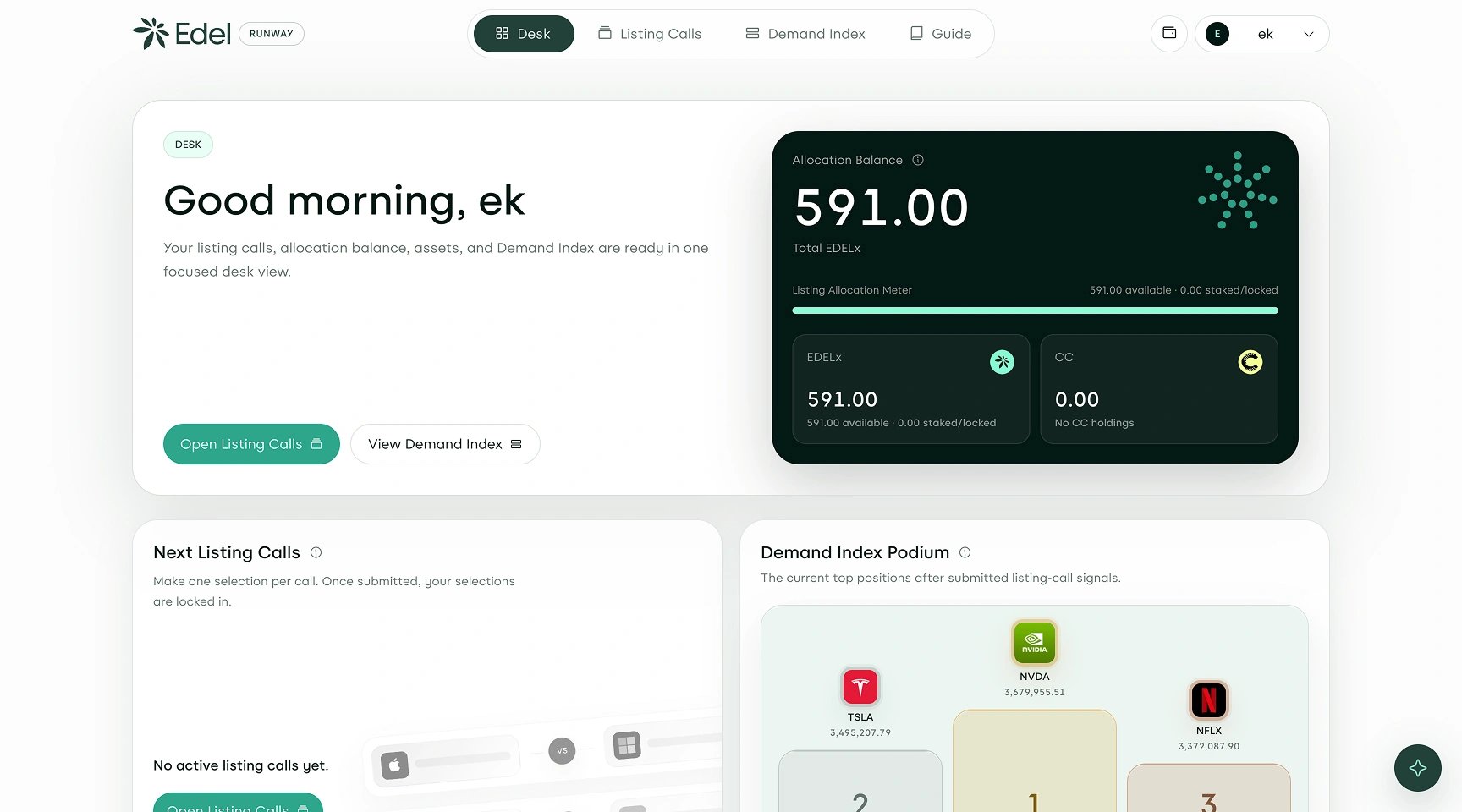
Edel Runway is a market participation platform that allows users to express demand for assets through Listing Calls and an aggregate Demand Index. Users can create a desk profile, review covered assets, compare them through Listing Calls, submit selections, and follow rankings based on participation activity. The platform operates on the Canton Network and incorporates EDELx into its participation flows. The Demand Index aggregates user selections and other participation data to indicate relative interest in different assets and provide signals that can inform future product and market coverage within the Edel ecosystem.
Runway provides interfaces for managing a user desk, wallet, covered assets, Listing Calls, and the Demand Index, with passkey-based access. Its infrastructure connects with the Canton Network and other providers, including Digital Asset, Cantex, OneSwap, and Loop. The platform also includes participation rewards and is built around community-driven asset discovery, with aggregated user preferences shaping asset prioritization for potential future support. Runway is positioned as a market research and participation layer within Edel rather than as a trading venue itself. [10] [11]
EDEL
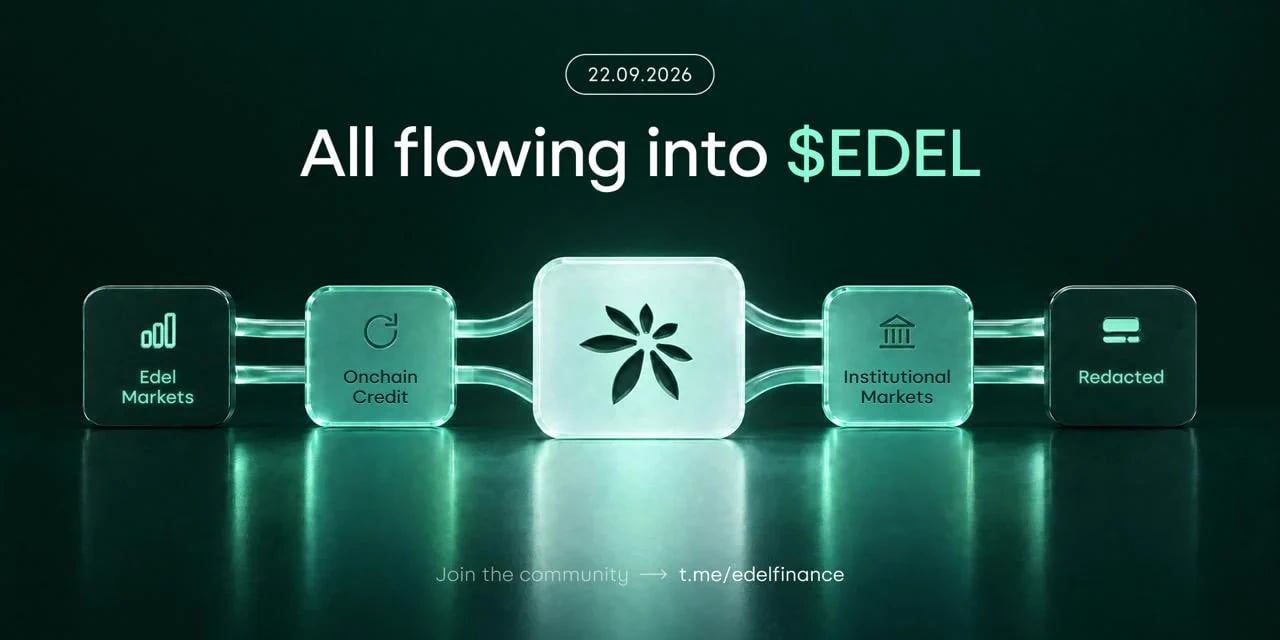
EDEL is Edel's public ecosystem token, operating across Base, Ethereum, BNB Smart Chain, and Solana. It is used within Edel's broader ecosystem for participation, incentives, governance direction, and coordination around its programmable market infrastructure, and it does not represent equity, ownership in Edel, a stable asset, or a claim on underlying securities. The token is separate from the tokenized equity products offered through Edel Stocks, which provide economic exposure to referenced stocks and ETFs. The documentation describes potential uses for EDEL in areas such as revenue participation, ecosystem programs, market incentives, collateral support, and coordinating liquidity and market development. [12]
EDELx
EDELx is Edel's Canton-side token layer for Canton-native products, institutional market environments, and planned Canton-based infrastructure. It is currently used within Edel Runway across functions including wallet balances, claims, Listing Calls, and Demand Index participation, while the broader design extends to compatible Canton wallets, exchanges, and swap applications. EDELx is intended to support Canton-based financial workflows and is distinct from the public EDEL token, although both are part of the same token system. The documentation presents EDELx as a mechanism for extending Edel's ecosystem into Canton rather than as a tokenized security or direct claim on underlying assets. [12]
Partnerships
See something wrong?
Official Website:
Social Profiles:
Founders:
Blockchains: