0% read
Last updated:
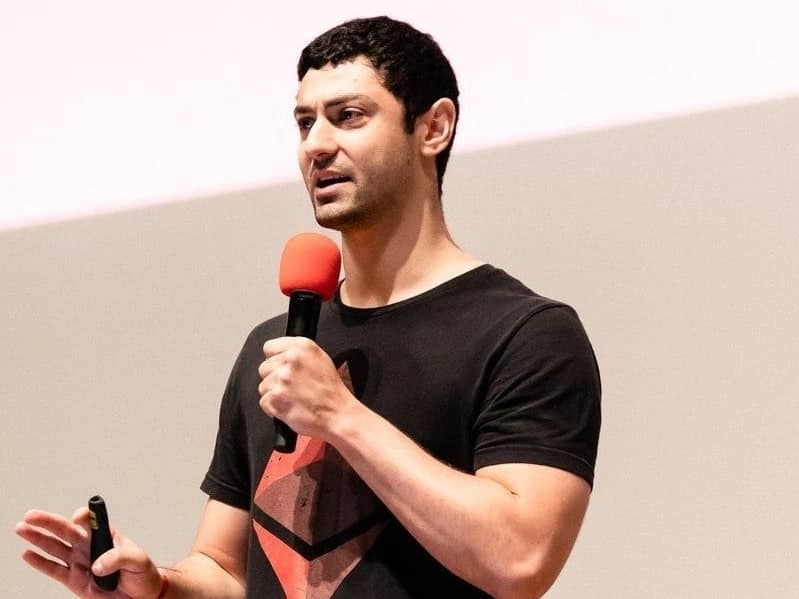
Ameen Soleimani
Ameen Soleimani is an Iranian-American software engineer, entrepreneur, and a prominent figure in the Ethereum ecosystem. [1] He is known for founding the adult entertainment platform SpankChain, the influential grant-giving DAO MolochDAO, and the non-pegged stablecoin protocol Reflexer Finance. [2] [1] [6] [5] His work centers on radical decentralization, "ungovernance," and developing censorship-resistant financial tools. [1]
Education
Ameen Soleimani holds a bachelor's degree in Chemical Engineering from Rensselaer Polytechnic Institute. [3] [4]
Career
Soleimani began his career in the blockchain industry as a software engineer at ConsenSys, an Ethereum venture production studio, where he worked from February 2016 to May 2017. [4] [2] During his time there, he focused on state channels and helped launch AdChain before leaving to found his first major project, SpankChain. [2]
SpankChain
In May 2017, Soleimani co-founded and became the CEO of SpankChain, a cryptocurrency-based payment platform for the adult entertainment industry. [1] [4] [6] The project was designed to address payment processing and censorship issues common in the adult sector by providing performers with a transparent and fair compensation system. [2] This venture established his reputation as a builder willing to apply blockchain technology to controversial use cases. [1]
MolochDAO
Soleimani is credited as the "summoner" of MolochDAO, a decentralized autonomous organization launched on February 14, 2019, at ETHDenver. [1] [5] [6] The DAO was created to solve coordination failures—often referred to as the "tragedy of the commons"—in funding Ethereum public goods and open-source infrastructure. [1]
MolochDAO's design was intentionally minimalist to maximize security and comprehensibility. [4] Its most significant innovation was the ragequit mechanism, which allows any member to exit the DAO at any time with their proportional share of the treasury's assets. This feature protects minority members from being coerced by majority votes and ensures a fair exit path if they disagree with a funding proposal. The MolochDAO framework, particularly its "v2" iteration, became a widely adopted standard for other grant-giving and investment DAOs. [1]
Reflexer Finance and RAI
In 2020, Soleimani co-founded Reflexer Labs and serves as its CEO. [1] [5] [6] The company is the primary developer of the Reflexer Finance protocol, which launched its core product, RAI, on the Ethereum mainnet in February 2021. [1] Described as a "cypherpunk stablecoin," RAI is a stable asset backed exclusively by Ether (ETH) and is not pegged to any fiat currency like the US dollar. [6]
Instead of maintaining a hard peg, RAI operates as a "reflex index" with a floating value. The protocol uses a Proportional-Integral-Derivative (PID) controller, a mechanism from control systems engineering, to algorithmically adjust interest rates. These adjustments incentivize users to perform actions that return RAI's market price to its "redemption price," a target price also managed by the protocol. This design aims to create a more decentralized and censorship-resistant stable asset. [1] The long-term vision for Reflexer is to achieve "ungovernance," where the protocol operates autonomously with minimal need for human intervention. The protocol also includes the FLX governance token, which serves as a backstop in case of a collateral shortfall. [1]
By early 2024, RAI's market capitalization was just under $5 million, with its adoption remaining niche within the larger stablecoin market. [7]
HAI Stablecoin
HAI is a stablecoin protocol launched on February 20, 2024, representing an evolution of the model pioneered by RAI. [7] Described by Soleimani as a "float coin," HAI operates on the Optimism Layer 2 network to make transactions more accessible to everyday users. Unlike RAI's ETH-only backing, HAI is a multi-collateral protocol designed to accept a wider range of assets, such as Optimism's OP token and liquid staking tokens like stETH. [7] [5]
The protocol is governed by holders of the KITE token. The launch included an airdrop of 20% of the total KITE supply to approximately 18,000 crypto wallets, targeting past users of RAI, Optimism, and a prototype version of HAI. To prevent the type of mission drift seen in other DAOs that came to rely on centralized collateral, HAI's governance incorporates safeguards, including higher voting thresholds and mandatory time delays for adding new collateral types. [7]
Privacy Pools and 0xbow
Soleimani is a key figure behind Privacy Pools, a protocol designed to enhance transaction privacy on Ethereum while allowing for regulatory compliance. [5] [8] The project emerged as a response to the regulatory crackdown on the cryptocurrency mixer Tornado Cash, aiming to provide a tool that allows users to provably dissociate their funds from known illicit sources without sacrificing their own privacy. The core technology was detailed in a September 2023 research paper co-authored by Soleimani, Ethereum co-founder Vitalik Buterin, Jacob Illum of Chainalysis, and other researchers. [8]
The development of Privacy Pools is associated with 0xbow, an entity where Soleimani is the Chief Technology Officer (CTO). [5] [3] His GitHub activity shows contributions to the Privacy Pools website under the 0xbow-io organization. [9]
IranUnchained
IranUnchained is a non-profit initiative co-founded by Soleimani that focuses on using cryptocurrency to support pro-democracy initiatives and distribute humanitarian aid in Iran. [3] The organization reported distributing over $100,000 in aid. Soleimani uses the iranunchained handle as a personal identifier, and since October 2022, has served as a "Founding Steward" of the initiative. [1] [3] He has also written political commentary related to Iran's history under this banner. [8]
Angel Investing
Soleimani is an active angel investor in the Web3 space. His investments include participation in funding rounds for Lido Finance (a liquid staking provider), Silo Labs (a lending protocol), Spruce (a decentralized identity company), Mountain Protocol (a stablecoin project), Sprinter, and SpaceComputer. [10]
Philosophy and Public Stances
Soleimani is a vocal advocate for creating fully automated, censorship-resistant financial systems. His philosophy is encapsulated in the concept of "ungovernance," which seeks to minimize human intervention in protocol operations in favor of automated, algorithmic control. [1] He has described his goal as creating a "money god"—an autonomous financial instrument free from human whims and political pressures. [7]
His journey from a fringe builder to a recognized figure in DeFi was summarized in a March 2021 podcast title quoting him: "We Were Idiots and We Were Poor; Then From Mid 2020 to Now, Suddenly, We're Right." [6] On his motivation, Soleimani stated, "I would like to have money that doesn’t get rugged — for me, for my friends, for everybody on the planet." [7]
On his X (formerly Twitter) account, Soleimani has expressed several controversial opinions. In October 2025, he posted his agreement with investor Peter Thiel's statement, "I no longer believe that freedom and democracy are compatible." [8] In a separate post from January 2025, he suggested that voting rights should be earned, proposing that an individual gets a vote only when their net tax contribution becomes positive. He has also expressed frustration that less decentralized platforms like USDT on the Tron network have seen more real-world use for financial freedom in Iran than the Ethereum-based projects he helped create. [8]
Controversies
Soleimani's career has been marked by a willingness to engage with controversial topics and a vocal public persona that has sometimes led to public disputes. His first major project, SpankChain, operated in the adult entertainment industry, which brought both mainstream attention and criticism. [1]
He is known for his unfiltered and strong opinions on social media regarding DeFi governance, the actions of other protocols, and the philosophical tenets of decentralization. [1] His public support for developer Virgil Griffith, who was prosecuted for giving a presentation on blockchain in North Korea, indicated a clear stance against the criminalization of developers for writing and sharing code. [8] The "ungovernance" ideal he champions, while central to his work, is also a subject of debate, with critics arguing that some degree of human oversight will always be necessary for protocols to adapt to unforeseen challenges. [1]
Interviews
Coordination, DAOs, and Institutional Design #01
In an interview published on 20 September 2022 on the Bankless YouTube channel, Ameen Soleimani discussed decentralized autonomous organizations, coordination challenges, and the role of blockchain systems within broader institutional contexts. The conversation took place within the Layer Zero podcast format and addressed concepts associated with his involvement in projects such as MolochDAO, Reflexer Labs, SpankChain, and the RAI stable asset.

According to Soleimani, DAOs developed in response to recurring coordination problems present in both conventional institutions and earlier blockchain based initiatives. He described MolochDAO as a governance structure designed to formalize collective funding and decision making while allowing participants to retain the ability to exit and recover funds without requiring approval. He associated these features with efforts to reduce trust assumptions following the 2016 DAO exploit and its effects on the Ethereum ecosystem.
Within the interview, Soleimani characterized Ethereum as a coordination infrastructure rather than solely a financial network. He stated that its permissionless architecture and resistance to censorship allow the creation of organizational arrangements that operate independently of existing political or legal jurisdictions. In this context, DAOs were described as ongoing experiments in governance and incentive alignment.
The discussion also addressed Soleimani’s interpretation of the global monetary system. He outlined his perspective on the United States dollar and the role of the Federal Reserve, describing the system as influenced by geopolitical and military factors. Based on this assessment, he proposed that blockchain based arrangements could support alternative coordination models, which he referred to as “positive ponzis,” defined as voluntary and transparent systems structured around participant consent rather than coercion.
Throughout the interview, Soleimani clarified that these views reflect his analytical framework and philosophical interpretation of blockchain governance. He indicated that DAOs and coordination mechanisms remain subject to change and should be understood as evolving structures influenced by technical design choices and collective behavior rather than as finalized institutional models. [11]
PMF, Privacy, and Pragmatism Onchain #02
Recorded and released on Apr 15, 2025, this interview from the PMFers series hosted by Austin Griffith features Ameen Soleimani outlining his own account of building and evaluating onchain products within the Ethereum ecosystem. The discussion centers on his professional trajectory, from an engineering background to software development and later involvement in multiple Ethereum based projects, with a focus on how these experiences informed his understanding of product market fit.

Soleimani describes early initiatives such as SpankChain and MolochDAO as practical case studies in coordination and product design. He explains SpankChain as a technically complex system that faced adoption challenges, while MolochDAO is presented as a governance structure that prioritized simplicity and specific funding objectives. In his account, these projects illustrate recurring tensions between technical design choices and user adoption constraints.
The conversation devotes considerable attention to Tornado Cash, which Soleimani characterizes as responding to an existing demand for transaction privacy on Ethereum. He recounts its development process and subsequent regulatory scrutiny, describing these events as examples of how immutable smart contracts interact with legal and compliance considerations. He links these experiences to his later involvement with Oxbow, where privacy pools are developed using zero knowledge proofs to allow users to demonstrate exclusion from sanctioned activity without revealing transaction histories.
Soleimani also addresses broader ecosystem topics, including Layer 2 network fragmentation, the growth of developer oriented environments such as Base, and the integration of AI assisted tools into development workflows. He describes AI systems as instruments that can increase development efficiency, while emphasizing that they currently require human supervision to manage errors and limitations.
Across the interview, Soleimani presents these observations as reflections derived from personal experience rather than general prescriptions. Concepts such as the “Ethereum Hero’s Journey” and meme driven development are introduced as interpretative frameworks he uses to describe builder motivations, sustainability, and communication practices within crypto communities. The discussion, as articulated from his perspective, focuses on observed tradeoffs, design constraints, and long term operational considerations in decentralized system development. [12]
See something wrong?