0% read
Last updated:
Papertrade
Papertrade is a decentralized perpetual futures exchange built on Hyperliquid’s HyperEVM that offers what it describes as synthetic perpetuals. The project markets itself on its stated design and centers on high leverage of up to 1000x, zero slippage, no trading fees, no funding rates, and full user ownership of the protocol, as self-described by the team.[1][2]
Overview
Papertrade is a synthetic perpetuals exchange, meaning it allows traders to take leveraged long or short positions on the price of an asset without holding or directly trading the underlying asset itself. Perpetual futures, or "perps," are derivative contracts with no expiry date, and synthetic versions replicate an asset's price exposure through onchain accounting rather than a conventional order book matched against real spot supply. The project is built on Hyperliquid, a blockchain oriented toward onchain trading, and the team states the exchange is "fully onchain on hyperliquid," implemented on Hyperliquid’s HyperEVM execution environment.[2][4]
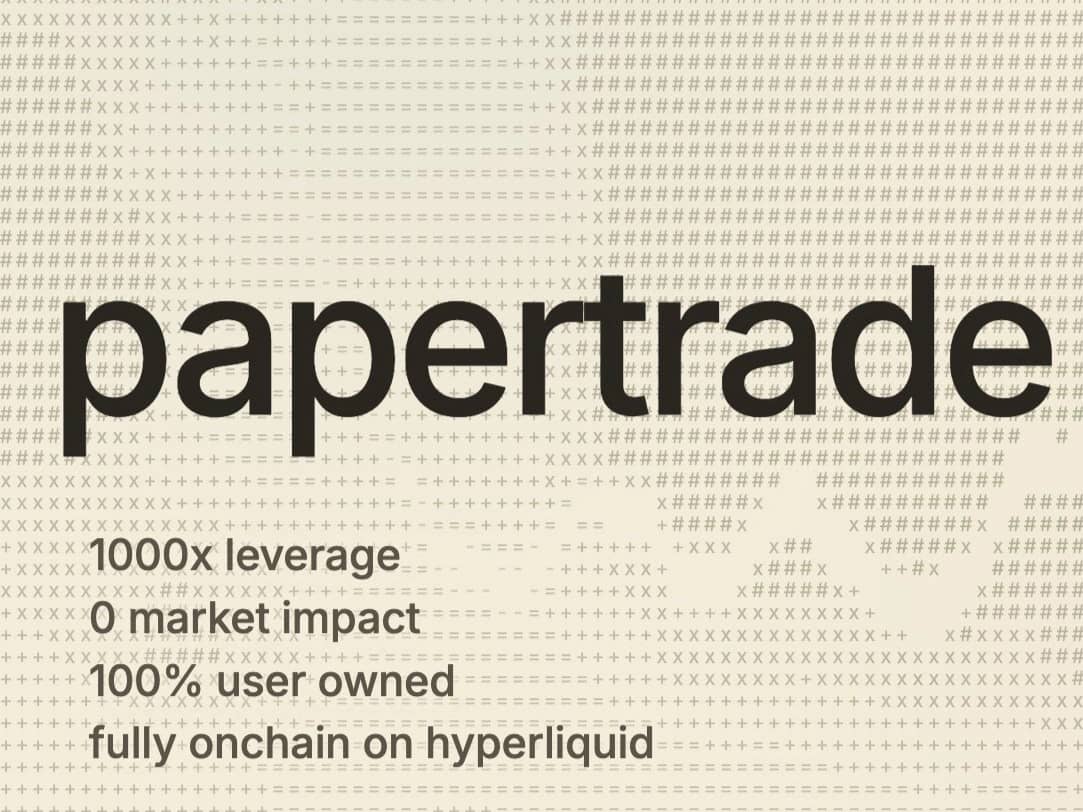
The protocol advertises four core characteristics on its homepage: leverage of up to 1000x, zero market impact, complete user ownership described as "100% user owned," and full onchain operation.[2] In its own descriptions, the team frames the exchange around "1000x leverage and 0 slippage," and external descriptions summarize the intended design as offering 0 trading fees and no funding fees in addition to high leverage and the absence of slippage.[1][4] These figures are the project's self-reported claims and describe its intended design rather than independently verified performance.
On the technical side, trades are created and maintained inside Papertrade’s own smart contracts on HyperEVM rather than as regular perpetual contracts on Hyperliquid itself. The protocol uses Hyperliquid’s best-bid-offer (BBO) mid price as an oracle, reading the midpoint between the best bid and best ask on Hyperliquid to set both entry and exit prices.[4] Positions are synthetic, with the protocol’s single liquidity provider (LP) pool acting as the counterparty, so realized profits and losses are settled against that pool instead of against other traders. This design removes a traditional matching engine or onchain order book for users and underpins the intended combination of zero slippage, zero trading fees, and no funding rates.[4]
As of late September 2026, publicly available sources continue to describe Papertrade as not yet fully live on mainnet and as a soon‑to‑be‑launched perpetual futures exchange.[4][6] Coverage in May–June 2026 referred to a limited beta announced on May 17 for a short testing period and stated that the protocol was "not live on mainnet yet," with the team indicating that a mainnet deployment would follow a preannounced deposit window before live trading.[4] Available commentary through September 2026 does not include independently sourced confirmation of a production mainnet launch. In May 2026 the project announced that it had engaged Guardian Audits to review its contracts as part of preparing for a planned Summer 2026 launch on Hyperliquid.[5]
Beyond leverage and slippage, the team has stated that the exchange carries "no funding costs" and uses a "self-bootstrapping LP." Funding costs, or funding rates, are periodic payments exchanged between long and short traders on most perpetual exchanges to keep contract prices aligned with the underlying market; the absence of such costs is presented as a distinguishing feature.[1] A self-bootstrapping liquidity pool refers to a mechanism by which the protocol builds its own trading liquidity rather than relying entirely on external market makers, with the LP balance growing or shrinking based on the aggregated profits and losses of synthetic trades.[4]
Fair Launch and Ownership
Papertrade describes itself as a "fair-launched" project, a term used in cryptocurrency to indicate that a token or protocol is released without preferential early allocations to insiders or investors. The team has emphasized this positioning by stating that its distribution will involve "no stealth launch, surprises, whitelist, airdrop, etc," and that "everything will be preannounced well in advance." This includes a stated commitment to announce a deposit period before live trading begins, with the team cautioning that there is "no bonus for blindly" participating early.[1]
In its token design, Papertrade describes the protocol as 100% user owned, with no pre-mint, no team allocation, no venture capital allocation, no airdrop, and no vesting schedule for its PAPER token; supply is intended to begin from zero and grow only through trading activity on the protocol.[4] As of 2026 this fair-launch framing is central to the project’s public positioning, with ownership meant to accrue to traders and stakers rather than to a founding team or external investors.
Tokenomics
$PAPER is Papertrade's native ERC-20 token, with an initial supply of zero and no predefined team, investor, or airdrop allocations.[4] Its supply is generated through an on-chain emissions curve, with minting triggered when the protocol’s LP gains value from traders realizing eligible losses or being liquidated. In this design, users cannot deposit directly into the LP to obtain exposure; instead, PAPER is minted to traders whose realized losses or liquidations increase the LP balance, leading some commentators to describe the model as “loss-backed.”[4]
Below an LP size of $2,000,000, including periods when the LP is underwater, the protocol uses a flat emission rate of 100 PAPER per $1 of LP gain. For example, if the LP gains $1,000 from trader losses while below this threshold, the system mints 100,000 PAPER to the losing traders. After the LP crosses the $2,000,000 threshold, the mint rate begins to decay along a high‑watermark “flat‑then‑ratchet” curve, so that each additional dollar of LP gain mints fewer PAPER tokens than earlier gains, while avoiding a simple reset to higher emission rates if the LP later pays out and decreases.[4] These parameters are described as configurable, but the flat 100 PAPER per $1 rate below $2,000,000 and a decaying rate above that level are presented as the default settings.
Staked $PAPER entitles holders to a proportional share of liquidity provider (LP) revenue, distributed continuously in USDC.[4] In the protocol’s design, stakers also participate in upside if the LP grows beyond a defined cap: once the LP exceeds $5,000,000, excess LP gains can be swept to PAPER stakers in addition to regular protocol fee revenue, aligning their incentives with the long‑term health and growth of the LP.[4] Tokens are minted to eligible traders as claims on potential future protocol value, and the launch model does not include pre-minting, vesting schedules, or predefined allocations for the team or venture capital investors.[3]
See something wrong?