0% read
Last updated:
Zest Protocol
Zest Protocol is a Bitcoin-focused decentralized finance protocol that provides lending, yield strategies, token swaps, and Bitcoin collateral products. Its product suite includes lending markets and automated vaults on Stacks, as well as Bitcoin Collateral Vaults that allow BTC to be used as collateral while remaining on the Bitcoin network. [1]
Overview
Zest Protocol is a Bitcoin-focused decentralized finance platform that provides lending, yield strategies, and token swaps through Bitcoin Collateral Vaults and a suite of products on Stacks. Bitcoin Collateral Vaults let users lock BTC on the Bitcoin network and borrow stablecoins on other chains, using BitVM to enable destination-chain lending markets to verify the state of Bitcoin collateral without requiring BTC to leave the base layer. On Stacks, Zest operates a lending market where users can supply assets such as sBTC, STX, and stSTX to earn yield or use them as collateral for overcollateralized loans. Its Stacks Vaults package automated yield strategies into single-deposit products, including a leveraged Bitcoin staking strategy that uses collateralized borrowing and staking, while Stacks Swap aggregates liquidity across supported decentralized exchanges and routes trades between pools and intermediate tokens. [2]
Features
Bitcoin Collateral Vaults
Bitcoin Collateral Vaults allow users to use BTC as collateral for stablecoin borrowing while keeping the underlying BTC in a vault on the Bitcoin network. Each position is tied to a customer-specific Taproot vault and a corresponding collateral record on a destination chain, allowing the BTC to remain on Bitcoin rather than being wrapped, bridged, or transferred to a third-party custodian. The vault's spending conditions are established when the position is created, while connected lending markets manage borrowing and liquidation rules on the destination chain. The architecture supports partial liquidations, collateral top-ups, and withdrawals of excess collateral, with the remaining BTC staying in the original vault.
The system initially uses customer-authorized Bitcoin transactions and independent guardians to enforce settlement conditions, while a planned BitVM-based phase would use cryptographic proofs and an open challenge process to verify events on external chains. In the BitVM design, repayment or liquidation events on a destination chain would be submitted as claims on Bitcoin, and challengers could dispute invalid claims before BTC is released. The architecture connects Bitcoin vaults, collateral records, lending-market positions, event observations, and settlement transactions, with controls intended to prevent conflicting claims on collateral. Zest Protocol announced a working mainnet prototype in May 2026, with production deployment planned in phases and stablecoin borrowing initially targeting EVM-based destination chains. [3] [6]
Stacks Market
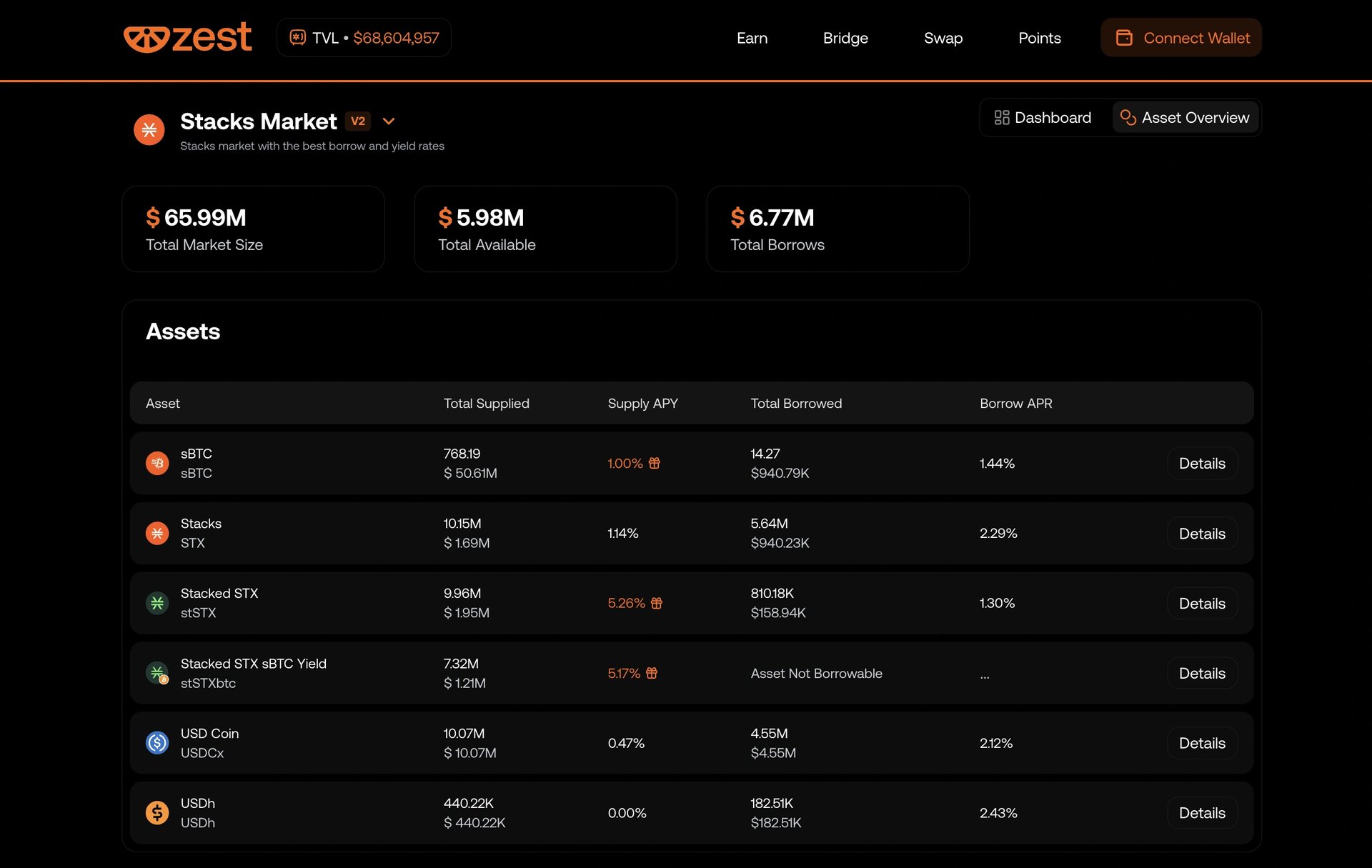
Stacks Market V2 is Zest Protocol’s lending market on Stacks, introducing pair-specific risk parameters, partial liquidations, and optional non-rehypothecation. Unlike the V1 model, where each collateral asset used the same loan-to-value ratio, liquidation threshold, liquidation penalty, and other parameters regardless of the borrowed asset, V2 uses Risk Groups that configure these settings for individual collateral and debt pairs. This allows markets with different volatility, liquidity, or correlation characteristics to use separate borrowing limits and liquidation conditions. The market also supports partial liquidations, which reduce unhealthy positions in stages rather than immediately liquidating the entire position; the applicable Risk Group determines the liquidation amount and penalty. Suppliers can additionally enable non-rehypothecation, keeping supported deposits segregated as collateral rather than making them available for borrowing, although these positions remain subject to smart-contract, oracle, and liquidation risks.
Stacks Market V2 also introduces a liquidation model with separate partial and full liquidation thresholds, allowing positions to move through a liquidation range rather than being liquidated at a single threshold. The model uses a liquidation slope and exponent curve, with penalties varying within configured minimum and maximum ranges, while pricing data is provided through Pyth. Risk Groups can assign different parameters to individual markets, such as higher LTVs for relatively stable asset pairs and lower limits for more volatile combinations. The V2 market supports migration from V1 through a single-transaction process in the Zest Protocol application, while users can also migrate manually by closing V1 borrowing positions, withdrawing liquidity, and redepositing it into V2. [8] [7]
Stacks Vault
Stacks Vaults are automated yield strategies built on top of Zest Protocol’s lending markets on Stacks. Users deposit a supported asset into a vault and receive shares representing their proportional position, while the vault executes the configured strategy and reflects returns through changes in the share price. Each vault has its own supported assets, strategy, withdrawal process, fees, and risk parameters, and its net asset value is calculated from the vault’s assets and liabilities. The vault architecture separates custody from strategy execution, allowing strategy logic to be maintained independently while restricting the actions the vault can perform. Vaults use controls such as deposit caps, position limits, onchain timelocks, and emergency pause functions, although they remain subject to smart-contract, market, liquidity, and liquidation risks.
The first Stacks Vault is the zvstBTC Vault, which implements a leveraged Bitcoin staking strategy using stBTC, a liquid Bitcoin staking token from Stacking DAO. The vault deposits stBTC as collateral on Zest Protocol, borrows sBTC against the collateral, stakes the borrowed sBTC into additional stBTC, and repeats the process within its configured risk limits. Users do not need to manage the individual lending and staking positions or claim separate rewards, as returns are reflected through the value of their vault shares. The realised return depends on factors including Bitcoin staking yield, borrowing costs, market utilisation, fees, and market conditions. [9]
zvstBTC Vault
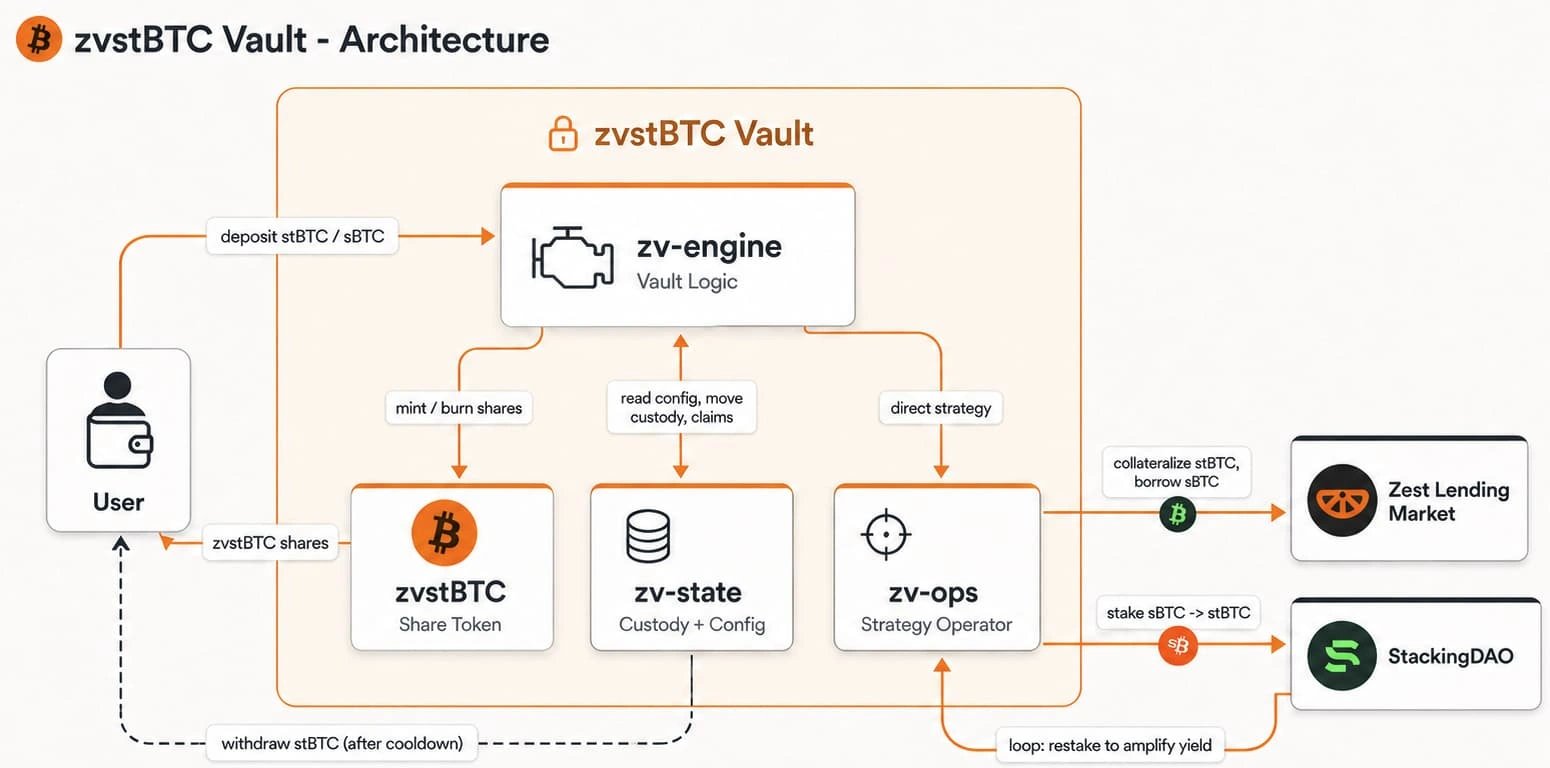
The zvstBTC Vault is Zest Protocol’s first Stacks Vault and automates a leveraged Bitcoin staking strategy using stBTC from Stacking DAO. Users can enter by depositing stBTC directly, depositing sBTC that is converted into stBTC through the supported staking path, or depositing BTC that is converted through the supported sBTC and staking process. The vault uses the deposited stBTC as collateral on Zest Protocol’s Stacks lending market, borrows sBTC against it, and stakes the borrowed sBTC into additional stBTC. The resulting stBTC is added as collateral, allowing the borrowing and staking cycle to repeat within configured risk limits. Returns are reflected in the vault’s net asset value and the value of zvstBTC shares rather than through separate reward distributions, with realised returns depending on staking yield, borrowing costs, utilisation, fees, and market conditions. The vault uses deposit caps, collateral and borrowing limits, exchange-rate checks, onchain timelocks, and emergency pause functions as risk controls. These measures do not eliminate exposure to smart-contract, liquidation, liquidity, oracle, stBTC, and Bitcoin staking risks. Withdrawals use a request, cooldown, and claim process that allows the vault to reduce its leveraged position, with payouts made in stBTC. Users seeking sBTC can redeem their stBTC through Stacking DAO’s supported redemption process. [9]
Stacks Swap
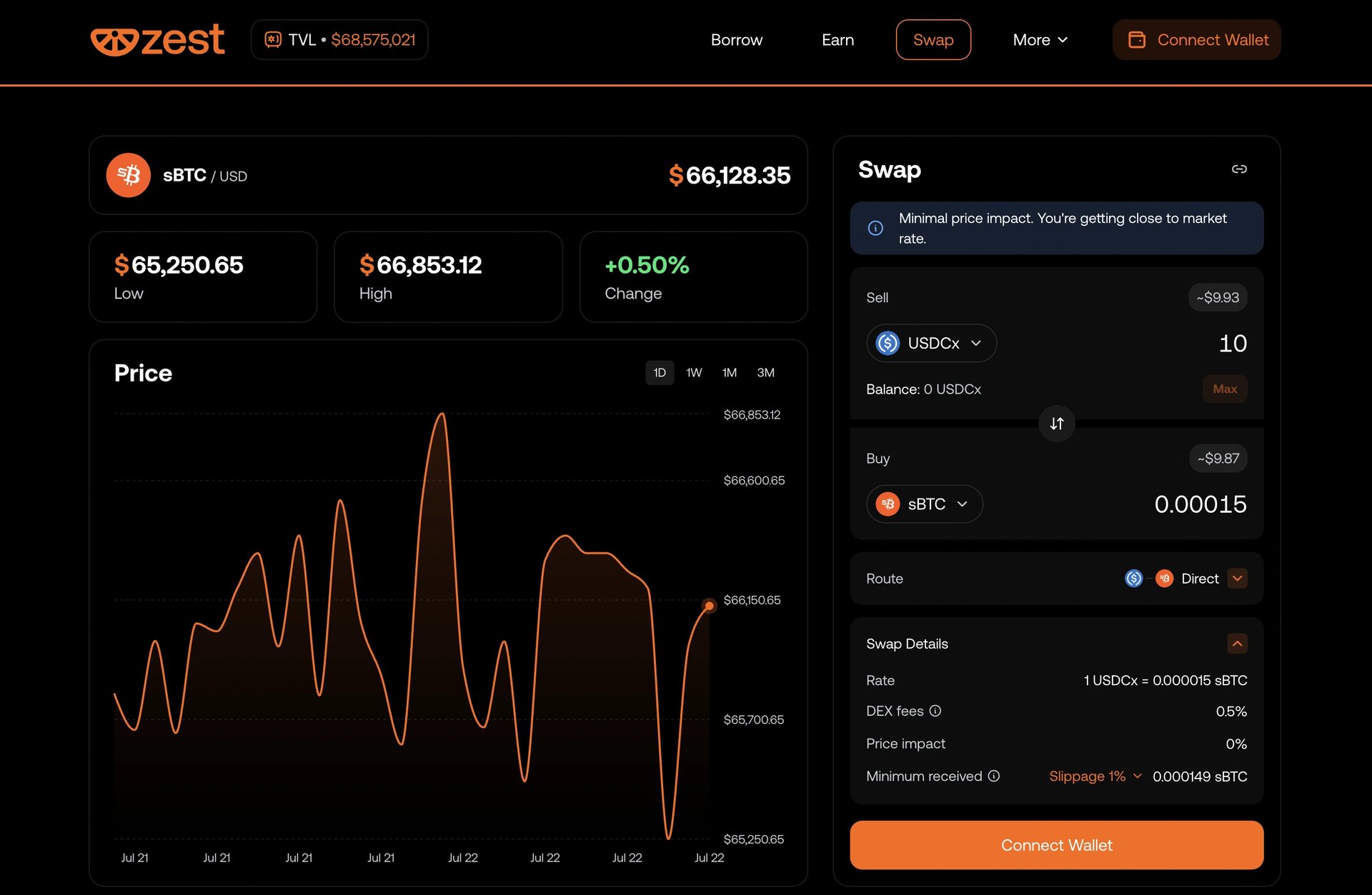
Stacks Swap is a non-custodial swap aggregator on Stacks that compares liquidity and routes trades across supported decentralized exchanges, including Bitflow, Velar, ALEX, and Arkadiko. Its routing system can split trades across multiple pools or DEXes and use intermediate tokens when these routes provide better available output, while also supporting direct conversions through Stacking DAO for certain assets. Each trade executes as a single atomic Stacks transaction, meaning the transaction either completes at or above the user’s specified minimum received amount or reverts. Tokens remain in the user’s wallet between transactions, with no deposits or account balances required, and the minimum-received amount is enforced through Stacks transaction post conditions. [10]
ZEST
ZEST is the native token of Zest Protocol. The protocol’s current products include Bitcoin Collateral Vaults and lending and yield strategies on Stacks, while governance and staking are planned features rather than current token utilities. The protocol’s stated priorities include developing Bitcoin Collateral Vaults, expanding protocol usage, and adding markets for Bitcoin-based financial activity. Governance and staking are expected to become active after the protocol reaches the required scale and establishes the mechanisms to implement them. [11]
Tokenomics
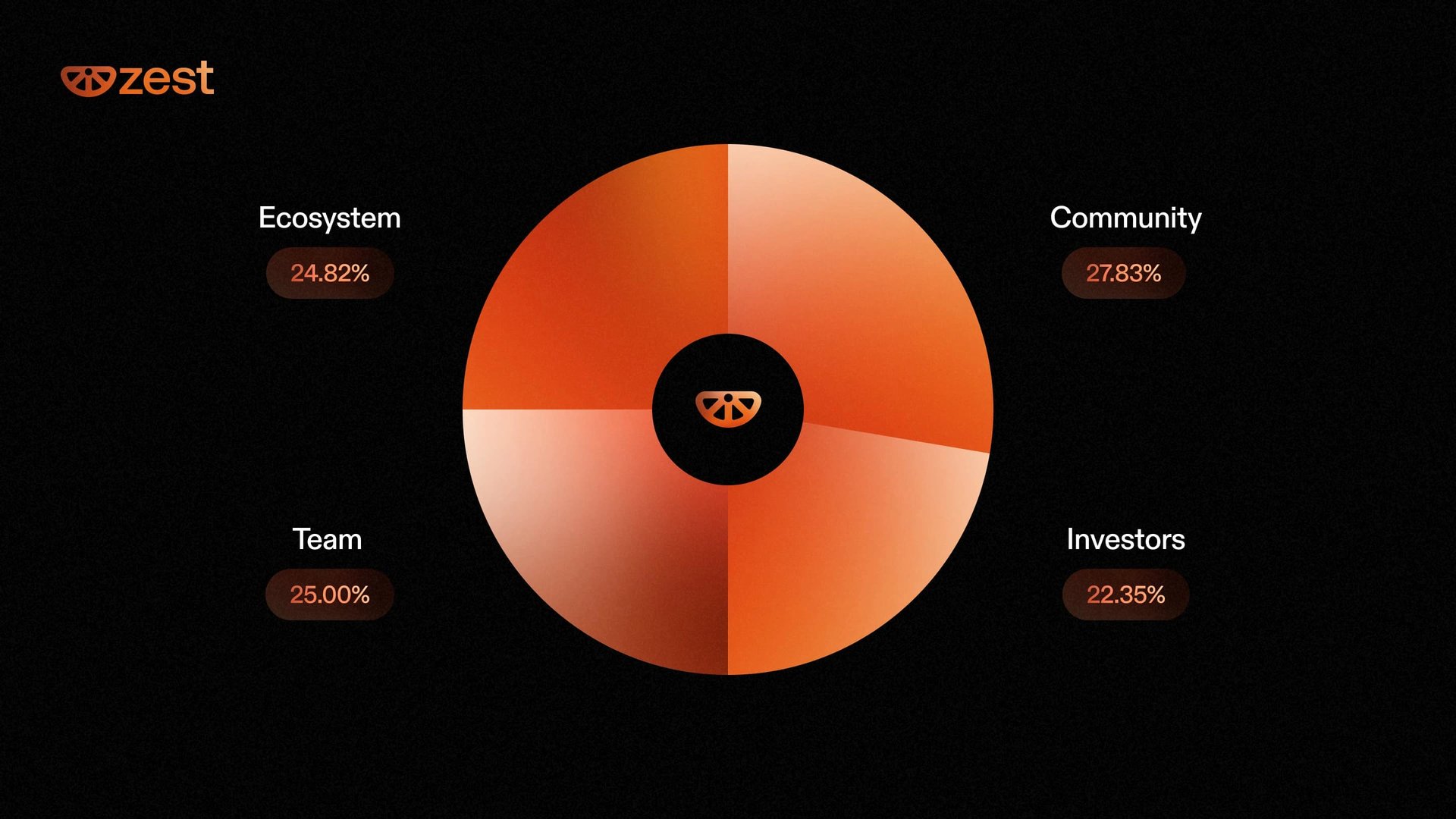
ZEST has a total supply of 1B tokens and has the following allocation: [5]
- Community: 27.83%
- Team: 25%
- Ecosystem Development: 24.82%
- Investors: 22.35%
Partnerships
See something wrong?
Official Website:
Social Profiles:
Founders: