0% read
Last updated:
Liquidity Provider
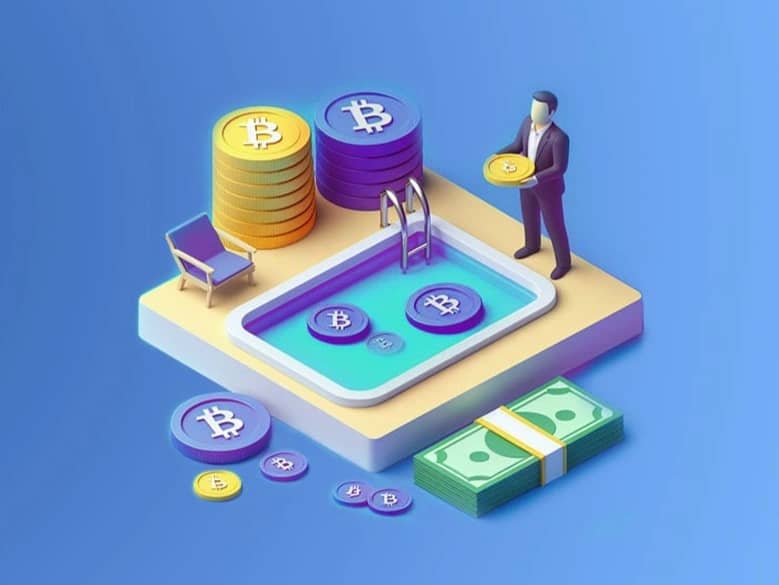
A liquidity provider (LP) is a participant who supplies assets to a market or protocol to facilitate trading or other transactions. In decentralized finance (DeFi), this commonly means depositing crypto assets into a liquidity pool used for swaps on a decentralized exchange.[1][2] Automated market makers (AMMs) use pooled assets to execute trades without matching individual buyers and sellers.[1]
LPs may earn a share of swap fees or other rewards when their supplied assets are used, depending on the pool or protocol’s rules. Deposit requirements, fee and reward allocation, and the mechanisms for claiming assets or accrued fees vary by design: many pools use paired assets, while some concentrated-liquidity positions can be funded with one token and earn fees only while the market price is within the selected range.[6][7]
Liquidity Pools in DeFi
When users fund liquidity pools, many traditional, full-range AMMs require deposits of two different assets to enable traders to switch between them by trading the pair.[1] Other designs differ; for example, a concentrated-liquidity position can be funded with one token when its selected range is entirely above or below the current price.[5]
How AMM Pools Work
Liquidity pools are used by decentralized exchanges (DEXs) that use automated market maker-based systems. AMM-based DEXs execute swaps against pooled assets rather than matching orders through a traditional order book. Execution and slippage depend on active liquidity and pool mechanics; the existence of a pool alone does not assure execution or a particular price impact.[1]
Other exchanges that have used liquidity pools include Curve Finance and Balancer on Ethereum, as well as PancakeSwap, BakerySwap (BAKE), and BurgerSwap on Binance Smart Chain (BSC).[2]
Pooling liquidity can be used in a number of different ways, such as Yield Farming or Liquidity Mining. Liquidity pools are the basis of automated yield-generating platforms like yEarn, where users add their funds to pools that are then used to generate yield.[2]
DEX liquidity provision and lending are distinct activities. Uniswap v2 issues liquidity tokens that account for a provider’s proportional share of the pool; redeeming them returns a share of the pool’s assets, whose quantities can change.[8] In Compound v2, supplying assets is lending: the supplier receives cTokens, ERC-20 representations of supplied balances, and the cToken exchange rate reflects accrued interest. cTokens are not AMM pool-share tokens.[16] Users may deposit liquidity tokens into another pool or protocol and earn a return. As protocols integrate other protocols’ pool tokens into their products, these chains can become complicated.[2]
A hypothetical illustration is a provider supplying $5,000 worth of ETH and $5,000 of DAI to a paired-asset pool for trading between the two. Fee accrual depends on eligible swaps using the provider’s active liquidity and on the pool’s rules and the provider’s share of that liquidity.[1]
Concentrated Liquidity
In concentrated-liquidity designs, providers choose a price interval for their position. This can concentrate capital and deepen liquidity within that interval, but liquidity is divided among positions with different ranges, changing the management requirements for providers.[6][7]
A position does not earn swap fees while the price is outside its interval. Its assets may become entirely one token, and the position may become active again if the price returns to the interval. Providers can create multiple positions with separate ranges.[6][7]
Swap-fee income depends on swaps using the provider’s active liquidity, the pool’s fee rules, and the position’s share of that liquidity; it is not guaranteed.[7]
Programmable Pools and Hooks
Uniswap v4 went live on January 31, 2025. It uses optional hook contracts attached to individual pools, which can run before or after actions such as swaps and liquidity changes. Hooks let developers customize pool behavior, including logic for swaps, fees, and liquidity positions.[12][13]
Hook behavior depends on the pool’s configuration. Hooks can implement custom accounting or liquidity-management logic, and pools configured for dynamic fees can use fees that update periodically or change per swap.[13][14] Dynamic fees do not guarantee higher returns for liquidity providers, and custom hook logic can introduce additional contract risk.[14][15]
Liquidity Provider Risks
Impermanent, or divergence, loss describes how the value of a position under pool rebalancing compares with the value of holding the deposited assets, before fees. Fee income and incentives may offset this difference but do not ensure a profit. “Impermanent” does not mean the loss must reverse: token prices may not return to their initial levels, and concentrated liquidity can affect a provider’s exposure.[8][9]
Other risks include price volatility, smart-contract vulnerabilities, untrusted token teams or liquidity that can be removed, and network costs and position-management requirements, including costs associated with rebalancing or adjusting a position.[10][7] Hook-based pools can also introduce risks from the attached third-party hook’s code or behavior.[15]
Actual withdrawal amounts and asset composition, fee collection, and incentives depend on pool and protocol mechanics. For example, Uniswap v3 position management supports decreasing liquidity and collecting accrued fees through distinct operations; rewards may also be governed by program-specific rules.[17][7]
Liquidity Provider (LP) Tokens
In pool designs that issue them, liquidity providers who supply liquidity to a DEX receive liquidity provider tokens, or LP tokens, as a receipt. These fungible tokens can represent a provider’s proportional share of the pool and may allow the provider to claim a share of its liquidity and any fees owed. Classic pool liquidity tokens account for a provider’s proportional share.[3][4][8]
LP tokens are not universal. For example, Uniswap v3 positions are represented by position-specific NFTs with individual IDs and position records, including token pair, fee, price ticks, liquidity, and fees owed; other protocols may represent positions differently.[11] The assets retrievable, fee-collection process, and withdrawal conditions depend on the protocol. Tokens and position records do not guarantee a fixed quantity of assets, fees, or yield.
LP tokens can be used for yield farming, as collateral for loans, and for other purposes. Depositing them into other protocols can add composability and potential returns, as well as risks from those protocols. These chains can become quite complicated, as protocols integrate other protocols’ pool tokens into their products, and so on.[3][4]
See something wrong?