0% read
Last updated:
3Jane
3Jane is an Ethereum-based, peer-to-pool credit market that connects USDC suppliers with credit exposure across cryptonative borrowers and fintech-originated receivables. Its structure uses senior and junior tranches alongside onchain and offchain credit data to support uncollateralized lending and structured credit financing. [13]
Overview
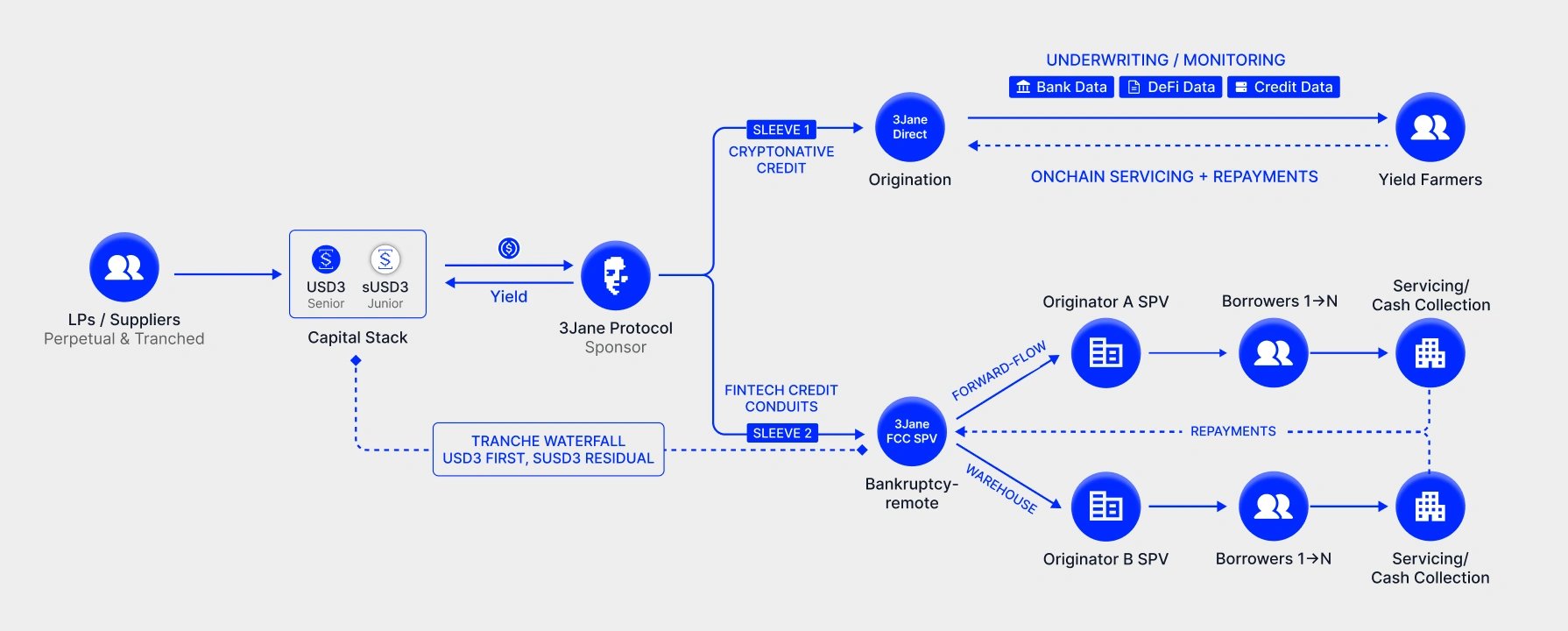
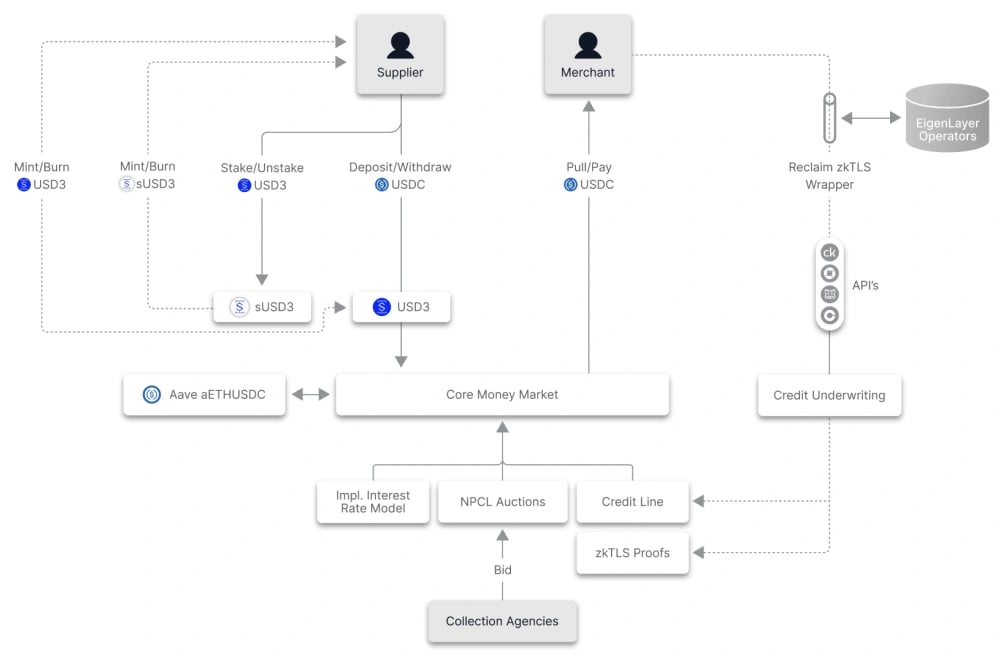
3Jane is a peer-to-pool, credit-based money market on Ethereum that connects USDC suppliers with two types of credit exposure through a single tranched capital structure. Suppliers deposit USDC into USD3, the senior tranche, or sUSD3, the junior first-loss tranche, with the capital funding both Crypto Credit Lines for cryptonative borrowers and Fintech Credit Conduits that finance short-duration receivables originated by U.S. fintech lenders. The Crypto Credit Lines provide uncollateralized, variable-rate credit based on borrowers’ verifiable DeFi, centralized exchange, brokerage, and bank assets, future cash flows, and credit scores, while the Fintech Credit Conduits provide structured funding through mechanisms such as warehouse loans, participations, and forward-flow agreements, all using bankruptcy-remote entities. 3Jane combines onchain credit assessments with offchain credit scores attested through zkTLS to determine credit limits, rates, and repayment requirements, while its solvency mechanisms include credit-score slashing and auctions of non-performing loans to licensed U.S. collections agencies. The protocol is designed to diversify credit exposure across asset types, maturities, and counterparties, while extending financing to cryptonative individuals, businesses, and AI agents, as well as to fintech lenders serving U.S. consumers and small businesses. [1] [2]
Features
Levered Callable Capital (LCC)
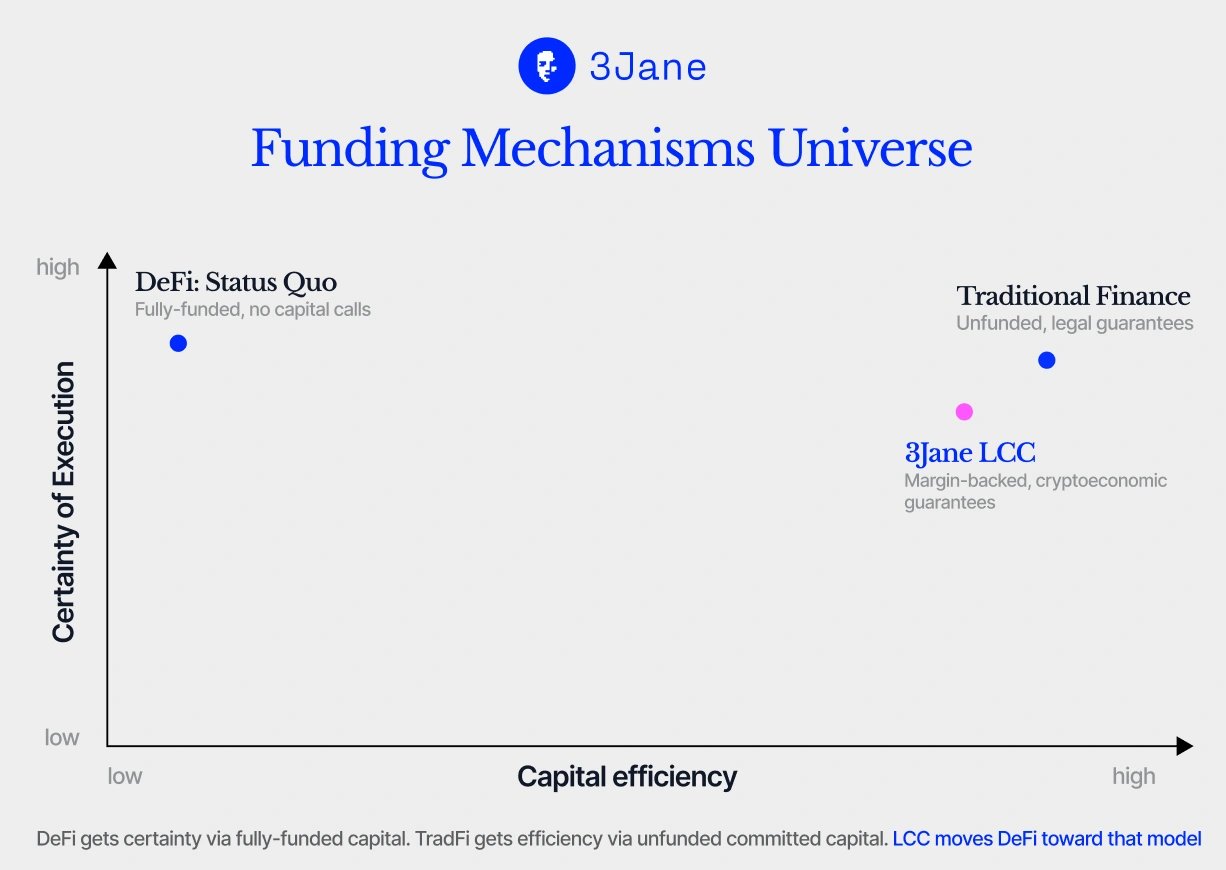
Levered Callable Capital (LCC) is a capital-commitment mechanism developed by 3Jane that converts unfunded commitments into a permissionless, globally syndicated form of contingent capital. Stakers post margin to back a larger callable standby, earn fees on the standby notional, and provide USDC when 3Jane has an eligible capital deployment, while backstop bidders can fund missed calls in exchange for the defaulting staker’s slashed margin. Rather than relying on legal agreements for enforcement, LCC uses margin-backed cryptoeconomic guarantees, allowing uncalled capital to remain deployed elsewhere while providing 3Jane with access to funding when required. The mechanism standardizes callable commitments so that missed calls can be resolved through auctions, with bidders repricing and funding shortfalls over a defined period, rather than relying on lengthy legal enforcement processes. By defining standby commitments through standardized terms and collateral rather than individual counterparties, LCC is intended to make contingent capital transferable and support permissionless capital formation and secondary markets for balance-sheet capacity. [10]
Fintech Credit Conduits (FCC)
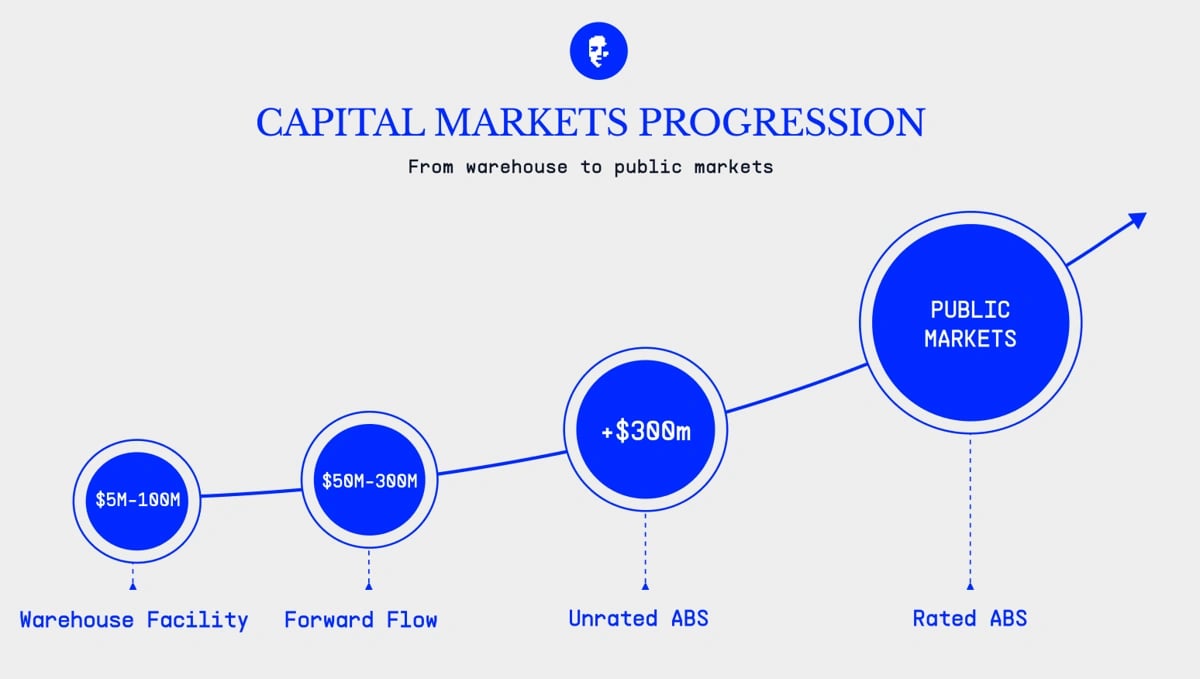
Fintech Credit Conduits (FCCs) are standing, revolving, tranched funding structures within 3Jane that finance short-duration small-business and consumer receivables originated by U.S. fintech lenders. They use mechanisms such as warehouse loans, participations, and forward-flow agreements, with financing routed through bankruptcy-remote SPVs that separate the underlying assets from the originator and 3Jane’s sponsor entity. FCCs are designed to give smaller fintech lenders access to structured credit funding without requiring them to build the infrastructure needed for larger securitization markets. The structure is funded through 3Jane’s USD3 and sUSD3 senior-junior capital stack and provides exposure primarily to pools of underlying loans rather than directly to the fintech originators. By combining standardized tranching with an onchain funding base, FCCs are intended to make structured credit more programmable and accessible to lenders with portfolios spanning SMB lending, merchant cash advances, BNPL, revenue-based finance, factoring, and short-duration consumer credit. [9]
Crypto Credit Lines (CCL)
Crypto Credit Lines (CCL) are one of 3Jane’s two credit sleeves, providing uncollateralized USDC credit lines directly to U.S.-based cryptonative borrowers, including traders, businesses, sole proprietors, and AI agents. Borrowers connect verifiable financial information from their crypto, bank, and credit accounts to generate open-term, variable-rate credit facilities without traditional collateral. 3Jane underwrites, originates, services, and holds the resulting receivables itself, using credit scoring and risk-pricing mechanisms to determine borrowing terms. The CCL sleeve operates through a two-sided money market, with suppliers depositing USDC to mint USD3 and optionally staking for sUSD3 in exchange for exposure to a diversified pool of credit lines. Its infrastructure combines a Morpho Blue-based money market with credit underwriting, interest-rate, and default-deterrence mechanisms, while offchain financial data is attested and connected to borrowers through systems such as Plaid and zkTLS. The structure is designed to extend credit based on a borrower’s broader financial profile rather than requiring traditional asset collateral. [8]
JANE
JANE is 3Jane’s protocol token, distributed through a liquidity-mining program that rewards users for supplying capital to the protocol’s various farms. Rewards are paid in locked JANE until the final token mint in 2026, when the remaining supply will be issued and token transfers enabled. The final total supply is expected to range from 1.11 billion to 6.67 billion JANE, while accrued rewards remain fixed and represent a variable percentage of the eventual supply. JANE emissions are distributed weekly, with each farm having a minimum emission level that increases as its total value locked grows. Before a farm reaches its internal TVL target, its weekly JANE allocation remains fixed, meaning early liquidity providers receive more tokens per dollar deposited; after the target is reached, emissions scale with TVL to maintain a more consistent reward rate. JANE can currently be earned through farms associated with USD3, sUSD3, Morpho USDC, Pendle USD3 products, USD3/frxUSD, and other 3Jane initiatives, with additional incentives planned for Levered Callable Capital as facilities launch. [7]
USD3
USD3 and sUSD3 are the senior and junior tranches of 3Jane’s capital structure, funding its Crypto Credit Lines and Fintech Credit Conduits. USD3 is the senior tranche and earns a variable share of pool yield while receiving protection from external credit enhancements and the junior sUSD3 tranche. sUSD3 is created by staking USD3 and serves as the first-loss tranche, earning a levered share of pool yield and absorbing credit losses before USD3. Suppliers can deposit USDC to mint USD3 or sUSD3, or stake USD3 for sUSD3 through an ERC-4626 structure. Both tranches earn rates that vary with the income generated by the underlying credit portfolio rather than fixed coupons, with sUSD3 carrying greater risk and potential yield. The capital is deployed across crypto credit lines and fintech receivables, while idle funds are held in Aave, creating diversified exposure across different credit assets, durations, and counterparties. [5] [7]
Funding
3Jane raised $5.2 million in seed funding in June 2025 in a round led by Paradigm, with participation from Wintermute Ventures, Coinbase Ventures, Breed VC, Robot Ventures, and Bodhi Ventures. The funding accompanied 3Jane’s emergence from stealth and supported the development of its Ethereum-based credit market for uncollateralized USDC lending, which uses verifiable credit scores, DeFi assets, bank assets, and cash flows to underwrite borrowers. The funding was intended to help 3Jane develop and scale its unsecured credit marketplace while maintaining its underwriting and risk controls. Its planned rollout included tuning the 3CA underwriting algorithm with early credit data, opening USD3 and sUSD3 deposits, extending unsecured credit to an initial group of borrowers, and using repayment and default data to refine credit limits, risk pricing, and lending capacity over time. [3]
Partnerships
- Blockchain Bureau
- Plaid Bank
- Slope
- LendSwift
- Erebor
See something wrong?