0% read
Last updated:
Guy Young
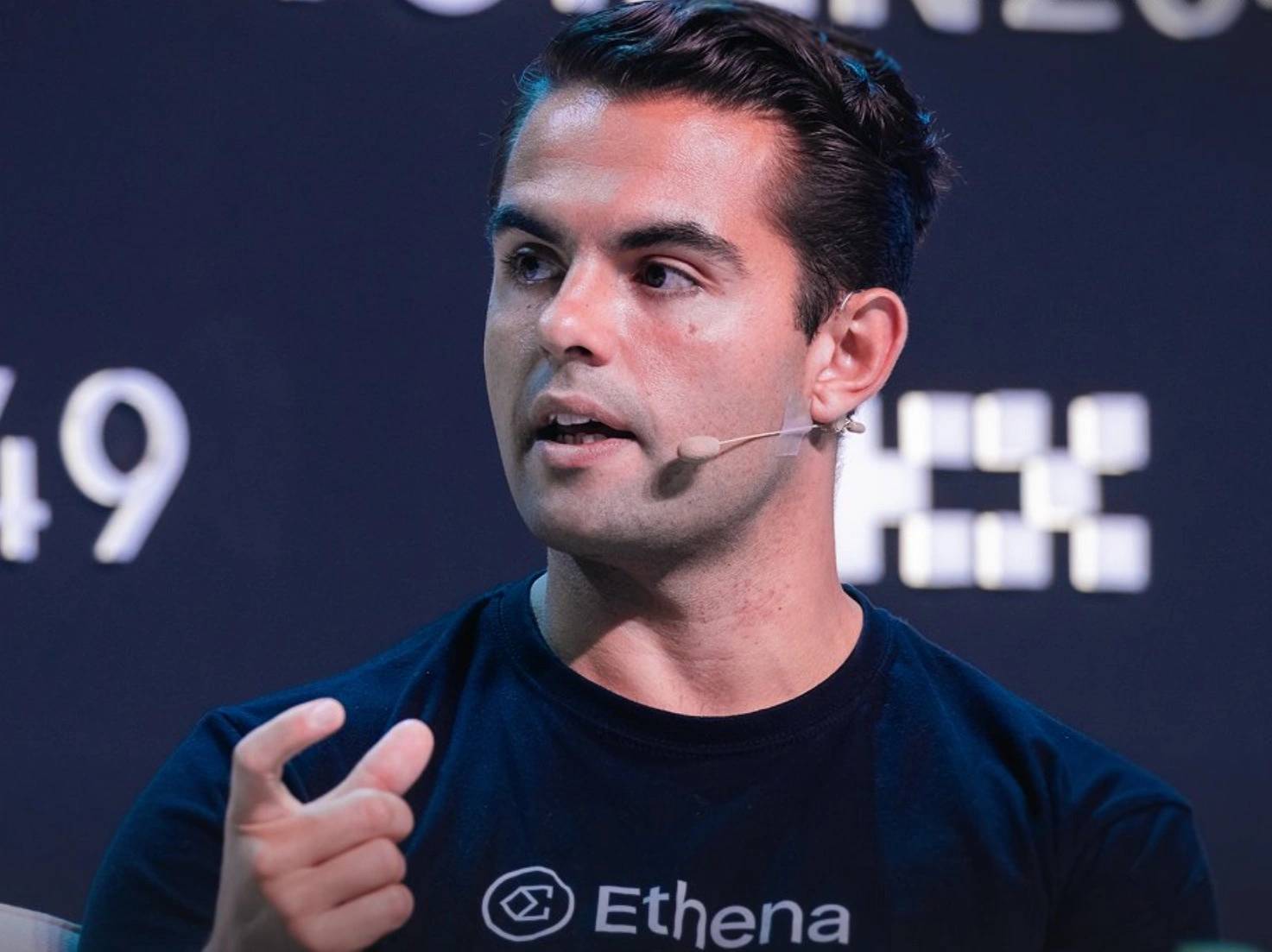
Guy Young is a finance professional and entrepreneur known for his work on synthetic dollars and yield-bearing “internet bond” stablecoins. He spent nearly a decade in traditional finance across investment banking, hedge funds, and private equity before founding Ethena Labs, where he serves as CEO and leads the design of crypto-collateralized dollar instruments.[10]
At Ethena Labs, Young launched USDe, a fully backed on-chain synthetic dollar powered by ETH staking yield and delta-neutral perpetual swap hedging, alongside institutional products such as iUSDe and USDtb.[2][10][11] Since launching in February 2024, USDe has grown into one of the largest dollar-denominated stablecoins and remained a leading crypto-collateralized synthetic dollar through mid-2026, even after a significant contraction in supply following its late-2025 peak.[10]
Young continued to lead Ethena Labs through regulatory developments, including Germany’s BaFin barring USDe ahead of full MiCA enforcement in July 2026, which restricted its distribution in the European Union. He has remained a public advocate for synthetic dollar designs and yield-bearing stablecoins as instruments for both crypto-native and traditional financial participants.[11]

Career
Young began his career in traditional finance, where he held roles in investment banking, hedge funds, and private equity for nearly a decade. He spent around six years at Cerberus Capital Management, a U.S.-based investment firm with roughly $60 billion in assets under management, where he ultimately served as head of principal investments at a Cerberus affiliate.[10] During this period, he contributed to the firm’s expansion into Australian markets and oversaw investments in sectors such as banking, specialty finance, insurance, and financial technology.[10]
In 2023, Young founded Ethena Labs, a decentralized finance protocol built on the Ethereum blockchain. The company introduced USDe, a synthetic U.S. dollar stablecoin designed to operate independently of the traditional banking system by holding crypto collateral and shorting equivalent perpetual futures in a broadly delta-neutral structure.[2] Under his direction, Ethena Labs secured a $6 million seed funding round in July 2023 from a mix of venture capital firms, trading firms, and industry investors, including Dragonfly and Arthur Hayes.[3] The project drew attention for its approach to stability and for gaining early backing from figures such as Arthur Hayes, who supported Young’s vision for a non-bank-dependent digital dollar.[3][1]
Following USDe’s mainnet launch in February 2024, Young led Ethena through a period in which USDe’s circulating supply expanded from launch to just under $15 billion within eighteen months, before retracing by roughly 60% to around $5.5–6 billion by mid-2026 as derivatives market leverage and demand for looping strategies declined.[10] During this time, Ethena introduced sUSDe as a yield-bearing staking wrapper, launched iUSDe as an institutional version with added compliance and custody features, and created USDtb, a separate dollar product backed by a BlackRock money-market fund to address regulated markets such as those shaped by the U.S. GENIUS framework.[10] Young also oversaw efforts to diversify USDe’s backing beyond perpetual futures into institutional lending and real-world asset exposures, and by 2026 Ethena was planning to extend its basis-trading strategy into equity perpetuals and real-world-asset-linked derivatives to make USDe’s yield less dependent on crypto cycles.[10][12] As founder and CEO, Young remained the public face of the protocol through mid-2026, including in the context of regulatory developments such as Germany’s BaFin barring USDe under the European Union’s MiCA framework ahead of its July 2026 enforcement date.[11]
Interviews
Crypto Treasury Companies
In an August 2025 episode of "Unchained," the discussion centered on corporate treasury companies and their viability in the cryptocurrency space. Host Laura Shin, Young, and Rob Hadick from Dragonfly examined the emergence of treasury vehicles, focusing on structures such as Special Purpose Acquisition Companies (SPACs) and equity financing. They highlighted how the industry's growth led to a saturation of similar projects, creating potential oversupply and a risk of deflation in valuations. Young and Hadick emphasized the importance of aligning incentives within these companies and being cautious about excessive dilution from PIPE investments. They also noted the distinction of MicroStrategy as having unique financial structures, driven by its Bitcoin acquisitions, while expressing skepticism regarding the general speculative climate in crypto. The episode examined how differing treasury strategies, structural choices, and changing market conditions shape the performance and resilience of corporate treasury vehicles in the cryptocurrency sector.[4]

$ENA
On BidCast in August 2025, a discussion about the potential future of $ENA featured Young, who highlighted the rapid growth of their stablecoin, USDe, which had surged to approximately $8.5 billion in supply over a short period. He discussed various growth strategies, including partnerships and integrations with platforms like Hyperliquid, which could significantly increase revenue by leveraging new trading opportunities. Young noted that there were key developments, such as the recent approval of the GENIUS Act, which would facilitate interactions with major financial institutions. However, immediate impacts on revenue were not expected. Despite some disappointments regarding the performance of certain initiatives, he remained optimistic about achieving a target of $12 billion in total value locked (TVL) by the year's end, emphasizing a thoughtful approach to fee structures to ensure sustainable growth.[5]

Presentations
Ethena x TON Keynote
Young and Halil Mirakhmed presented a collaboration between Ethena and Telegram's TON at TOKEN2049 in Dubai in May 2025, aiming to develop a financial product accessible to a billion users, specifically a dollar savings account. They discussed how the integration would leverage Telegram's massive user base and TON's blockchain technology to provide solutions for users affected by local currency inflation. The partnership was set to introduce new features to the Telegram wallet, allowing users to earn savings through the TSUSD product, powered by Ethena. They highlighted the potential benefits of this collaboration in expanding the DeFi ecosystem and creating a seamless experience for users to save, spend, and stake their assets within the TON framework. The initiative aimed to provide accessible financial solutions to individuals struggling with local economic challenges.[6]

TradFi x DeFi
At the Digital Asset Summit in March 2025, Young and Sergey Nazarov (Chainlink) discussed stablecoin innovation. Young introduced Ethena Labs and its products, including the IUSD and the established USDe, highlighting the rapid growth of their stablecoin, which reached over $6 billion in supply within a year. He explained that Ethena's mission focused on creating a compliant, yield-bearing dollar product that appeals to both retail individuals and large financial institutions. Nazarov described the innovative use of off-chain custody and automated hedging mechanisms in managing risks, as well as the importance of identity verification in facilitating institutional participation in decentralized finance (DeFi). He discussed the convergence of traditional finance (TradFi) and DeFi, emphasizing the challenges posed by compliance requirements and the potential for developing dual versions of financial applications to bridge the two worlds. Finally, he outlined plans for Converge, a blockchain designed to enhance the settlement layer for compliant cryptocurrency transactions and attract institutional capital, aiming to merge traditional finance (TradFi) structures with decentralized finance (DeFi) innovations.[7]

Panels
GENIUS & L1s
In July 2025, on the Hivemind podcast, host Jose and the Hivemind team held a discussion with Young about key developments in the cryptocurrency market, with particular focus on Ethena’s new USD stablecoin vehicle. They explored the dynamics of the cryptocurrency market, highlighting key players such as Binance, Tether, and the futures market, which collectively generate substantial cash flow. The conversation included an analysis of market sentiment following the passing of the GENIUS Act, which could reshape the regulatory environment for stablecoins. Furthermore, the panel examined the challenges faced by newer players in the stablecoin space, emphasizing that while concerns were raised regarding the sustainability of existing platforms, such as Ethena, in the face of strong incumbents, they also recognized the scope for new designs, competitive responses by established issuers, and shifts in market structure driven by regulatory and technological change.[8]

Stablecoin Evolution
At TOKEN2049 Singapore in September 2023, a panel discussion focused on the evolution of stablecoins featured Emma Cui (LongHash Ventures), Young, and Vincent Chok (First Digital), as well as Raagulan Pathy (Circle). Pathy emphasized the significance of USDC as a leading regulated stablecoin. At the same time, Chok introduced First Digital Trust's new project, fdUSD, which aims to become a key player in Hong Kong's stablecoin landscape. Young discussed his work on a decentralized stablecoin set to launch soon. The panelists explored various stablecoin structures, their use cases—ranging from cryptocurrency trading to providing alternative currencies for individuals in economically unstable regions—and the challenges they face, particularly in terms of regulatory compliance. They acknowledged the need for user-friendly technology to drive mass adoption of stablecoins. Overall, the discussion highlighted both centralized and decentralized approaches, with consensus on the need to maintain stable and transparent stablecoins to protect users, while also expressing optimism for future innovations and integrations in the space.[9]


See something wrong?