0% read
Last updated:
Shiba Inu
Shiba Inu is an Ethereum-based token ecosystem themed around the Japanese dog breed. Created in August 2020 by the pseudonymous developer Ryoshi, it began as a meme token intended to compete with Dogecoin.[1]
The ecosystem now includes related tokens and applications for DeFi, NFTs, and blockchain services, including Shibarium, an Ethereum Layer 2 network. Its applications include the decentralized exchange ShibaSwap, and its principal tokens include SHIB, LEASH, BONE, and TREAT.
Compare Cryptoassets
Select an asset to compare its price and other stats against Shiba Inu.
Overview
Shiba Inu has grown from an Ethereum meme token into a token-and-application ecosystem. Its four principal tokens are SHIB, LEASH, BONE, and TREAT. The ecosystem includes Shibarium, an Ethereum Layer 2 network; ShibaSwap, its decentralized exchange; and the Shib Alpha Layer beta, an announced stack for application-specific rollups.
ShibOS, the Shiba Inu Operating System, was formerly called the 36 Chambers of Tech. The project presents it as a modular technology stack and framework for building Web3 applications, with modules intended to support areas including DeFi, identity, and governance.[16][29]
History
The project was created in August 2020 by an anonymous developer called Ryoshi. According to the team's original white paper, known as the Woof Paper, Shiba Inu's goal was to be “the Dogecoin killer” and it was “primed and ready to overtake the value of Dogecoin”.[1]
The initial supply was one quadrillion SHIB. Of this, 500 trillion SHIB (50%) was sent to Vitalik Buterin, while the other 500 trillion was locked for liquidity on Uniswap.[25] In May 2021, Buterin donated 50 trillion SHIB to the India COVID-Crypto Relief Fund. He then burned 410.24 trillion SHIB, about 90% of his remaining SHIB after the donation. These were separate transactions.[25][26]
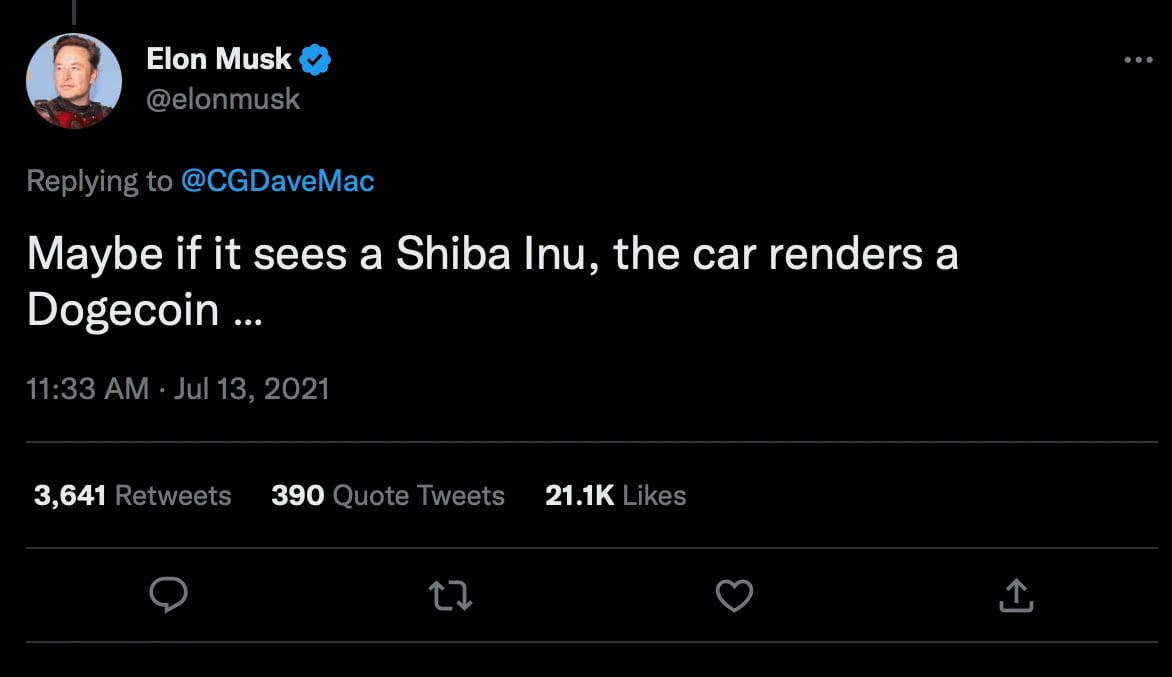
Shiba Inu’s growth in 2021 was influenced by the rise of Dogecoin and speculation associated with public figures such as Elon Musk.[7]
On July 21, 2022, Buterin thanked the Shiba Inu community for making possible the first cohort of recipients of the artificial intelligence grant program Ph.D. Fellowship in AI Existential Safety, as he utilized part of the tokens that the Shiba Inu developers sent him the previous year.[5]
The project later expanded from an Ethereum-based token toward an ecosystem, including Shibarium, the ShibaSwap decentralized exchange, and token-burn tools.
On February 24, 2024, the Shiba Inu ecosystem team announced that it had adopted the DN404 token standard for the SHEboshi collection.[8]
On January 14, 2025, TREAT launched initially on Ethereum as the ecosystem’s fourth principal token, intended for rewards, access, governance, and voting.[14][15] On January 26, Shytoshi Kusama announced that he was moving from lead visionary to Lead Ambassador and described a planned transition toward DAO control. He said the role would focus on promoting ShibOS, the name that replaced the 36 Chambers of Tech.[16]
In June 2025, the Shib Alpha Layer beta was announced as a rollup-abstraction stack intended to support application-specific rollups built around Shibarium as the settlement layer.[17] On September 12, 2025, Shibarium suffered a bridge exploit involving a validator attack; withdrawals totaled about $4.1 million in ETH, SHIB, and 15 other tokens.[18]
DN404 Standard
DN404 is an experimental model described as an alternative to ERC-404. It uses a base ERC-20 contract linked to an ERC-721 contract. Its design sought to provide fractional exposure to NFT-linked tokens, and its developers estimated that it could reduce the transaction-fee impact of trading them.[30]
In the case of Shiba Inu, the project adopted the DN404 standard for the SHEboshi collection.
Shibarium
In June 2022, Unification Foundation, the team behind SHIB’s Layer 2 solution Shibarium, announced that a public beta was planned. The announcement described BONE as the planned gas and transaction token and a validator reward.[6]
Shibarium targets problems commonly associated with Ethereum, including transaction fees and speed. It aims to improve scalability and provide higher throughput, token utility, a DApp accelerator, and metaverse development.[4]
Official documentation describes Shibarium as a proof-of-stake network with staking and checkpoint contracts connected to Ethereum. Heimdall manages validators and checkpoints, while Bor produces blocks and executes EVM transactions. Validators and delegators stake BONE, which is also used as gas. Bridge transfers represent tokens on Shibarium by minting pegged tokens against tokens leaving Ethereum; return transfers burn the Shibarium tokens and unlock the corresponding Ethereum tokens.[31][32]
The 2022 announcement also described a proposed cap of 230 million BONE and a reserve of the remaining supply for Shibarium validators.[6] Shibarium’s implemented burn process uses BONE for gas, with base fees accruing in a burn contract. ShibTorch, launched on Shibarium in August 2024, allows a user to initiate the process after an administrator-set threshold is reached. Seventy percent of accumulated base fees is converted from BONE to SHIB, which is permanently burned; the remaining 30% goes to the treasury and network operations.[27]
Shib Alpha Layer
In June 2025, developer Kaal Dhairya announced the Shib Alpha Layer beta as a rollup-abstraction stack intended to support application-specific rollups, with Shibarium serving as the settlement layer. The announcement proposed integration with Zama’s fully homomorphic encryption (FHE) for encrypted smart-contract computation, along with multi-gas support and a unified user experience as planned capabilities.[17]
Bridge Exploit and Recovery
On September 12, 2025, a validator attack exploited Shibarium’s bridge, enabling withdrawals of about $4.1 million in ETH, SHIB, and 15 other tokens. The bridge was shut down as an emergency safety measure. The response included rotating validator keys, moving more than 100 ecosystem contracts to secure wallets, and recovering 4.6 million BONE.[18]
The BONE Plasma Bridge reopened for BONE transfers on October 14, 2025, after testing and an independent review by Hexens. Security changes included address blacklisting and a seven-day withdrawal delay. BONE bridging reopened first, with support for additional tokens planned.[19]
By February 17, 2026, the SOU (Shib Owes You) claims system was reported live, issuing transferable Ethereum NFTs to track claims for users affected by the bridge exploit. Documented functions include splitting, merging, transferring, and trading claims.[20][21] The official terms describe SOU as voluntary claim tracking; any distributions are discretionary and not guaranteed.[22]
Token Overview
Shiba Inu has four principal tokens: SHIB, LEASH, BONE, and TREAT. Its ecosystem also includes the NFT incubator project Shiba Incubator and its decentralized exchange, ShibaSwap, where SHIB, LEASH, and BONE can be traded and staked for rewards.
SHIB
SHIB is the ecosystem’s main token. Its genesis supply was 1 quadrillion SHIB; see History for the disposition of the initial allocation.[1]
The following staking and pool allocations describe the original Woofpaper model. When staked, users get xSHIB in exchange, and rewards in the form of BONE tokens are given. xSHIB holders get a share of the 3% of all BONE Per Block (BPM) that is allocated to the SHIB pool, which also collects 0.1% of all ETH swap transaction fees that take place on ShibaSwap. Additionally, 0.05% of the allocated swap fees (fees from any transaction within ShibaSwap excluding ETH, WBTC, DAI, USDT, and USDC) are distributed into the staking pools.[1]
On the other side, when the token is utilized to provide liquidity, users get SHIB-ETH SSLP tokens in exchange, which represent their share of the corresponding pool.[1]
LEASH
LEASH (LEASH), with a total supply of 107,636 tokens, is the second incentivized token on ShibaSwap and a medium of reward for liquidity providers. It was initially created to be tied to the price of Dogecoin, but later it was decided that it would remain a simple ERC-20 token.[1]
The following staking and pool allocations describe the original Woofpaper model. When users stake their LEASH tokens, they get xLEASH. Users get a stake of 1% of all BPM minted plus 0.05% of swap fees that are distributed in the staking pools. When liquidity is provided, users get LEASH-ETH SSLP tokens representing their share of the pool, which gathers 0.01% of all WBTC swap transactions and 0.1% of all USDC swap transactions.[1]
BONE
BONE (BONE), with a total supply of 250,000,000 tokens, is a governance token that allows holders to vote on upcoming proposals. Holding a greater amount of this token grants more weight to the holder’s vote.[1]
The following staking and pool allocations describe the original Woofpaper model. When staked, tBONE is generated, which grants the user a share of the 1% of BPB allocation to tBONE holders. Furthermore, 0.05% of the swap fees are distributed into the same pools. When providing liquidity, BONE SSLP tokens are offered. The corresponding pool collects 0.1% of all DAI swap returns and 0.1% of all USDT swap returns.[1]
TREAT
TREAT (Transactional Rewards for Engagement and Access) launched on January 14, 2025, initially on Ethereum. It is intended to provide rewards and access and to support governance and voting in the ecosystem. Integration into Shibarium was described as planned.[14][15]
TREAT has a total supply of 10 billion tokens. Its announced distribution is 32% for ecosystem growth, 30% for community and launch, 20% for protocol development, 14% for protocol sales, and 4% for the foundation treasury.[28]
ShibaSwap
ShibaSwap is a decentralized exchange (DEX) in the Shiba Inu ecosystem for swapping tokens and providing liquidity on Ethereum and Shibarium. Version 1 is a classic automated-market-maker exchange, while version 2 adds concentrated-liquidity pools with NFT-based liquidity positions.[23]
The ecosystem utilizes its own terminology to describe DeFi concepts. “Dig” means to provide liquidity, “bury” to stake, and “fetch” to exchange one token for another. Users (called “shibas”) generate “woof” returns (rewards) that are distributed to pools called “puppy pools”. The term “bonefolio” is also mentioned to refer to the user’s portfolio.[1]
Users can stake their tokens or deposit them into liquidity pools.
In case of staking, users can get xSHIB, xLEASH, or tBONE, depending on the staked token. Version 1 liquidity providers can stake LP tokens for BONE rewards on Ethereum. Version 2 liquidity providers earn trading fees and time-in-range bonuses.[23]
In case of providing liquidity, users get SSLP (ShibaSwap Liquidity Protocol) tokens.
Shiba Incubator
Previously known as the Artist Incubator, Shiba Incubator is the NFT project of the platform where artistic initiatives, such as painting, photography, and digital rendering, are supported and encouraged through funding. The platform invites artists interested in getting support for their NFT work, which later can be displayed, sold, or auctioned through ShibaSwap.[2][3]
SHEboshi NFTs
On February 20, 2024, the Shiba Inu ecosystem team announced the launch of the SHEboshi NFT collection. It comprises 20,000 items and is associated with the project’s experimental DN404 hybrid-token approach.[9][10][11]
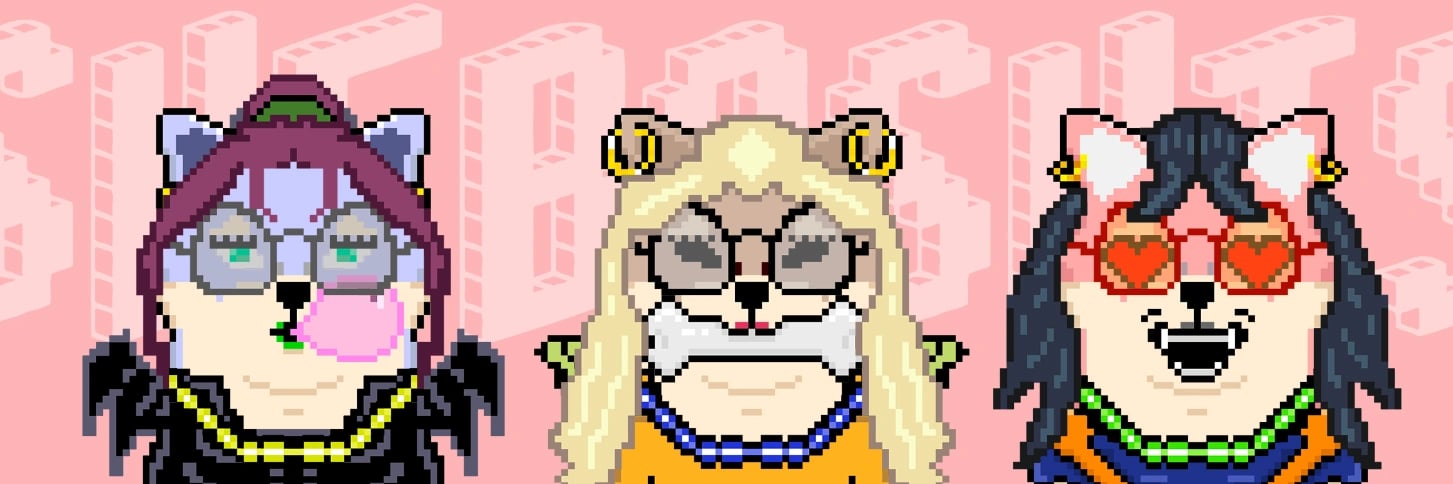
The SHEboshi proceeds will be allocated to different initiatives. Part of the proceeds will be used to burn Shiba Inu ecosystem tokens, including SHIB, LEASH, BONE, TREAT, and SHI. The remaining portion will be allocated to Shiba Inu’s treasury, non-profit initiatives, expenses, and foundation.[10]
Shib the Metaverse
Shib: The Metaverse is a virtual world with customizable avatars, buildable plots associated with Metaverse Land NFTs, interactive hubs, and opportunities for exploration and social interaction. The project documentation describes it as being in early access.[33]
Shibacals
Shibacals is a concept for physical merchandise fitted with embedded NFC tags linked to online pages or NFT records. Scanning a tag is intended to support merchandise authentication and connect the physical item to related digital content or benefits.[13][34]
Partnerships
In February 2025, the UAE Ministry of Energy and Infrastructure signed an agreement with Shiba Inu to develop projects designed to unify development on ShibOS.[24]
Team
On January 26, 2025, Shytoshi Kusama announced that he was moving from lead visionary to Lead Ambassador. He said he intended to promote ShibOS and support a transition toward DAO control.[16]
See something wrong?