0% read
Last updated:
Adrian Brink
Adrian Brink is a technologist, protocol engineer, and entrepreneur in the blockchain industry. He is a co-founder of the Anoma protocol, Namada, Heliax, Cryptium Labs, and Metastate, and is known for his work developing intent-centric architecture for decentralized applications. [1] [9]
Education
Brink holds a Bachelor of Science in Business Management from Cass Business School and a Master of Science in Computer Science from the University of Copenhagen, where his graduate thesis explored censorship-resistant electronic voting systems. [2] [9]
Career
Brink began his career as a software engineer at Appstract from May 2016 to April 2017. He entered the blockchain industry in April 2017 when he joined All in Bits (now Ignite), the company behind Tendermint. He served as a core protocol developer and later as head of partnerships and community, contributing to the early development of the Cosmos ecosystem until October 2018. From October 2018 to March 2019, he worked as a technologist at the Web3 Foundation. [9]
In June 2018, Brink co-founded Cryptium Labs, a professional proof-of-stake validator and infrastructure operator, which was later sold to Chorus One. He served as its managing director until January 2021. He continued his entrepreneurial work by co-founding Metastate in March 2019, a research and engineering firm that contributed to major upgrades for the Tezos protocol. He was involved with Metastate until January 2021. Since 2020, Brink has been a co-founder of the Anoma protocol. In 2021, he co-founded Heliax, where he serves as CEO, and also joined the board of the Anoma Foundation. [9] [10]
Publications
In an opinion piece for Blockworks published on September 9, 2024, titled "Without decentralization, our data will never be safe," Brink argued that securing the digital world requires the development of conflict-resistant digital infrastructure. He framed this as essential for building systems that can remain resilient in the face of global crises. [10]
Interviews
Resilient Communities
On The Defiant Podcast in August 2025, Brink discussed the importance of intention, privacy, and resilience in building community-centric technology. Brink, an early developer in the Cosmos ecosystem, emphasized the need for self-sovereign infrastructures capable of resisting external threats and maintaining data privacy. He articulated his vision for a blockchain-based platform, Anoma, that allows users to express intents rather than merely executing transactions, acknowledging that privacy and community security are increasingly critical in a fragmented world. The conversation also addressed the challenges of designing intuitive systems that facilitate trust and coordination in various geopolitical contexts, suggesting that a flexible, intent-based framework could empower individuals and communities while navigating complex regulation and market dynamics. [7]

Crypto Infrastructure
On the Crypto News podcast in August 2025, host Matt Zahab interviewed Brink, co-founder of Anoma and Namada, discussing various topics, including the state of Web3 and the concept of "intents" in crypto infrastructure. Brink, who previously worked with Tendermint and the Web3 Foundation, reflected on his move to Switzerland and the historical context of local communities and their infrastructures in relation to potential global crises. He articulated his views on the limitations of current blockchain technologies, highlighting that most innovations have stagnated and failed to address interoperability among different chains. Instead, he advocated for Anoma's approach, which emphasizes a multi-chain capability through its intent-driven system that allows users to define desired outcomes without being tied to specific assets or chains. Brink noted that enhancing user-configurable privacy and developing applications that resonate with everyday life were vital for broader adoption. He also expressed optimism for the future, suggesting that Anoma could pave the way for new applications and community-oriented solutions beyond mere financial transactions. [6]

Staking & Intents
In a February 2025 episode of the Staking Insider podcast, Brink discussed his journey in the blockchain space, detailing his experiences as a professional validator and his work on projects like Cryptium Labs and the Cosmos ecosystem. He highlighted the fully decentralized launch of Namada, a privacy-centric blockchain designed to support intents-centric applications, emphasizing the importance of community involvement and governance. Brink also shared insights into the unique staking mechanisms of Namada, including cubic slashing and the innovative use of a shielded set for privacy-enhanced transactions. He elaborated on the concept of intents, likening them to expressing desires rather than executing specific transactions, and discussed their potential to integrate with AI and decentralized labor markets. The episode underscored the evolution of blockchain technologies, focusing on the need for privacy guarantees and its implications for the future of decentralized applications. [8]

Presentations
Ethereum’s Intent Machine
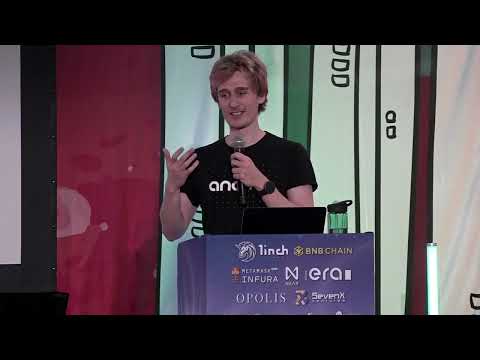
During his presentation at EDCON 2024 in September, Brink discussed the concept of Ethereum's Intent Machine (IM), outlining its potential to transform how developers and users interact with Ethereum. He explained that while traditional virtual machines (VMs) execute transactions sequentially, an Intent Machine processes a batch of intents—declarative instructions that specify desired state changes—allowing for increased flexibility and composability in decentralized applications (dApps). Brink emphasized the distinction between intermediaries and interfaces, advocating for the use of pure interfaces to minimize trust issues and latency. He highlighted the Anoma protocol as a leading framework for integrating intents into the Ethereum ecosystem, presenting benefits such as permissionless infrastructure, enhanced scalability, and improved privacy controls. By addressing how intents could facilitate novel applications beyond typical financial use cases, Brink illustrated the overarching goal of achieving a decentralized and efficient ecosystem on Ethereum. [5]

Anoma
In a presentation at Scaling 2023 in June, Brink discussed the concept of intent-centric architecture, which positions "intents" as fundamental to blockchain development, contrasting them with traditional transaction-centric models. He outlined the evolution of blockchain protocols from early systems like Bitcoin, which focused on scriptable settlement, to Ethereum, which introduced programmable settlement. Brink posited that current systems largely remain within a second generation of transaction-centric frameworks. Anoma, as a third-generation platform, operates on the principle of intents, allowing users to express their desires without specifying how to achieve them, thereby enhancing composability and reducing the complexity that leads to bugs and inefficiencies in existing systems. He highlighted the potential applications of Anoma, such as decentralized exchanges and privacy-preserving applications. He emphasized the architecture's flexibility in being deployed across various security models, suitable for diverse user needs. [3]

Declarative Decentralization
In a presentation at ETHDenver in March 2023, Brink discussed the concept of "declarative decentralization" as a transformative architecture for Web3 applications. He reflected on the evolution of blockchain systems from Generation 1, with scriptable settlement, such as Bitcoin, to Generation 2, with programmable settlement found in Ethereum. While acknowledging that contemporary platforms like Solana and Avalanche offer incremental improvements, he argued they do not fundamentally alter the landscape of decentralized applications (dApps). Brink emphasized that many dApps still rely on centralized components for counterparty discovery, thereby limiting composability. He introduced the architecture of Anoma, which aims to solve these issues by allowing users to submit intents—specifying desired state changes without detailing execution—thereby enhancing scalability and facilitating decentralized counterparty discovery. Ultimately, he proposed that this declarative approach would lead to a more interoperable and user-friendly ecosystem of decentralized applications. [4]
See something wrong?

Official Website:
Social Profiles: