0% read
Last updated:
Theo
Theo is a blockchain-based financial technology platform that connects on-chain capital with global financial markets by enabling tokenized access to real-world assets (RWAs). As a full-stack tokenization platform, Theo provides end-to-end infrastructure for institutional-grade tokenized assets, including automated trading strategies, vault-based asset management, and integration with both decentralized and traditional financial infrastructure. [1] [3]
Overview
Theo is a financial technology platform built to democratize access to institutional-grade trading infrastructure and connect on-chain capital with global markets. The platform's team includes former quantitative traders from firms such as Optiver and IMC Trading, as well as investment professionals from UBS and Polygon Ventures. Theo’s model centers on tokenizing financial assets and making them available through blockchain networks. This approach is intended to allow both institutional and retail participants to interact with traditionally siloed assets within digital financial ecosystems. The platform operates at the intersection of traditional finance and decentralized finance. [11] [12]
Theo’s framework extends beyond the initial issuance of tokenized assets, emphasizing the development of broader on-chain financial ecosystems under its "Beyond Issuance" strategy. The platform is designed to support trading liquidity, lending activity, and interoperability with other decentralized finance applications. Through this structure, tokenized assets can circulate within decentralized financial networks rather than existing as isolated instruments. The company’s reusable tokenization infrastructure aims to integrate these assets with decentralized exchanges, lending protocols, and other financial services. This approach reflects a broader trend in the tokenization sector toward building financial systems that combine asset issuance with market infrastructure. [2] [5]
Founders
Theo was founded by Abhi Pingle, Arijit Pingle, and TK Kwon. Abhi and Arijit Pingle are both former quantitative traders from Optiver. TK Kwon is a former quantitative trader from IMC Trading. [11]
Technology
tTokens
tTokens are vault-based tokens that represent ownership of a single tokenized asset or real-world asset held within a smart contract. Each vault issues a corresponding receipt token, prefixed with “t” (such as tULTRA), and follows the ERC-4626 tokenized vault standard for managing deposits and asset accounting. The vault’s exchange rate is determined by dividing the total assets held by the total token supply, with total assets including both onchain balances and assets recorded as pending during settlement. Pending assets track deposits that have been initiated but not yet delivered onchain, allowing the system to account for transactions that are still in progress. The minting process uses an optimistic model in which tokens are issued immediately after a deposit request, while the underlying asset settlement occurs afterward. Administrative roles, multisignature controls, and upgradeable proxy contracts are used to manage minting, user access, contract upgrades, and emergency functions within the system. [6]
Minting Service
The tToken Minting Service is a backend system that processes mint requests through a series of coordinated components. A queue service receives mint orders through an API and stores them as asynchronous tasks, allowing frontend requests to be separated from backend processing for reliability and scalability. A minting orchestrator then processes these queued orders by verifying user signatures and checking whitelist status before coordinating the transfer of stablecoins to the issuer of the underlying asset through a multi-party computation wallet. During this process, tTokens are minted using an optimistic model, meaning tokens are issued immediately while the underlying asset transfer is still in progress. A settlement watcher monitors blockchain activity to confirm when the issuer has delivered the underlying assets. Once settlement occurs, the system updates the vault’s asset accounting by resolving any pending asset entries through the minter contract. [7]
iTokens
iTokens are index tokens that represent a basket of underlying assets comprising multiple tTokens and, in some cases, other iTokens. They follow the ERC-20 token standard and issue receipt tokens prefixed with “i,” such as iDN. The value of an iToken is based on the combined value of its underlying assets, which is calculated using price data provided by oracles. Asset composition within each index can be configured according to predefined allocation ratios enforced at the smart contract level. This structure allows a single token to represent diversified exposure to multiple tokenized assets while maintaining onchain pricing and accounting. [8]
Products
thBILL
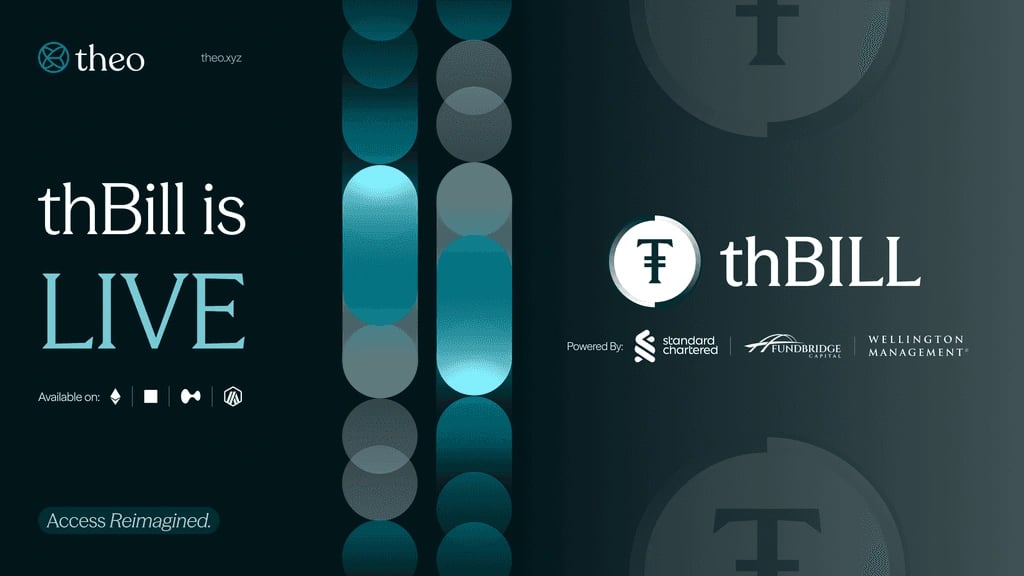
Launched on July 24, 2025, thBILL is an institutional-grade, tokenized money market fund that provides exposure to short-duration U.S. Treasury bills. Structured as an iToken, it represents a basket of tokenized Treasury assets. The product launched with tULTRA as its sole underlying asset. Since its launch, thBILL has surpassed $200 million in total value locked (TVL) and $1 billion in cumulative trading volume, reaching over 80,000 users in more than 60 countries. It is a multi-chain product available on Ethereum, Base, Arbitrum, and HyperEVM. Minting and redemption are limited to users who complete identity verification, and redemptions are settled in USDC. [13] [10]
tULTRA
tULTRA is a token that represents a wrapped version of the ULTRA money market fund, a financial product focused on short-duration U.S. Treasury instruments. In December 2025, Theo and Stable committed over $100 million to the ULTRA strategy to provide deep liquidity. The underlying fund invests primarily in ultra-short-term U.S. Treasury securities, repurchase agreements, and cash reserves, with returns generally aligned with prevailing U.S. interest rates after fees. The fund is managed by FundBridge Capital, with Wellington Management serving as the investment manager and Standard Chartered Bank acting as custodian. The tokenization infrastructure is provided by Standard Chartered's Libeara platform, and the fund operates under a Singapore unit trust structure regulated by the Monetary Authority of Singapore. Within the Theo system, tULTRA follows the tToken vault standard. Each tULTRA token is backed one-to-one by shares of the ULTRA fund or by USDC reserved to mint those shares. [9] [12]
thGOLD
Launched on January 27, 2026, thGOLD is a tokenized, yield-bearing gold product designed to provide exposure to the price of gold while generating an estimated annual yield of approximately 2%. The product tracks the MG999 Onchain Gold Fund, which generates yield by providing secured, gold-denominated loans to established gold retailers. The initial borrower for the fund was Mustafa Gold, a major Singapore-based retailer. The fund is operated by FundBridge Capital with tokenization infrastructure provided by Libeara. To mitigate credit risk, the loans are secured by the retailer's gold inventory, and the fund includes a 20% first-loss buffer held by the fund sponsor. The product launched in phases, with initial access limited to institutional partners and accredited investors. [3]
thUSD
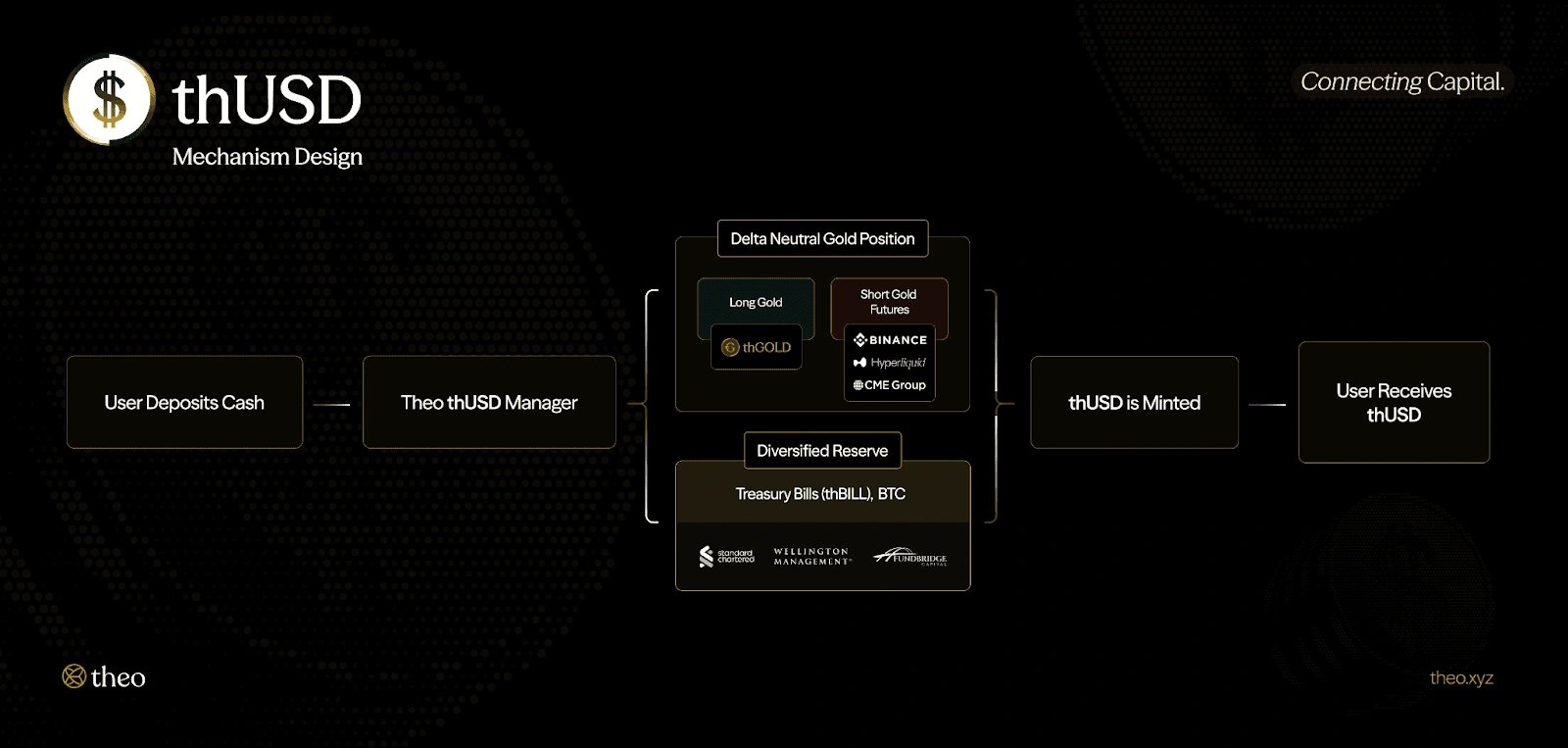
Announced on February 26, 2026, thUSD is a yield-bearing stablecoin designed to combine dollar stability with exposure to gold as a productive asset. It is collateralized primarily by thGOLD, Theo's yield-bearing gold token, while simultaneously hedging gold price exposure through delta-neutral positions using short gold futures. This structure is designed to generate yield from two independent sources: lending interest from thGOLD and the carry trade (basis and roll yield) from gold futures. Based on backtesting for the 2025 calendar year, this strategy produced an average APR of 8.27%. The reserves are supplemented by other diversified assets, including thBILL and delta-neutral Bitcoin positions. Following the announcement, a $100 million pre-deposit thUSD Genesis Vault was opened to users in early March 2026. [10]
Funding
In April 2025, Theo announced it had raised $20 million in a Series A funding round. The round was co-led by Hack VC, Mirana Ventures, and Anthos Capital. Other participants included Manifold Trading, Metalayer Ventures, SCB, MEXC, Amber Group, and Selini Capital. The round also featured angel investors from traditional finance firms such as Citadel, Jane Street, HRT, Optiver, IMC, 5 Rings, and JPMorgan. The funding was structured through token warrants that provide investors with allocations of a future cryptocurrency associated with the platform. [11] [4]
Partnerships
Theo has established partnerships across the traditional and decentralized finance sectors to support its product ecosystem. Key partners for its tokenized asset products, thBILL and thGOLD, include Standard Chartered's Libeara (tokenization infrastructure), Wellington Management (investment management), and FundBridge Capital (fund operations). [14]
For liquidity and market access, the platform works with liquidity providers such as SIG, Flowdesk, and Amber. Other strategic partners include Stable, with which Theo committed over $100 million to the ULTRA tokenized fund, and Zodia Markets. Investors who also act as partners include Mirana Ventures, Hack VC, Manifold, and Selini Capital. [12] [5]
See something wrong?
Official Website:
Social Profiles:
Blockchains: