0% read
Last updated:
Orca
Orca is a decentralized exchange on Solana that uses automated market-making to enable token trading and liquidity provision via on-chain pools. It also includes tools for concentrated liquidity, token launches, and yield generation, with a governance token that supports protocol decision-making. Orca has developed into a major liquidity layer on Solana, processing over $300 billion in cumulative trading volume by February 2025 and serving as the primary on-chain venue for PayPal USD (PYUSD) liquidity on Solana since May 2024.[3][11]
Overview
Orca (ORCA) is a decentralized exchange (DEX) built on the Solana blockchain that uses an automated market maker (AMM) model to enable token swapping and liquidity provision. It is designed to simplify decentralized finance by offering a user-friendly interface for trading, yield generation, and liquidity management with low fees and fast transaction speeds supported by Solana’s high-performance infrastructure. The platform focuses on reducing complexity in DeFi so that both beginners and advanced users can interact with on-chain markets more easily. Orca also functions as a core liquidity layer within the Solana ecosystem, supporting trading and capital allocation across multiple token markets, and by February 2025 had processed over $300 billion in cumulative trading volume. Beyond Solana, Orca is deployed on Eclipse, an SVM-based Ethereum layer 2 chain, where it operates as the primary DEX. By October 2026, Orca had processed more than $550 billion in trading volume since 2021 and expanded from crypto-native markets into infrastructure for tokenized financial assets, including real-world assets (RWAs).[16][17] Its overall goal is to make decentralized trading more accessible while maintaining efficient and transparent market operations.[1][11][12]
A key technical feature of Orca is its “Whirlpools” system, which implements concentrated liquidity, allowing liquidity providers to allocate capital within specific price ranges rather than across the entire market curve. This improves capital efficiency by enabling providers to earn fees more effectively when trading activity occurs within their selected ranges, while also reducing slippage for traders. The system is comparable in structure to other concentrated liquidity models in DeFi but optimized for Solana’s fast, low-cost transaction environment. Orca operates through smart contracts that support liquidity pools, swaps, and token launches, and it also provides tools for portfolio management and analytics. Its infrastructure is built to serve multiple user groups, including traders, liquidity providers, token creators, and developers integrating DeFi functionality into applications.[1]
Features
Liquidity Provision
Providing liquidity on Orca involves depositing assets into concentrated liquidity pools (CLMMs) on the Solana-based decentralized exchange to earn trading fees. Unlike traditional automated market makers that distribute liquidity across all possible prices, Orca’s CLMM model allows liquidity providers to allocate capital within specific price ranges, increasing capital efficiency but requiring more active management. This structure is designed to replace or supplement traditional order book systems by enabling permissionless pool creation and fee generation directly from trading activity. Liquidity providers choose between full-range positions, which are more passive and always active but less efficient, and custom-range positions, which concentrate liquidity for potentially higher returns but require ongoing monitoring. The system introduces trade-offs, such as increased impermanent loss risk when liquidity is poorly positioned, alongside the potential for higher fee earnings when liquidity is well managed.[9]
In 2025, Orca upgraded Whirlpools with Dynamic Tick Arrays, which initialize smaller tick array accounts that expand as needed and refund most rent when positions close. This “grow-as-you-go” design reduces the upfront on-chain cost of creating many liquidity pools by roughly an order of magnitude, primarily benefiting liquidity providers while leaving swap behavior for traders unchanged.[13]
Liquidity Terminal
The Liquidity Terminal is the primary interface for managing and monitoring liquidity positions in Orca. It provides real-time pool data, including the current price, total value locked (TVL), 24-hour trading volume, and fees generated, along with a price chart that supports different timeframes, indicators, and liquidity depth. Users can interact with multiple views through bottom-pane tabs, including active positions, transaction history, closed positions, and simulation tools for testing hypothetical strategies. The interface also includes a position creation panel where users select between full-range and custom-range liquidity strategies and adjust parameters such as asset ratios and price ranges. Once a position is created, it can be tracked and adjusted through a dedicated sidebar that provides details, deposit options, and withdrawal controls.[8][10]
Vaults
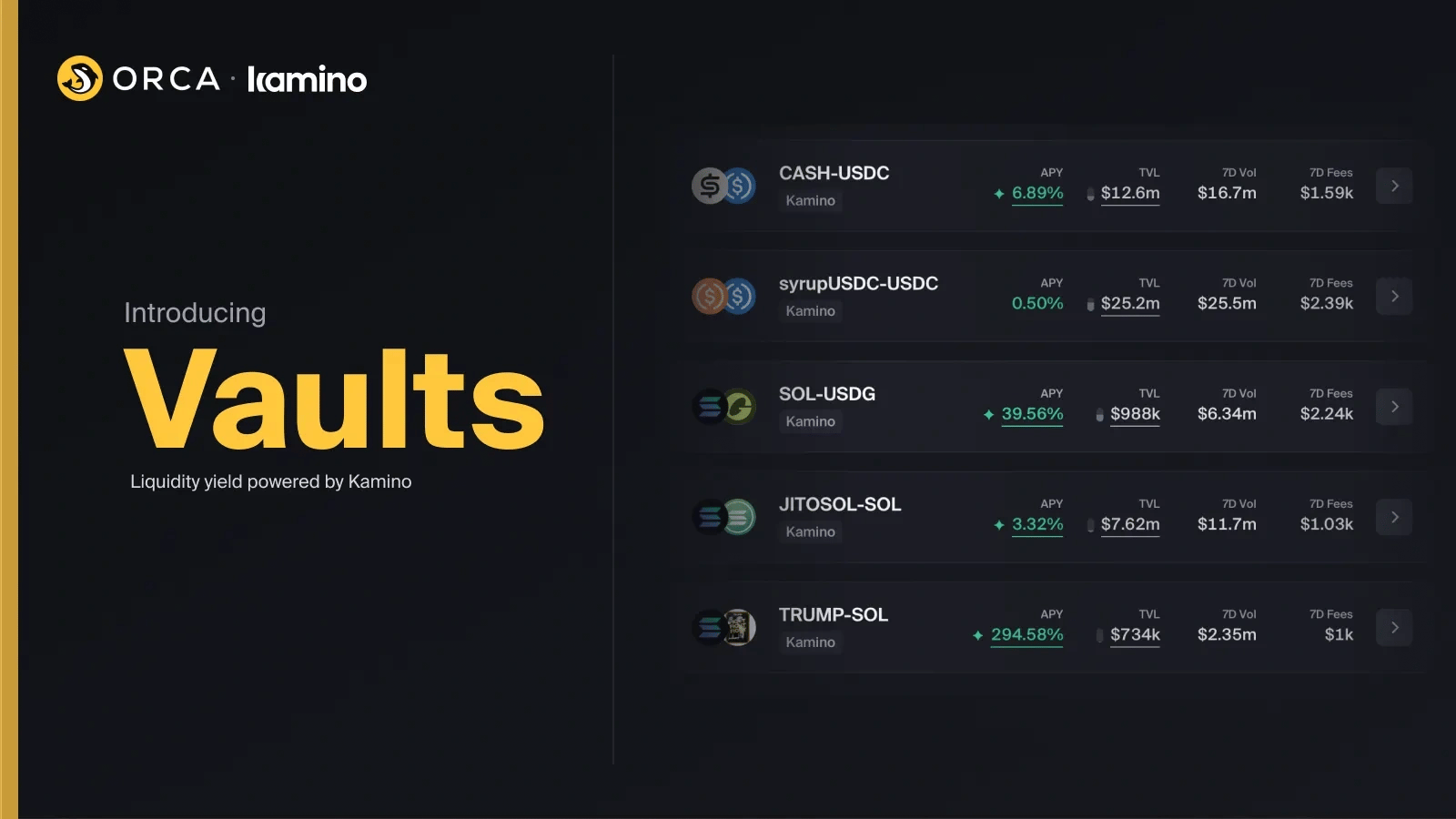
Vaults on Orca are automated yield strategies that manage liquidity positions on behalf of users, removing the need for manual range selection, rebalancing, or active position management. Users deposit tokens into a vault, and the system allocates capital across liquidity positions designed to efficiently generate trading fees, often focusing on high-volume price ranges. These strategies continuously adjust as market conditions change, and any earned yield is typically compounded back into the position to enhance returns over time. Vaults are powered by external strategy systems and operate as a simplified interface for participating in liquidity provisioning without direct operational involvement. While they aim to optimize yield, outcomes still depend on market conditions and the performance of the underlying strategy.
Vault functionality includes features such as Autoswap, which allows users to deposit or withdraw using a single token by automatically converting assets into the required pair through integrated swap mechanisms. Each vault page provides key data points, including the strategy type, underlying pool, fee tier, oracle source, and capacity limits that define the maximum total capital that can be accepted. Capacity constraints are important because vaults can become capped, preventing additional deposits once limits are reached. Users can also view their personal position and transaction history if they have participated in a vault. Despite automation, risks remain, including exposure to smart contracts, market volatility, and potential delays in position updates, which means deposits still carry financial risk.[7]
Trading
Trading on Orca provides a streamlined way to swap tokens on Solana using decentralized liquidity pools. The platform emphasizes fast execution, low fees, and simplified user interaction, allowing users to complete trades with minimal steps. Orca v2 enhances pricing efficiency by comparing quotes from both its internal liquidity pools and the Jupiter aggregator, ensuring users receive competitive execution prices within a single interface. This reduces the need to search across multiple platforms for the best trade outcome manually. Overall, the trading system is structured to optimize speed, price discovery, and usability for on-chain asset exchange.
At the core of Orca’s trading system is its use of concentrated liquidity, where capital is concentrated around active market prices rather than spread across the entire price curve. This design reduces slippage and improves pricing efficiency compared to traditional decentralized exchanges that rely on uniform liquidity distribution. When a user submits a trade, the system first scans available liquidity across pools, then determines the most efficient routing path, and finally compares execution outcomes with external aggregators. After selecting the optimal route, the trade is executed with minimal delay on Solana’s high-speed network. Users can also access additional features such as range orders, which function similarly to limit orders while continuing to earn fees while active.
Trading costs on Orca consist primarily of small network fees, variable liquidity provider fees, and user-defined slippage tolerance. Network fees are typically very low due to Solana’s infrastructure, while trading fees vary by pool depending on asset type and volatility, and are distributed to liquidity providers. Slippage is the difference between the expected and executed prices and is influenced by market liquidity and volatility. Fee tiers differ across pools, with stable pairs generally charging lower fees and more volatile pairs charging higher fees. To begin trading, users connect a Solana wallet, ensure they hold sufficient SOL for transaction fees, select token pairs, enter trade amounts, and confirm transactions through their wallet interface. The system also provides practical trading guidance, such as using high-liquidity pairs, verifying token addresses, and managing slippage settings to reduce execution risk.[6]
In May 2026, Orca introduced permissioned pools on Solana that allow only approved, KYC-verified investors to trade regulated tokenized assets. The first asset supported in these pools was Streamex’s gold-linked GLDY security, with the design aimed at issuers needing to comply with securities laws while reusing Orca’s existing liquidity and trading infrastructure. The permissioned pools are targeted primarily at the U.S. market and mark Orca’s expansion into tokenized real-world asset (RWA) markets.[18]
Token Creation
Orca for Token Creators provides a set of tools for launching and managing liquidity markets for new tokens on Solana without requiring approval from a centralized authority. It allows creators to create liquidity pools, list tokens for visibility, and optionally incentivize liquidity providers through reward programs. The system is designed to support permissionless market creation, meaning tokens can be introduced and paired with liquidity directly through the protocol. Token creators can also choose from different pool types based on their technical needs and level of experience. Overall, the toolkit focuses on enabling token deployment and initial market formation within Orca’s decentralized exchange infrastructure.
Two main pool types are available: Splash Pools and CLMM Pools, each serving different levels of complexity and control. Splash Pools are designed for simpler launches with minimal configuration, lower costs, and full-range liquidity, making them suitable for most new token deployments. CLMM Pools, by contrast, offer advanced features such as customizable price ranges and multiple fee tiers but require more active management and technical understanding. Token creators are guided through a launch process that includes preparing the token, setting initial liquidity conditions, creating the pool, and optionally applying for token listing to improve discoverability. Additional steps, such as offering liquidity incentives or rewards, can attract liquidity providers and increase trading activity.
The platform also supports SPL Token Extensions, allowing compatibility with tokens that have advanced compliance or functional requirements. Best practices emphasize careful selection of initial pricing, sufficient liquidity provision to reduce slippage, and appropriate fee tier selection based on token volatility and market behavior. Fee tiers vary by asset type: stable pairs typically pay lower fees, while more volatile tokens pay higher fees. Token creators are encouraged to verify pool configurations before finalizing creation, as certain parameters, like initial pricing, cannot be changed afterward. Listing on external platforms such as token aggregators or data providers can further improve visibility and trading accessibility once the pool is live.[5]
Splash Pools
Splash Pools on Orca are simplified liquidity pools designed for straightforward token launches and basic liquidity provision on Solana. They use a full-range liquidity model built on Orca’s concentrated liquidity infrastructure, meaning liquidity is spread across all possible prices and remains continuously active without requiring active position management. This makes them easier to use than CLMM pools, but less capital-efficient because liquidity is not concentrated in specific price ranges. They are typically used for new token launches or users who prefer minimal complexity and low setup costs over advanced optimization. Once created, a Splash Pool allows users to trade the token and provide liquidity, with positions represented as NFTs that track ownership and earned fees. Fees accumulate over time and can be manually harvested, while liquidity can be added or withdrawn as needed, depending on the provider’s strategy.[4]
ORCA
ORCA is the native governance and utility token of the Orca protocol on Solana. It is used primarily to support decentralized governance, allowing holders to vote on protocol decisions such as fee structures, treasury management, and upgrades. The token also helps align user incentives with the platform's long-term performance by linking value capture to overall protocol activity. In addition to governance, ORCA can be staked to receive xORCA, a staking derivative that earns a share of protocol revenue generated through trading fees. This staking mechanism connects token value to platform usage, as higher trading volume increases fee generation and potential returns for stakers.
Beyond staking and governance, ORCA supports broader DAO participation, including proposal submission, voting delegation, and council elections within the Orca ecosystem. xORCA functions as a liquid staking and governance derivative, with a portion of protocol fees from Whirlpools used to buy back ORCA on the open market and deposit it into an xORCA reserve vault. As this reserve grows, each xORCA token represents a claim on a larger pool of protocol revenue, aligning users, liquidity providers, and the protocol by tying incentives to sustained usage.[2][14][15]
By October 2026, an ongoing governance proposal titled “Resourcing Orca for Its Next Phase” sought to change the protocol fee split from 40/10/50 (xORCA/community/team) to 10/10/80, directing 10% of protocol fees to xORCA, 10% to a team-managed buyback account, and 80% to the development team. The proposal would also dissolve the Governance Council and transfer a large community treasury, including around 14.2M ORCA and a SOL-denominated fee treasury, into a team-controlled Strategic Account intended to fund operations and potential acquisitions. As of early October 2026, the vote remained in progress and drew criticism from some xORCA holders, who argued that the changes would reduce both staking rewards and the scope of tokenholder governance rights.[19]
Tokenomics
ORCA has a total supply of 50M following an April 2025 governance proposal that burned 25M ORCA, reducing the planned supply by 25% from 75M. The distribution percentages below were defined for the original 75M token supply:[2][14]
- Token Treasury: 55.9%
- Team: 20%
- Private Sale: 9.6%
- Contributor Grant: 5%
- Value Add/Advisory: 4.3%
- Liquidity Providers: 4%
- Heavy Traders: 0.5%
- Average Traders: 0.5%
- Advisors: 0.3%
Partnerships
- Bitlayer, reflecting integrations with broader infrastructure and scaling solutions.
- ByBit, supporting CEX–DEX connectivity and liquidity routing for Solana assets.
- Stripe, highlighting Orca’s role in connecting DeFi liquidity to fiat on-ramp and payment flows.
- Kamino Finance and other DeFi platforms that build strategy vaults and liquidity products on top of Orca’s Whirlpools.
- Tiger Data, contributing analytics and data services around Orca’s on-chain markets.
- Eclipse, where Orca operates as a primary DEX deployment on an SVM-based Ethereum layer 2 and extends its role in stablecoin and payments liquidity alongside PayPal USD (PYUSD) and Paxos on Solana.[11][12]
- Formation (Orca + Loopscale), reflecting the October 2026 merger into Formation, led by Loopscale co-founder Luke Truitt, which combines Orca’s trading and liquidity infrastructure with Loopscale’s credit and vault infrastructure while keeping both underlying protocols operating under their own names as the foundation of the ORCA/xORCA token network; Formation plans to build tools for tokenized assets and a tokenized securities venue under the U.S. SEC’s Innovation Exemption.[16][17]
See something wrong?
Official Website:
Social Profiles:
Explorers:
Founders:
Blockchains: