Jito
Jito is a Solana market-layer and infrastructure ecosystem spanning transaction ordering and block building, liquid staking, restaking, and trading. Its block-building infrastructure processes and orders transactions for Solana blocks; its Jito Stake Pool lets users stake SOL and receive JitoSOL, which provides liquidity while accruing staking and MEV rewards. Jito also develops StakeNet for stake delegation, Jito (Re)staking for economic security, and JTX, a self-custodial trading interface.[9][1][10]
Lucas Bruder and Zano Sherwani are Jito's co-founders.

개요
Jito is a Solana market-layer and infrastructure ecosystem that includes transaction-ordering and block-building infrastructure, liquid staking, restaking, and trading products. Its block-building infrastructure processes transactions for Solana blocks, while JitoSOL lets users stake SOL and receive a liquid token that accrues staking and MEV (maximum extractable value) rewards. Jito’s other systems include StakeNet, which supports stake-pool delegation; Jito (Re)staking, which provides economic security for Node Consensus Networks; and JTX, a self-custodial Solana trading interface. JitoSOL also supports DeFi integrations, enabling holders to use it in lending and farming protocols.[9][1][10]
Jito Foundation
The Jito Foundation, established in the Cayman Islands, supports the Jito Network's development and operates under its own Bylaws and governance documents. Tokenholders have decision-making power regarding the Foundation and the network. Governance of the Foundation is conducted through Tokenholder Votes, including the submission and voting on Jito Improvement Proposals (JIPs).[2]
On March 10, 2026, the Foundation announced that it had acquired SolanaFloor, a Solana-focused news and data platform. SolanaFloor had ceased operations in February 2026 following a $27 million exploit linked to its parent organization, Step Finance. The Foundation announced an immediate relaunch and said the newsroom would retain editorial independence, with the editorial team retaining control over story selection and coverage priorities.[32]
기능
Block Assembly Marketplace (BAM)
BAM is Jito’s block-building and transaction-ordering architecture. BAM Nodes sequence transactions inside Trusted Execution Environments (TEEs), while BAM Validators execute them. Plugins allow application-controlled execution, and cryptographic attestations make transaction ordering auditable. Jito described BAM’s privacy design as intended to mitigate harmful or negative MEV. BAM began an early mainnet launch on September 25, 2025.[9]
Direct Bundle Ingest (DBI), introduced in October 2026 after an early-cohort rollout, lets searchers submit bundles directly to BAM Nodes through QUIC or JSON-RPC, bypassing a Block Engine hop. Block Engine traffic also uses the faster direct-ingestion route. Comparing September 20–October 7, 2026 with September 3–20, DBI received 7.5% fewer bundles but 16.9% more landed; the end-to-end land rate rose from 0.45% to 0.57%.[11]
On November 15, 2026, BAM was reported to have 173.6 million SOL across 380 validators, more than 40% of Solana stake.[12]
Third-party BAM-node onboarding began on testnet with Bitwise, Triton One, and SOL Strategies. Full permissionless mainnet access remained a future target, contingent on mainnet attestations and Verifier and Autobahn features.[13][14]
Jito (Re)staking and TipRouter
Jito (Re)staking supports vault receipt tokens and Node Consensus Networks (NCNs), which use restaked assets to provide economic security for services. Deposit caps for Jito (Re)staking were removed on January 27, 2025. The TipRouter NCN launched on January 30, 2025 as the first Jito NCN; its operators reach consensus on MEV-tip distributions. Its initial 3% distribution fee was split as follows: 2.7% to the DAO treasury, 0.15% for JitoSOL-vault participants, and 0.15% for JTO-vault participants.[15][16]
MEV Solution
Maximum Extractable Value (MEV) refers to the profit that can be gained from the specific order of transaction execution. For example, if a large swap on Orca alters a pool’s price, traders might exploit the price discrepancy for arbitrage, which is considered MEV. Similarly, liquidation bots compete to process liquidations when a price threshold is met. MEV is prevalent in traditional finance and everyday scenarios, such as fans rushing to buy concert tickets to avoid resale markups.[3]
The Jito Foundation aims to optimize the extraction and distribution of MEV to enhance Solana's security and decentralization. Solana has faced network congestion from traders attempting to capture MEV by resending transactions multiple times, similar to users repeatedly refreshing a ticket sales website that is under heavy load. To address this, Jito introduced a solution involving an auction system where traders bid for transaction sequences they believe are profitable. A block engine selects the highest-value combination of transactions, and the proceeds from these auctions are shared with stakers through JitoSOL. This mechanism reduces the incentive for spam while boosting rewards for stakers, and JitoSOL benefits from these MEV rewards without being exposed to the risks of MEV trading.[3]
Stake Delegation
The Jito Foundation's Liquid Staking aims to enhance Solana's decentralization and performance. Validators meeting specific criteria can qualify for stake delegation. The goals are to support high-quality network operators, improve decentralization by avoiding the superminority, provide high yields to JitoSOL holders, and promote the adoption of the Jito-Solana validator client, which helps increase yields and reduce spam.[4]
Validators must meet certain requirements, including running an MEV-enabled client with a commission rate of 10% or less, not being part of the superminority, and not using unsafe consensus modifications. They are ranked based on their performance, measured by average epoch credits over the last 20 epochs and adjusted for commission rates.[4]
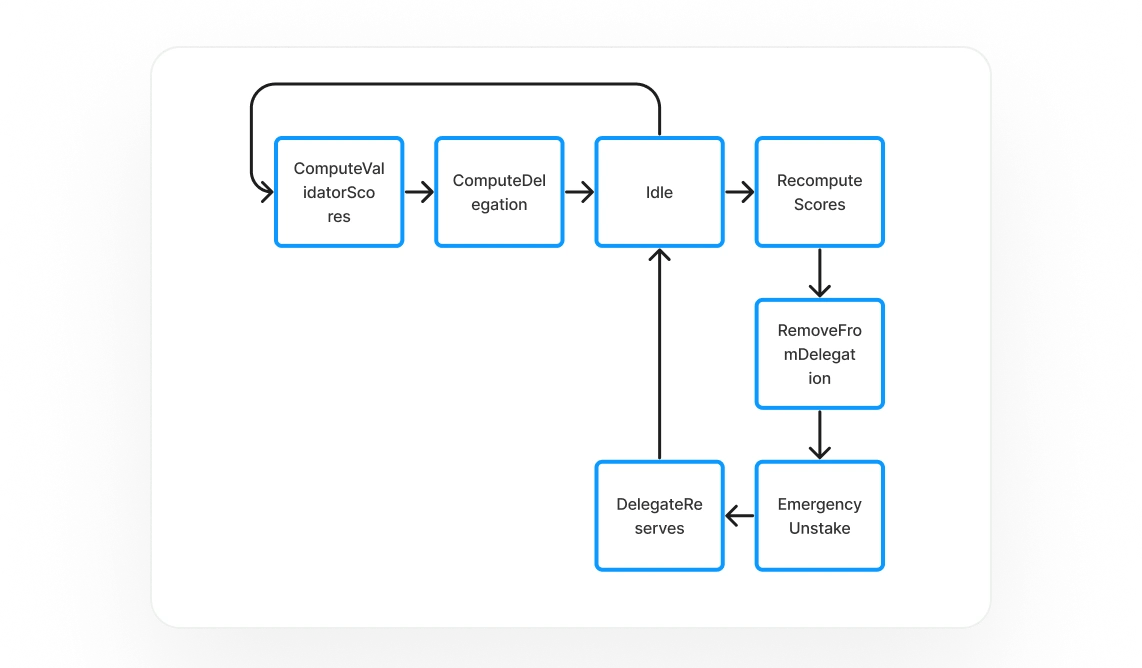
Delegation is given to the top 200 performing validators. If fewer than 200 meet the criteria, the delegation is distributed among those who do. Pool churn is limited to 7.5% of the total value locked per 10-epoch cycle to minimize the impact on JitoSOL yields. Validators may be immediately excluded for zero epoch credits, exceeding the 10% commission rate, or engaging in malicious behavior. Performance rebalancing involves unstaking up to 7.5% of the pool from lower-scoring validators and reallocating it to higher-performing ones.[4]
In September 2026, JIP-39 passed and directed a phased move of 25% of the pool’s delegation, pro rata, to Jito-operated reference validator(s) with 0% inflation and MEV commission. Under the proposal’s planned parameters, priority and signature-fee block rewards would be passed through to stakers; the planned delegation and reward arrangements describe approved mechanisms, not guaranteed yield outcomes. JIP-39 also retained the BAM subsidy at its full rate through Q4 2026, followed by an exponential wind-down ending by the end of Q2 2027. The change modifies the earlier delegation policy described above.[17][18][19]
StakeNet
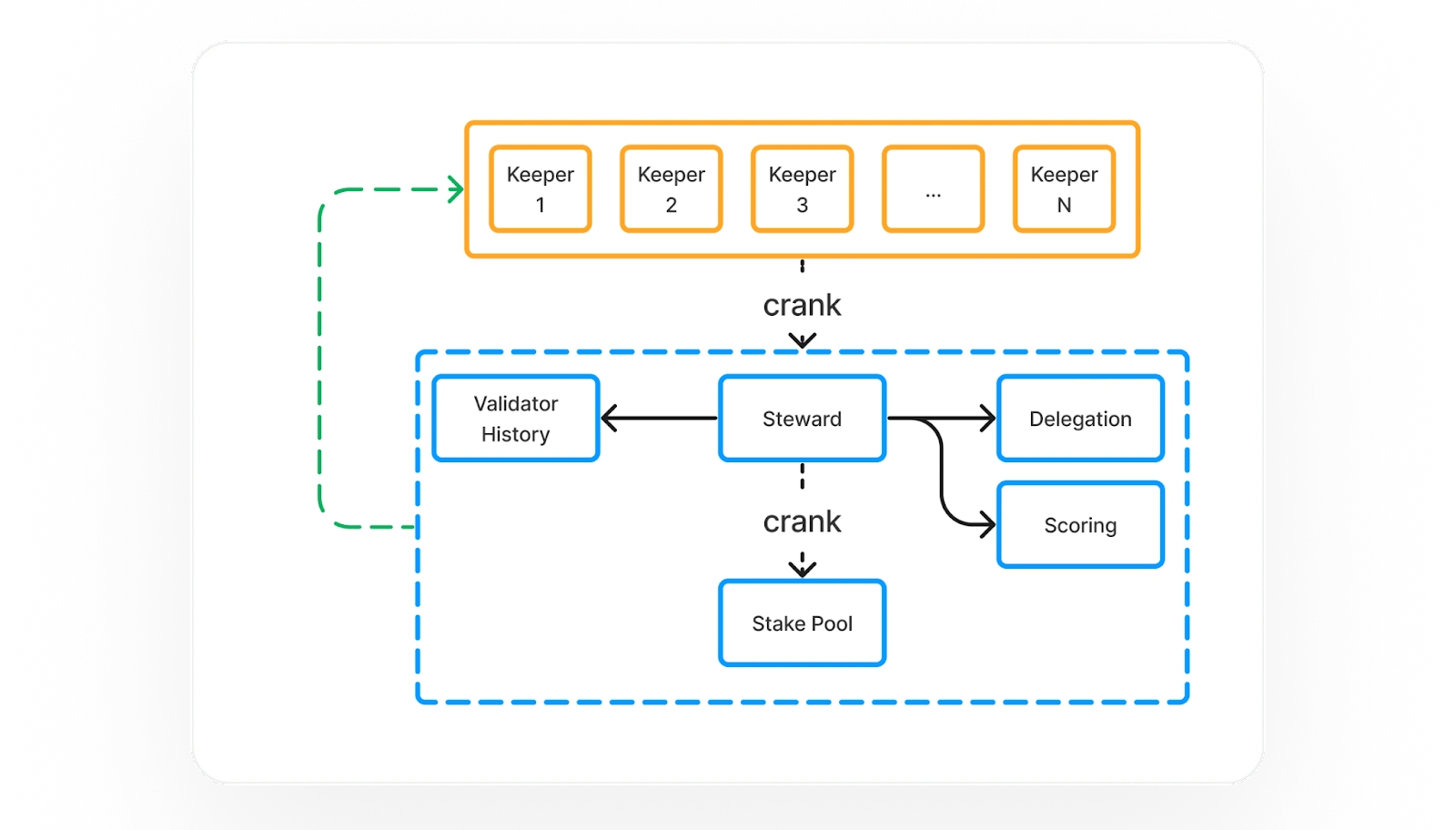
StakeNet consists of keepers and on-chain programs with two main components. The Validator History Program maintains a record of up to three years (512 epochs) of validator activity, offering a transparent and cryptographically verified history. This allows users and on-chain programs to assess validator performance.[5]
The Steward Program uses this historical data and other on-chain information to compute scores and determine stake delegation amounts for each validator. Keepers manage a state machine to ensure stakes are allocated to the highest-performing validators. This system operates autonomously and facilitates a transparent, efficient stake delegation process based on validated historical data. The operations of the stake pool are permissionless and accessible to anyone with a small amount of SOL for transaction execution.[5]

Validator Scoring
Since September 6, 2023, StakeNet has used on-chain data for validator scoring, which includes:[5]
- Vote Credits: Measures a validator's participation and accuracy in consensus.
- Commission: Reflects the fees charged by validators, affecting stakeholder rewards.
- MEV Commission: Additional earnings from efficient Maximum Extractable Value (MEV) extraction.
- Validator Version and Client Type: Provides insights into software reliability and operational status.
- Total Stake and Stake Rank: Shows each validator's total stake and ranking to identify those above the superminority line.
Data sources include on-chain accounts, which offer proof of authenticity, and gossip data, which provides real-time updates. StakeNet plans to expand the data set to include additional metrics such as geographical location and validator skip rates in the future.[5]
Stake Movement
Traditionally, stake pool management relies on a hot wallet controlled by the managing team, posing risks if compromised, as it could move all stakes to a single validator. To address this, StakeNet has shifted authority to an on-chain steward program. The hot wallet authority, or "Staker," is now managed by a Program Derived Address (PDA) controlled by the Steward. This change ensures that only stake movements calculated by the on-chain scoring algorithm can occur, enhancing security by preventing external manipulation. The Steward Program automates and aligns stake delegation with network health, rewarding high-performing validators and penalizing underperformers.[5]
JTX
On May 5, 2026, Jito announced plans for JTX, a consumer-facing trading app it targeted for release in July. The roadmap called for spot trading first, with perpetual futures and prediction markets described as future integrations. JTX represented Jito’s move from backend infrastructure into a product aimed directly at consumers. On May 5, CEO Lucas Bruder told Fortune that Jito had 39 employees across two entities and well over $100 million in cash. Fortune also reported that Jito generated nearly $6 million in revenue during one week after the January 2025 Solana memecoin launch, citing Blockworks data.[30]
In explaining why it was building JTX, Jito described fragmented trader workflows as the problem its app was designed to address. Its stated product rationale was to combine market charts, execution, portfolio tracking, and capital management in one self-custodial interface for active traders, with an emphasis on dependable maker limit orders.[34]
JTX opened publicly on July 21, 2026. Its self-custodial trading interface and the November 11, 2026, launch of Explore reflect later product status than the May roadmap announcement.[10]
JitoSOL
JitoSOL is a liquid staking derivative on the Solana blockchain that allows users to exchange their SOL for JitoSOL, maintaining liquidity and DeFi opportunities while earning staking yield. It also offers rewards from maximum extractable value (MEV) extraction on Solana. Users can trade JitoSOL on decentralized exchanges like Jupiter or withdraw SOL via Jito’s website after a 2-3 day cooldown. The token starts with a 1:1 exchange rate with SOL, which appreciates as rewards are accrued.[7]
JitoSOL and ETFs
The Jito Foundation has advocated for the inclusion of LSTs like JitoSOL in exchange-traded funds (ETFs) as a more flexible alternative to direct staking, especially in light of regulatory constraints around staking within traditional ETFs. LSTs offer benefits aligned with ETF architecture, such as collateral utility, in-kind redemption, and improved yield management. JitoSOL’s structure and classification as a non-security commodity position it as a candidate for ETF inclusion, enabling both long-term and short-term holders to gain yield exposure to Solana without operational staking complexity.[8]
VanEck filed an S-1 registration statement for a proposed JitoSOL ETF on August 22, 2025. Nasdaq separately filed listing-rule proposal SR-NASDAQ-2026-016 on March 10, 2026; Nasdaq withdrew it on October 14, 2026, and the SEC docket marks the related proceedings withdrawn. The withdrawal was neither approval nor a merits rejection, and a U.S. VanEck JitoSOL ETF is not listed.[20][21][22]
Jito Foundation reported that JitoSOL was included in the existing REX-Osprey SOL + Staking ETF (Cboe BZX: SSK) in July 2025. That fund is distinct from the proposed ETF designed to hold JitoSOL.[23]
JTO Token
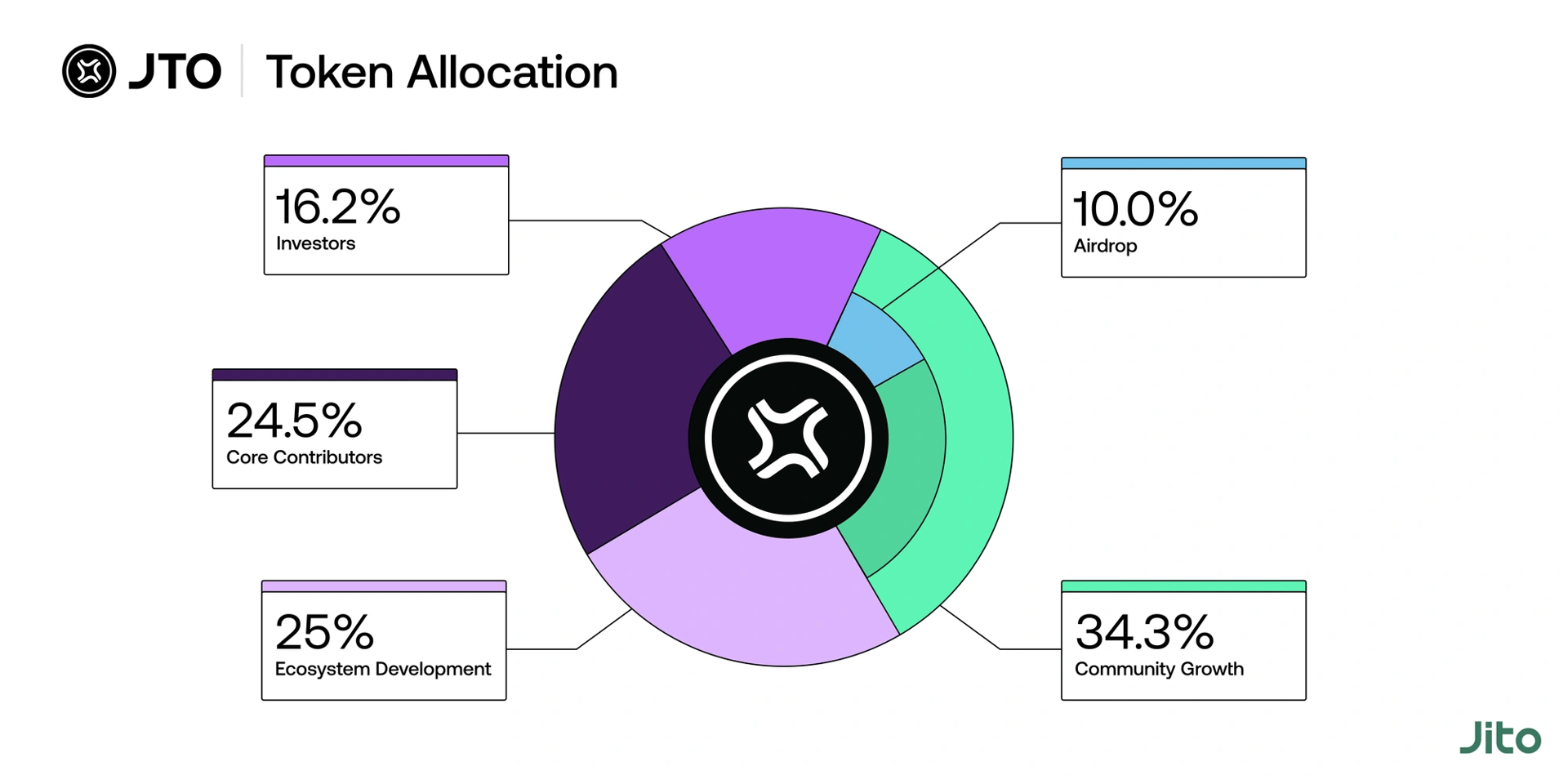
The JTO governance token enables community members to influence the decision-making and direction of the Jito Network directly. JTO has a total supply of 1 billion and has the following allocation:[6]
- Community Growth: 34.3%
- Ecosystem Development: 25%
- Core Contributors: 24.5%
- Investors: 16.2%
The 10% airdrop was drawn from within the Community Growth allocation, not allocated as an additional share.[6]
Under passed JIP-38, 80% of JTX platform fees go to the DAO, and the DAO’s entire share is committed to JTO buybacks and burns through at least the Q4 2027 reassessment. The remaining 20% is retained for JTX development.[24][25]
JIP-40, posted on November 23, 2026, proposes routing new and emerging revenue streams to a Foundation-controlled account until an annualized revenue floor of $20 million is reached, after which 80% would flow to the DAO and 20% to the Foundation. The proposal preserves existing DAO revenue streams and the JTX buyback commitment. It remains subject to governance and is not an enacted decision.[26][31]
파트너십
- Maple Finance
- Midcurve
- Phantom
- Infinex
- Drift
- Mango
- MarginFi
- Solend
- Orca
- Kamino Finance
- Raydium
- Meteora
- Invariant
On October 16, 2025, the Jito Foundation announced a $50 million strategic investment from a16z crypto via a private token sale to support protocol development, builders, and platform innovation.[27]
On February 10, 2026, Hex Trust announced a partnership with the Jito Foundation, integrating JitoSOL into its Solana liquid-staking offering for clients. Hex Trust reported that the integration lets clients maintain liquid-staking exposure and use JitoSOL as collateral for borrowing and lending through its markets desk.[33]
On April 13, 2026, the Jito Foundation and Korea Digital Asset (KODA) announced a memorandum of understanding (MOU) to explore compliant JitoSOL custody and staking pathways in Korea, as well as institutional market education and outreach. The MOU described an exploratory collaboration.[35]
On May 6, 2026, the Jito Foundation and Solana Company announced a strategic collaboration to deploy high-performance APAC validators running BAM and develop institutional staking solutions. The planned validators would use Solana Company’s Pacific Backbone across Hong Kong, Singapore, Japan, and South Korea. The parties also intended to develop institutional JitoSOL staking and yield solutions.[28]
On July 29, 2026, the Jito Foundation signed an MOU with Korea’s Wavebridge to explore institutional JitoSOL products and possible custody and settlement structures. The parties also discussed product structuring; issuance would depend on regulatory progress and cooperation with regulated asset managers.[29]
On September 28, 2026, the Jito Foundation and Wavebridge released a joint Digital Asset ETF Industry Report with Meritz Securities, Hanwha Asset Management, FnGuide, KODA, Solana Company, and Shin & Kim. The report brought together perspectives across the Korean digital-asset ETF product stack and examined structuring, issuance, distribution, custody, staking, index design, and regulatory considerations. It also described earlier Jito MOUs with Hanwha Asset Management to explore a JitoSOL ETP and with KODA concerning institutional custody and staking pathways.[36][35][29]