0% read
Last updated:
Axis
Axis is a digital asset market infrastructure company that provides liquidity, trading, settlement, and credit services across cryptocurrencies, currencies, and tokenized assets. Its products include USDx, a synthetic dollar used for financing and settlement; sUSDx, a vault token that distributes trading returns; and Axis Prime, an institutional service that provides cross-asset liquidity and execution. [6]
Overview
Axis is a digital asset market infrastructure platform that provides liquidity, market making, settlement, and credit services across trading venues, currencies, and settlement systems. Its operations use a market-neutral trading strategy that seeks to capture price differences through cross-venue arbitrage, cross-currency arbitrage, funding rate arbitrage, and over-the-counter (OTC) trading. The platform's infrastructure supports trade execution, hedging, and risk management, while its trading operations depend on off-chain systems and relationships with trading venues, custodians, and counterparties. Axis's first live product is USDx, a dollar-denominated, over-collateralized synthetic dollar backed by digital and tokenized assets, traditional assets, and corresponding futures and hedging positions. USDx is used to finance positions and settle trades between Axis counterparties, and it is not a stablecoin or a bank deposit.
Axis also offers sUSDx, a separate yield-bearing vault token created when users stake USDx. Unlike USDx, which does not earn rewards simply by being held, sUSDx accumulates distributed trading returns through changes in its exchange rate relative to USDx. These returns depend on the performance of Axis's trading operations and the rewards allocated to the vault, so the rate varies and is not guaranteed. The system uses smart contracts to manage minting, redemption, staking, reward distribution, and access controls, while the underlying trading and custody operations remain offchain. Both tokens carry risks related to market movements, liquidity, custody, counterparties, smart contracts, operations, and regulation, and USDx may trade above or below its intended dollar value. [2]
History
Axis was founded in 2025 by a team with a background in institutional cryptocurrency trading and market making. Co-founder and CEO Chris Kim was the first employee at QCP Capital, where he managed an active trading book focused on opportunities in digital assets, currencies, and non-dollar stablecoins. He later joined a proprietary quantitative trading firm that combined cross-border and cross-venue arbitrage with low-latency execution and eventually grew into a hedge fund with external investors. In 2025, the team returned capital to its limited partners and established Axis to extend its existing trading and risk-management infrastructure into an onchain platform. Its development coincided with increased institutional participation in digital asset markets, the growth of tokenized real-world assets, and wider adoption of synthetic dollars and yield-bearing tokens. Axis built USDx and sUSDx as onchain products connected to its existing market-neutral trading operations. [1]
Features
Axis Prime
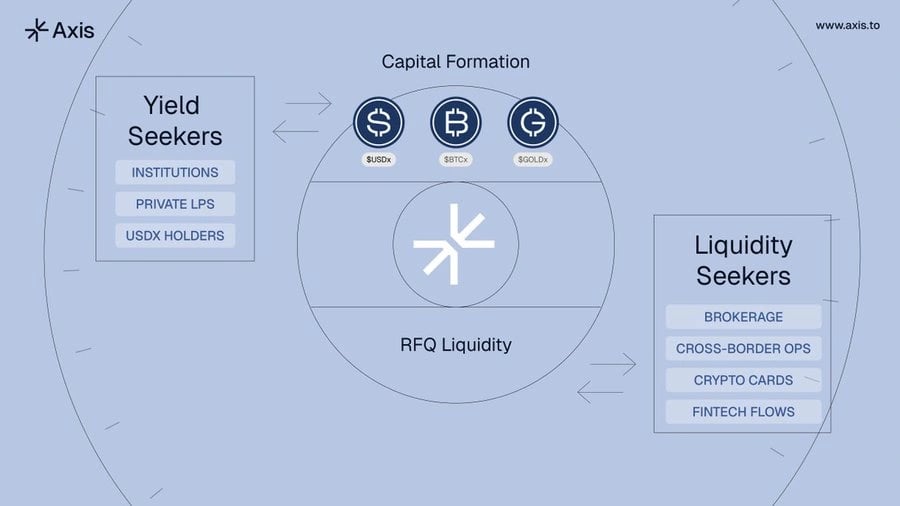
Axis Prime is an institutional liquidity and execution service that provides financial platforms with access to trading across currencies, stablecoins, tokenized assets, and settlement networks. Designed for neobanks, brokerages, remittance providers, payment businesses, and digital asset companies, it combines pricing, multi-venue execution, trade routing, cross-asset settlement, and liquidity management through a single institutional relationship. Its infrastructure evaluates multiple potential trading routes based on pricing, liquidity, execution costs, and settlement requirements to identify efficient conversion paths. Axis Prime supports more than 15 currencies, stablecoins, and settlement rails, and evaluates over 25 million cross-asset pricing paths. The service extends Axis's existing trading and risk-management infrastructure beyond its market-neutral trading strategies, enabling the firm to execute transactions for external financial platforms. Axis has completed its first over-the-counter order for a major centralized cryptocurrency exchange and plans to expand its institutional execution services across additional assets and markets. [4]
Origin Vault
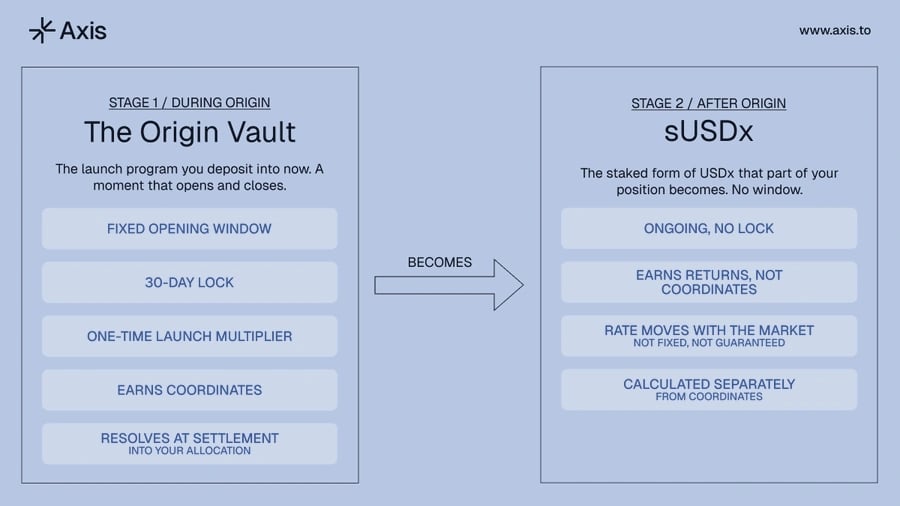
Origin Vault is a pre-deposit vault launched by Axis and hosted on Ethereum through Upshift, designed to expand the supply of USDx and establish its distribution across decentralized finance (DeFi) markets. Season 1 opened on July 29, 2026, accepting USDT and USDC deposits with an initial cap of $100 million and a 30-day lock-up; depositors received tokenized positions called ogUSDx and earned Coordinates reward points. The deposit period closed on August 5, 2026, with $67,248,750 deposited across 1,857 wallets. On September 4, the vault transitioned into the Ecosystem Vault, shifting its focus from attracting initial capital to deploying USDx and sUSDx across DeFi markets, including Curve and Pendle. Holders can retain their vault positions or redeem ogUSDx for USDx; standard redemptions take up to seven days, and instant redemptions are available for about a 0.3% fee. The vault's returns accrue through changes in the value of its positions, while Coordinates incentives are tied to eligible positions and their applicable multipliers. Origin Vault forms part of Axis's broader liquidity strategy, connecting capital formation around USDx with liquidity deployment across decentralized markets and the institutional execution services offered through Axis Prime. [9]
Architecture
Axis's architecture combines onchain smart contracts with off-chain trading, custody, settlement, and risk-management operations. Its three main contract components are USDx, an upgradeable ERC-20 synthetic dollar; USDxMarket, which manages collateral intake, minting, and redemption through signed EIP-712 orders and approved routes; and StakedUSDx, an ERC-4626 vault that issues sUSDx shares and distributes trading rewards. The smart contracts enforce issuance, redemption, staking, reward distribution, and access controls, while collateral is transferred to external custodians and trading venues. Rewards are funded into the vault in USDx and vest over a configured period, increasing the exchange rate between sUSDx and USDx as they become available. Vault withdrawals use an asynchronous redemption process involving a request, cooldown, servicing, and final claim.
The V2 contracts use OpenZeppelin access-control mechanisms and TransparentUpgradeableProxy contracts, with administrative authority separated from upgrade authority. A governance Safe multisignature wallet manages privileged roles and protocol configuration, while a separate TimelockController governs contract upgrades through a required delay. Role-based permissions distinguish operators who execute approved transactions from managers who configure or administer operations within defined limits. Emergency roles can pause or restrict certain functions to reduce risk but cannot independently expand operational permissions or raise capacity limits. Although the contracts separate token issuance, market operations, and rewards distribution, the components remain interdependent through USDx and their privileged roles. Consequently, the system's security and operation depend not only on smart contract controls but also on off-chain trading performance, custody arrangements, counterparty reliability, and operational procedures. [5]
USDx
USDx, also known as the Axis Dollar, is an upgradeable ERC-20 synthetic dollar used to finance positions and settle trades between Axis counterparties. It is overcollateralized and backed by digital and tokenized assets, traditional assets, and futures and hedging positions tied to Axis's market-neutral trading strategies. The token is issued through Axis's primary market contract, USDxMarket, which verifies signed orders, enforces capacity limits, and manages collateral transfers and redemptions. USDx also includes access controls for minting, bridging, emergency pauses, and address restrictions. Unlike a stablecoin, USDx is not guaranteed to maintain a value of one US dollar, as its backing consists of actively managed trading assets and its price may fluctuate. USDx holders do not earn trading rewards directly; instead, realized returns may be distributed through sUSDx, a separate vault token obtained by staking USDx. The system remains exposed to market, liquidity, custody, counterparty, operational, smart contract, and regulatory risks, and its onchain controls do not guarantee the value or availability of off-chain collateral. [3]

sUSDx
sUSDx is the Axis Rewards Vault, a yield-bearing tokenized vault position users receive when they stake USDx. It lets holders receive protocol incentive rewards, funded in USDx and accruing to the vault as the exchange rate between sUSDx and USDx increases. Rewards are generated from Axis's off-chain market-neutral trading strategies, including arbitrage across trading venues and assets, but distributions are discretionary and variable rather than guaranteed or directly tied to reserve yields. Rewards vest linearly over a configured period, allowing the amount of USDx each sUSDx token represents to increase gradually without requiring holders to claim rewards or change their token balances. To withdraw, holders must submit an asynchronous redemption request, which burns their sUSDx shares and initiates a cooldown period currently set to seven days. Once the request has been serviced, holders can claim their USDx, while pending requests may be canceled to restore the shares. Although the vault is designed to maintain over-collateralization and account for outstanding redemption liabilities, sUSDx remains subject to trading, liquidity, custody, counterparty, smart contract, and operational risks, and its rewards are not guaranteed. [8]
Partnerships
- Galaxy
- OKX Ventures
- FalconX
- Tether
- BlackRock
- UPbit
- Ondo
- Velodrome
- LG
- Blackstone
- QCP
- Maple Finance
- TrexQuant
See something wrong?