Olas
Olas (formerly Autonolas) launched in 2021 and was co-founded by David Minarsch and David Galindo.[36][37][38] It is a platform dedicated to the development of autonomous applications for developers and decentralized autonomous organizations (DAOs) by providing a foundation for continuous operation, independent decision-making, and external interaction through its open-source software stack. Its ecosystem combines open-source agent development and on-chain protocol infrastructure with the user-facing Pearl app and the agent-to-agent Olas Marketplace.[1][22][23]
Overview
Olas addresses the essential requirements for autonomous applications within the blockchain context, referred to as off-chain services. The platform offers an open-source software stack and an on-chain protocol, facilitating secure operations and incentivizing autonomous application development. The Olas tech stack comprises four key building blocks, enabling full-stack autonomy and creating opportunities for application growth. Olas aims to include business logic within their software components to be used within the cryptocurrency landscape. Its present-day ecosystem combines open-source agent development and on-chain protocol infrastructure with Pearl, a user-facing desktop agent app, and the Olas Marketplace, where agents can hire one another for services.[2][3][22][23]

History
On February 4, 2025, an Olas core contributor announced a $13.8 million financing round led by 1kx, alongside the Pearl agent-app-store initiative and the Olas Accelerator. The announced financing was raised by the core contributor.[24]
On February 27, 2025, Olas launched the Mech Marketplace, where agents could request specialized services from Mech Agents and developers could register service-providing agents.[25]
On June 30, 2025, Olas refreshed its branding and simplified its messaging to make its co-ownership-of-AI proposition easier to understand. The framing emphasized Pearl for owning agents, the Mech Marketplace for monetizing agent services, and OLAS as the token connecting participation across the ecosystem. This was a branding and messaging update, not a product launch.[29]
On November 4, 2025, Pearl advanced from beta to Pearl v1, a self-custodial desktop agent app supporting multiple agents and accessible account sign-in and funding options.[22]
During 2026, Olas added x402 interoperability, adopted lower staking emissions and Marketplace fees, and deployed protocol contracts to Robinhood Chain after DAO approval.[23][26][27][28]
Technology and Architecture
Olas' software framework, Open Autonomy, forms the basis for constructing agent services, which are off-chain autonomous entities operating as a multi-agent system. These services enhance on-chain functionalities while primarily residing off-chain, allowing for the creation of novel and fully autonomous applications. Open AEA is the older, separately named multi-agent-systems framework described in the Whitepaper; current Olas developer documentation distinguishes Open AEA from Open Autonomy.[1][33][4]
In the Olas agent economy, agents can hire other agents through the Marketplace. The x402 integration lets agents access off-chain services, including APIs, and pay for them with on-chain stablecoins. Requests can be handled off-chain to reduce latency while payments settle on-chain; x402 extends this economy without replacing the existing on-chain protocol.[23][28]
Marketplace Mech Routing
In October 2026, Optimus, Basius, Omenstrat, and Polystrat began obtaining token-price data and language-model responses from Mech agents through the Olas Marketplace rather than paying external services directly. An agent maintains a prepaid balance in a Marketplace balance-tracker contract, signs and sends requests over HTTP, and receives results from a Mech that checks the signature and balance. Completed work is settled on-chain asynchronously in batches after the requesting agent has received its answer. These services are also available to other Marketplace agents.[30]
Multi-Agent Systems Architecture
Olas employs Multi-Agent Systems (MAS) as the cornerstone for building autonomous software services. MAS involves groups of software agents operating in complex, multi-stakeholder scenarios with competing incentives, hereafter referred to as agent services. The Open AEA framework, an older, crypto-friendly MAS framework co-created by an Olas co-founder, is described in the Whitepaper separately from Open Autonomy, the framework used in current developer documentation. This Python-based open-source library enables developers to create agents capable of peer-to-peer communication, direct interaction with blockchains and smart contracts, and implementation of arbitrary business logic through reusable components.[1][33][5]
Consensus for Agent Services
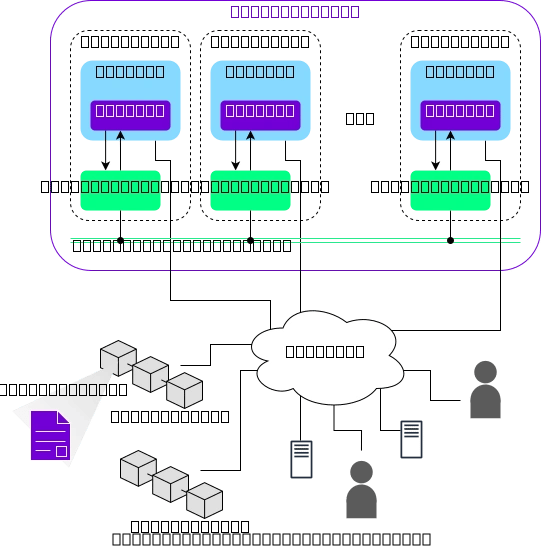
Agent services within the Open Autonomy framework function as multi-stakeholder systems requiring collective agreement on actions or computation outputs. Olas introduces state-minimized consensus gadgets, secure mechanisms facilitating internal consensus among agents without relying on traditional blockchains. The Whitepaper v1.0 describes Tendermint as the initial implementation of a consensus engine, providing secure Byzantine fault-tolerant replication and deterministic finality. The choice of consensus gadgets contributes to the efficiency and trust minimization of agent services, allowing for decentralized fault-tolerant operations. Current developer documentation continues to describe Open Autonomy and FSM/ABCI concepts.[1][33][6]
Architecture of Crypto-Native Agent Services
Olas' off-chain agent services, logically centralized yet replicated across multiple machines, leverage a temporary blockchain created using consensus gadgets. The Whitepaper v1.0 describes this architecture as its initial technical implementation: operators control agents and consensus gadget nodes, interconnected to achieve fault-tolerant replication. Each agent runs an ABCI application instance, defining a finite-state machine replicated on the temporary blockchain. The FSMBehaviour of agents ensures proactive logic, allowing for the composition of services through reusable components and the chaining of ABCI applications. Current developer documentation continues to cover FSM/ABCI concepts and developer workflows.[1][33][7]
On-Chain Protocol to Anchor Autonomous Services
The on-chain protocol serves as the anchor for Olas' autonomous services on the target settlement layer, providing primitives for service creation, operation, and security. The modular design of the protocol, featuring upgradable modules and a core-periphery architecture, ensures extensibility without compromising security. Olas' on-chain protocol supports various roles, including developers creating agent components, service owners controlling services, operators operating agent instances, and users utilizing services. The protocol relies on ERC-721 NFTs to uniquely represent agent components, canonical agents, and services, ensuring immutability and censorship resistance. Additionally, the protocol allows for the chaining of ABCI applications and the integration of service extension contracts, providing flexibility and customization beyond the agent protocol's scope.[7]
Olas Protocol
The Olas Protocol represents a suite of smart contracts designed to lead, secure, and govern software code within the public blockchain. Embracing the Open Autonomy framework as its primary structure for realizing autonomous services, the protocol is adaptable to alternative frameworks.[8]
Deployment and Components
Olas is deployed across multiple networks. In Q3 2026, the DAO approved deployment of protocol contracts to Robinhood Chain, enabling service registration and Marketplace use there.[28] The Olas Protocol enlists three principal components:[8]
- On-Chain Registries: Facilitates the registration of autonomous services, software agents, and agent components as on-chain NFTs. This functionality extends to the assembly of components into agents, agents into autonomous services, and the secure operation of these services.
- Tokenomics: Outlines the economic framework using the OLAS token as a coordination mechanism. This model fosters the pairing of capital and code, attracts escalating value to ensure decentralized services, and rewards developers in tandem with their contributions.
- Governance: Empowers the Olas DAO, a decentralized autonomous organization, to guide and refine the Olas protocol over time.[8]

Mint Packages NFTs
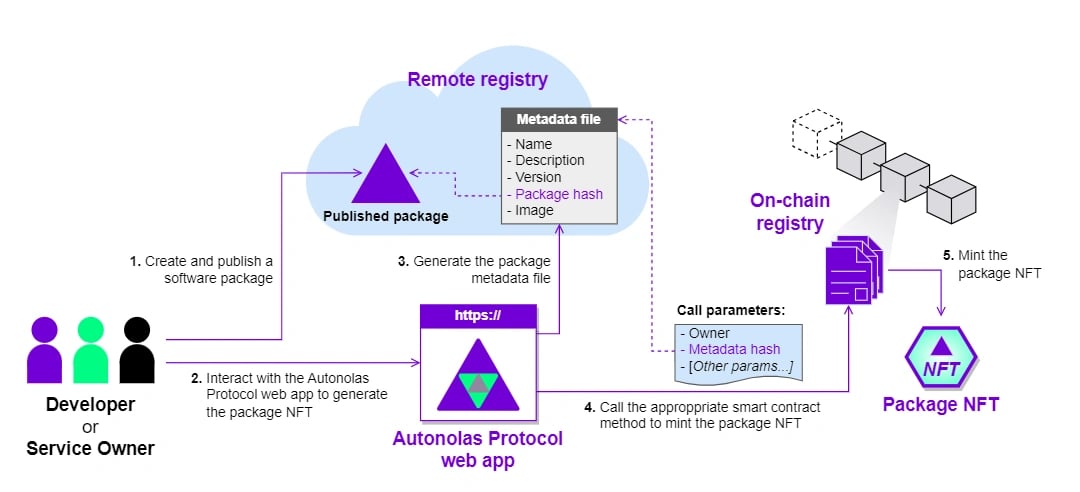
The Olas Protocol provides a web app for minting software packages as NFTs. Users can mint three types: services, agents, and components. The process involves creating a metadata file, publishing it on a remote IPFS registry, and interacting with protocol smart contracts for on-chain minting.[9] Wallet requirements include a wallet address (Metamask or Safe contract), a package hash published on the remote registry, and an NFT image URL for marketplace representation.
- Wallet address (Metamask or Safe contract)
- Package hash published on the remote registry
- NFT image URL for marketplace representation
Managing Service Life Cycles
The Olas Protocol governs the life cycle of services:[10]
- Pre-Registration: Initial stage for minted services.
- Actions: Update or activate registration.
- Active Registration: Awaits agent operators to register instances.
- Actions: Register agents or terminate the service.
- Finished Registration: All agent slots are filled, awaiting deployment.
- Actions: Deploy or terminate the service.
- Deployed: Operational state with deployed service.
- Actions: Terminate the service.
- Terminated Bonded: Service termination; awaits unbonding of registered agents.
- Actions: Unbond.
Products
The Olas ecosystem includes Pearl, a user-facing desktop agent app, and the Olas Marketplace, infrastructure for agents to offer and hire specialized services.[22][25]
Pearl
Pearl is a desktop app available for Windows, macOS, and Linux. Its agents run locally on the user's device and use self-custodial Safe smart wallets. Users can manage multiple agents, set goals in plain language, start and stop agents, and inspect their actions. Sign-in and funding options include Google or Apple account sign-in and credit or debit cards; users can also optionally recover accounts through Google or Apple. Pearl activity rewards are potential rewards. In Q3 2026, Pearl's auto-run feature could sequence agents and was designed to proceed to the next agent when the current agent's staking contract had no rewards remaining.[34][28][22]
In Q3 2026, Pearl Connect extended Marketplace access to coding agents and gave them access to a user-owned Safe smart account, with transaction signing and key encryption handled locally. As of October 1, 2026, Olas reported more than 20.7 million all-time on-chain agent transactions, including more than 14.7 million agent-to-agent transactions.[28]
On October 2, 2026, Pearl introduced a single-transfer funding flow. Users can send ETH or USDC from Ethereum, Base, Optimism, or Arbitrum; POL or USDC from Polygon; xDAI from Gnosis; or ETH from Robinhood Chain, even when the agent runs on another network. Pearl calculates the required amount and destination, then bridges and swaps the deposit into the Pearl Wallet and shows progress and transaction links. The flow replaces the need to manually acquire the right token on the agent’s chain and send separate amounts for agent funds and network fees.[31]
Pearl Mini
Introduced in May 2026, Pearl Mini was a browser-based Polymarket prediction co-pilot that provided AI likelihood estimates while users made trades themselves, unlike Pearl's desktop agents designed to operate autonomously. Users controlled their own keys and funds. A sunset notice followed Chrome Web Store policy changes announced July 1, 2026, with enforcement starting August 1. Pearl Mini was removed from the Chrome Web Store ahead of enforcement, and development there was paused. The change applied to the Chrome extension, not the Pearl desktop app or its autonomous agents. As of October 2026, the extension was discontinued.[35][28]
Pearl Success Agent
By September 2026, the Pearl Success Agent could investigate user issues and send an initial response without waiting for human approval. A scoping agent could draft plans, and coding agents could implement and review changes, including work on Pearl and Valory-built agents. Engineers continued to review scopes and code and approve every release. Between May 1 and September 21, 2026, 47 Pearl users were unblocked through this loop, meaning they received self-service steps or a released fix for a reported bug.[32]
Olas Marketplace
The Olas Marketplace is infrastructure for agents to offer and hire specialized services. Pearl agents can use it to hire other agents, while developers can register agents that provide services.[22][25]
Tokenomics
The Olas Protocol's tokenomics employ the OLAS token for developer incentives and bonding mechanisms. It encompasses staking models and a flywheel to attract donations for sustainable ecosystem development.[11]
In 2026, new staking contracts reduced activity-reward emissions to about 5%, down from earlier rates of 100–138.5% APR. The earlier higher-emission contracts no longer receive new OLAS emissions and remain available until their rewards are exhausted. The Proof-of-Active-Agent approach continues to link activity rewards to verifiable agent activity.[26]
A 15% Marketplace protocol fee applies to agent-to-agent payments across supported EVM chains. OLAS fees are burned on Ethereum, while fees paid in other tokens go to the Olas Treasury. Part of Marketplace and protocol-owned-liquidity fees can fund OLAS buybacks and burns.[27][26]
The reported governance threshold for proposals rose from 5,000 to 250,000 veOLAS, and quorum rose from 3% to 10%.[28]
Supply, Allocation, and Vesting
The Olas token page reports that, as of October 19, 2026, total OLAS supply was 473.70 million and circulating supply was 299.49 million. It separately listed approximately 46.72 million veOLAS, 74.75 million in the DAO Treasury, and 52.74 million associated with Valory. These are dated live figures, not immutable allocation shares.[39]
The original Whitepaper v1.0 capped issuance at 1 billion OLAS during the first ten years and set a maximum annual inflation rate of 2% thereafter, reducible by DAO governance. Its original allocation parameters assigned 32.65% to DAO founding members, 10% to the DAO Treasury, 10% to Valory AG as a development reserve, and 47.35% to ecosystem rewards, including bonding and developer incentives.[1] The tokenomics technical paper described the founding-member allocation as locked and unlocking over four years.[40] These percentages are the original allocation parameters, not the current supply breakdown.
OLAS Token Utilities
veOLAS is used for DAO governance participation and access to service whitelist functions. OLAS can be bonded with liquidity assets to support protocol-owned liquidity. OLAS also coordinates agent economies by linking participation across the ecosystem, while staking allows participation in activity rewards.
Earlier tokenomics documentation described the Tokenomics web app as offering an interface for donating, claiming developer rewards, reviewing bonding programs, and managing bonds. Users can participate in the economic model and contribute to the growth of the Olas ecosystem.[33][11]
Toolkits
These are toolkit and example-service descriptions from earlier Olas documentation. Current developer-docs navigation is organized around Open Autonomy, other agent frameworks, protocol workflows, and Marketplace Mech clients and servers.[33]
SMPKit
SMPKit. The SMPKit is a toolkit designed to construct services that implement investment strategies on liquidity pools. This functionality can be sourced from outputs generated by services like the APY Prediction service or external indicators such as the Crypto Fear & Greed Index. Pool management services utilizing SMPKit execute transactions based on investment strategies, performing actions such as maintaining the optimal investment strategy, refraining due to disproportionate fees, or executing capital swaps between liquidity pools for better positioning.[12]
MLKit
MLKit. The MLKit enables the construction of services with custom machine-learning capabilities. An example is the ML APY Prediction Oracle, which predicts liquidity pool yields using configurable machine learning techniques. This kit includes agents collecting historical data, optimizing, training prediction algorithms, and reaching consensus on forecasting steps. The live demo showcases predictions for Uniswap and SpookySwap.[15]
OracleKit
OracleKit. The OracleKit is designed for services providing data streams onto the blockchain. The Price Oracle, an agent service under OracleKit, estimates Bitcoin prices based on observations from various sources. Agents collectively compute a deterministic function to aggregate observations, reaching a consensus on estimates. The service is secured through a multisig contract, settling estimates on the Polygon chain.[16]
MintKit
MintKit. The MintKit serves as a toolkit for building services with minting capabilities. Notably, the El Collectooorr service, built on the MintKit, autonomously creates NFT collections by minting Art Blocks drops. The MintKit employs intricate logic to determine participation in mints and bid prices. Community-funded collections have unique ERC-20 tokens, enabling collective decision-making on collection management.[13]
MechKit
MechKit. The MechKit enables the creation of AI Mechs, and services on the Gnosis chain, allowing users to post AI task requests on-chain and efficiently receive results. AI Mechs operate with xDAI fees, providing a hassle-free, crypto-native, and infinitely composable solution.[19]
KeeperKit
KeeperKit. KeeperKit is a toolkit for constructing agent services that execute smart contract functionalities in a reliable, trustless, and cost-efficient manner. Operating on off-chain infrastructure, KeeperKit allows for complex computations unrestricted by blockchain storage and free from expensive on-chain transaction fees. This toolkit enables individuals, applications, or DAOs to perform DevOps jobs in a permissionless, secure, and fully automated manner.[20]
GovKit
GovKit. GovKit is a toolkit for building autonomous, AI-powered delegates that vote on on-chain governance proposals across Ethereum and Solana networks. It extends its functionality to off-chain governance proposals on Snapshot for the Ethereum network.[18]
CoordinationKit
CoordinationKit. The CoordinationKit facilitates the creation of services showcasing community contributions through the minting of evolving badges. By monitoring user contributions and updating badges, services built with CoordinationKit use Ceramic streams to automate the tracking and rewarding of contributions, demonstrating versatility for custom impact evaluators.[14]
IEKit
IEKit. The Impact Evaluator Kit (IEKit) is an advanced version of CoordinationKit, that automates tracking and rewarding user contributions using Ceramic streams. Demonstrated through a Twitter mention tracking service, IEKit monitors registrations, and contributions, and updates user badges based on scores. The kit is modular and adaptable for various custom impact evaluators.[17]
MessagingKit
MessagingKit. The MessagingKit serves as a toolkit for building agent-messaging services based on the Open Agent Communication Network.[21]