
Mezo
Mezo is an on-chain financial system and Bitcoin economic layer that integrates lending, trading, liquidity, and governance through smart contracts. It allows users to deposit Bitcoin as collateral to access financial services, such as borrowing a native dollar-pegged stablecoin (MUSD), without relinquishing custody of their assets to a traditional intermediary. The platform is designed to function as a programmable "self-service banking" environment built around Bitcoin. [1]
Overview
Mezo is an on-chain financial platform built around Bitcoin that enables users to access lending, saving, and trading services without relying on traditional financial intermediaries. It allows users to deposit Bitcoin as collateral to borrow a dollar-pegged stablecoin (MUSD), providing liquidity without selling their underlying assets. The platform operates continuously, with users managing their positions directly rather than through institutional processes like credit checks or fixed repayment schedules. Its core functions include collateralized Bitcoin loans with fixed interest rates, yield-generating vaults for Bitcoin and stablecoins, and integrated asset swaps. Transactions are conducted using Bitcoin, and the system is supported by a decentralized Bitcoin bridge (tBTC) that enables cross-chain functionality. Mezo also supports a marketplace for spending stablecoins and provides developers with infrastructure through compatibility with Ethereum-based tools, enabling the creation of additional financial applications. [2]
Features
MUSD
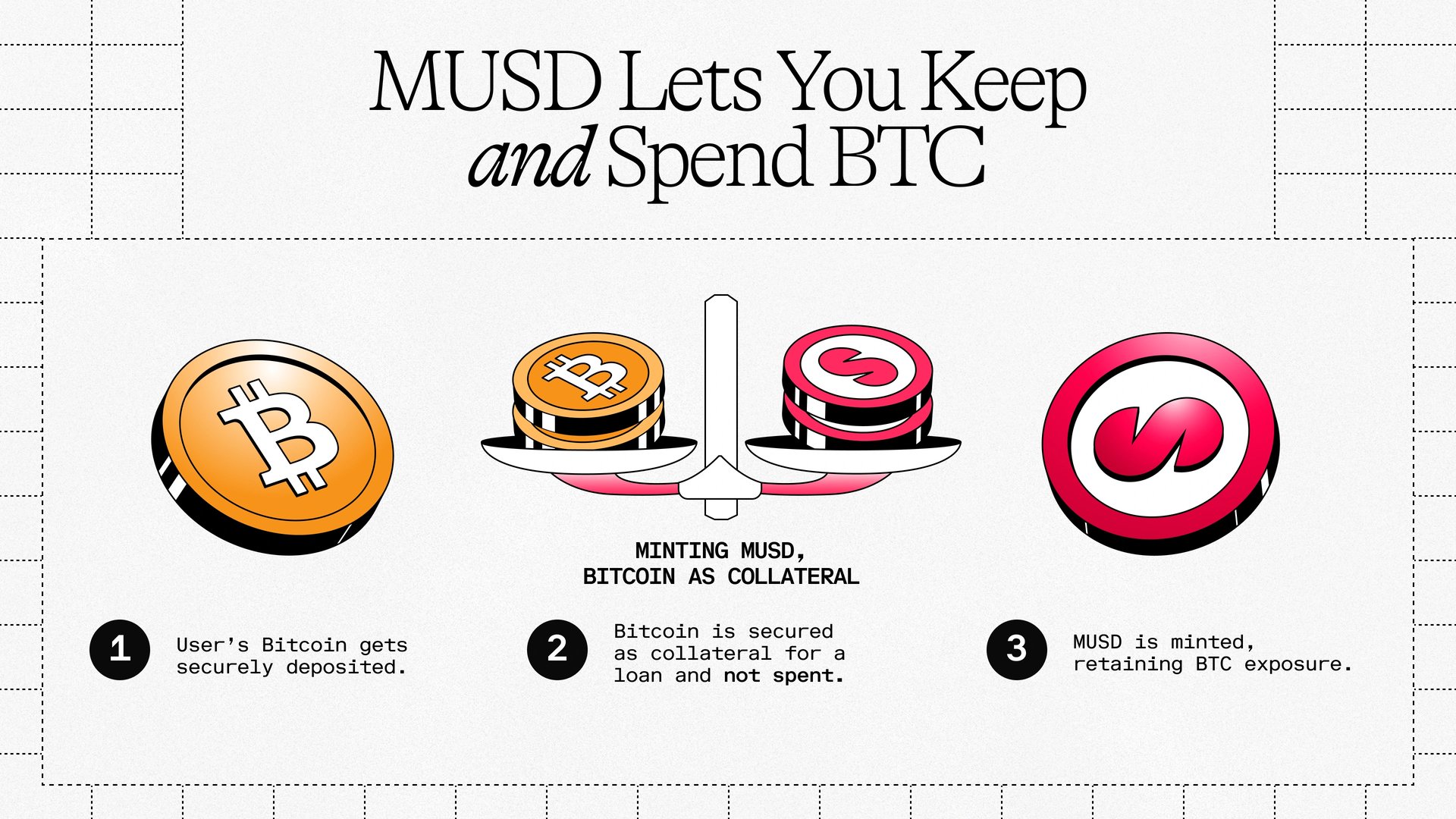
MUSD is a dollar-pegged stablecoin backed entirely by Bitcoin collateral. It is created by depositing Bitcoin into a smart contract, allowing users to access liquidity while retaining ownership of their underlying assets. The stablecoin is designed to maintain a 1:1 value with the U.S. dollar and can be redeemed by repaying the borrowed amount plus interest to unlock the collateral. The system operates on a non-custodial, on-chain basis, where all collateral and loan activity is transparently verifiable. Loans issued in MUSD use fixed interest rates set at the time of borrowing and do not rely on credit assessments or traditional lending requirements. Users can borrow against a portion of their Bitcoin holdings and manage repayment without predefined schedules. [4]
Mezo Earn
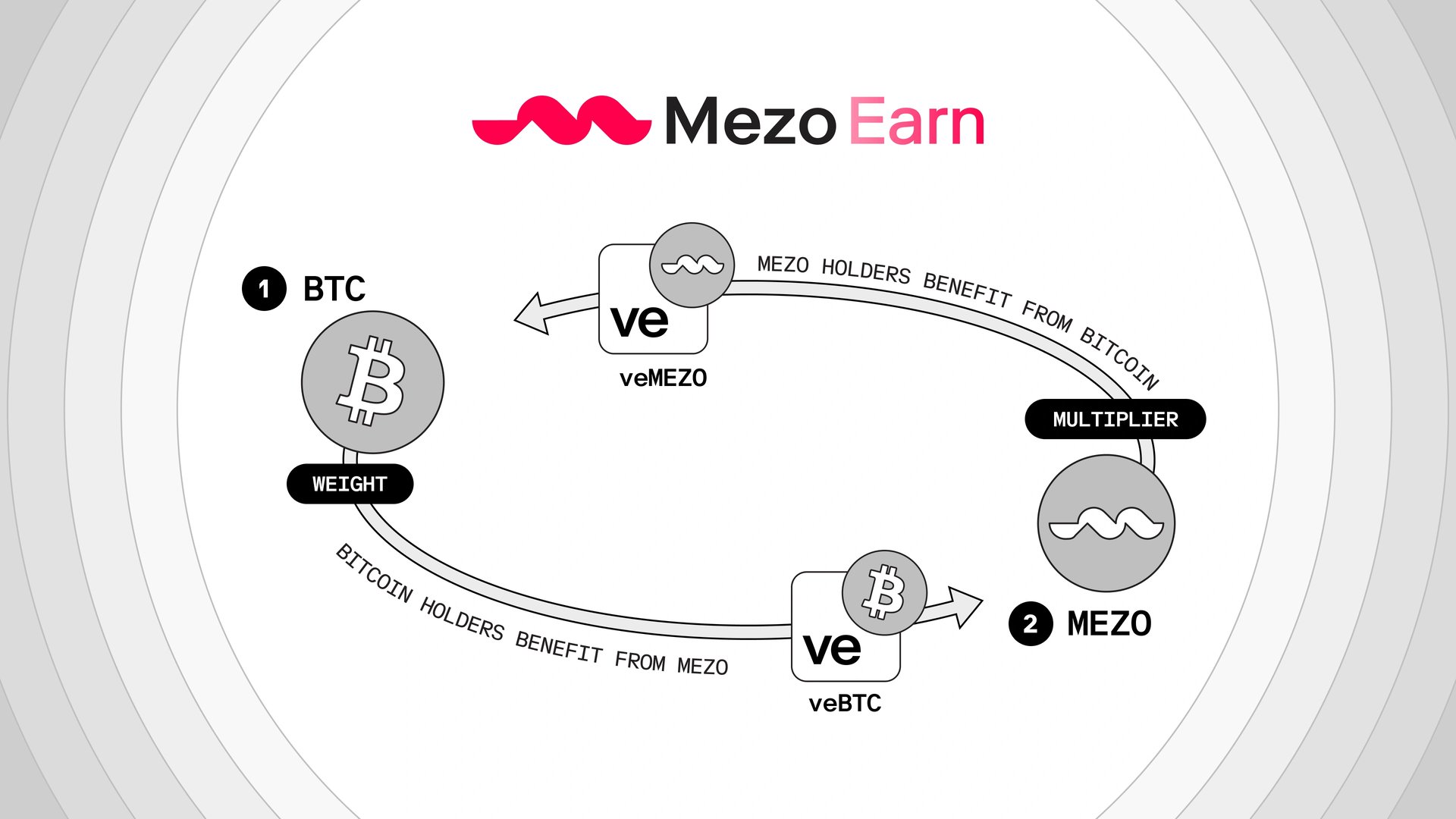
Mezo Earn is a network mechanism that allows Bitcoin holders to lock their assets to earn yield and participate in governance. By committing Bitcoin to the system, users gain voting power that influences how rewards and liquidity are distributed across the platform, while also earning returns from network activity. Yield is derived from three main sources: trading fees from on-platform asset swaps, revenue from loans issued in a Bitcoin-backed stablecoin (MUSD), and transaction and asset-bridging fees. These revenues are distributed to participants based on their level of participation and voting weight.
The system uses a dual-token structure. Locked Bitcoin generates a voting position (veBTC), which provides base governance rights and access to a share of network fees. A secondary token (veMEZO), created by locking a separate asset, can increase the influence of these Bitcoin-based positions but does not provide independent governance power. Voting power determines how rewards are allocated through designated distribution contracts (“gauges”), which direct incentives to different parts of the ecosystem, such as liquidity pools or network validators. Rewards are distributed in recurring time cycles, with participants able to earn passive returns from general network activity or additional returns by actively directing their voting power. [5] [7]
Mezo Pools
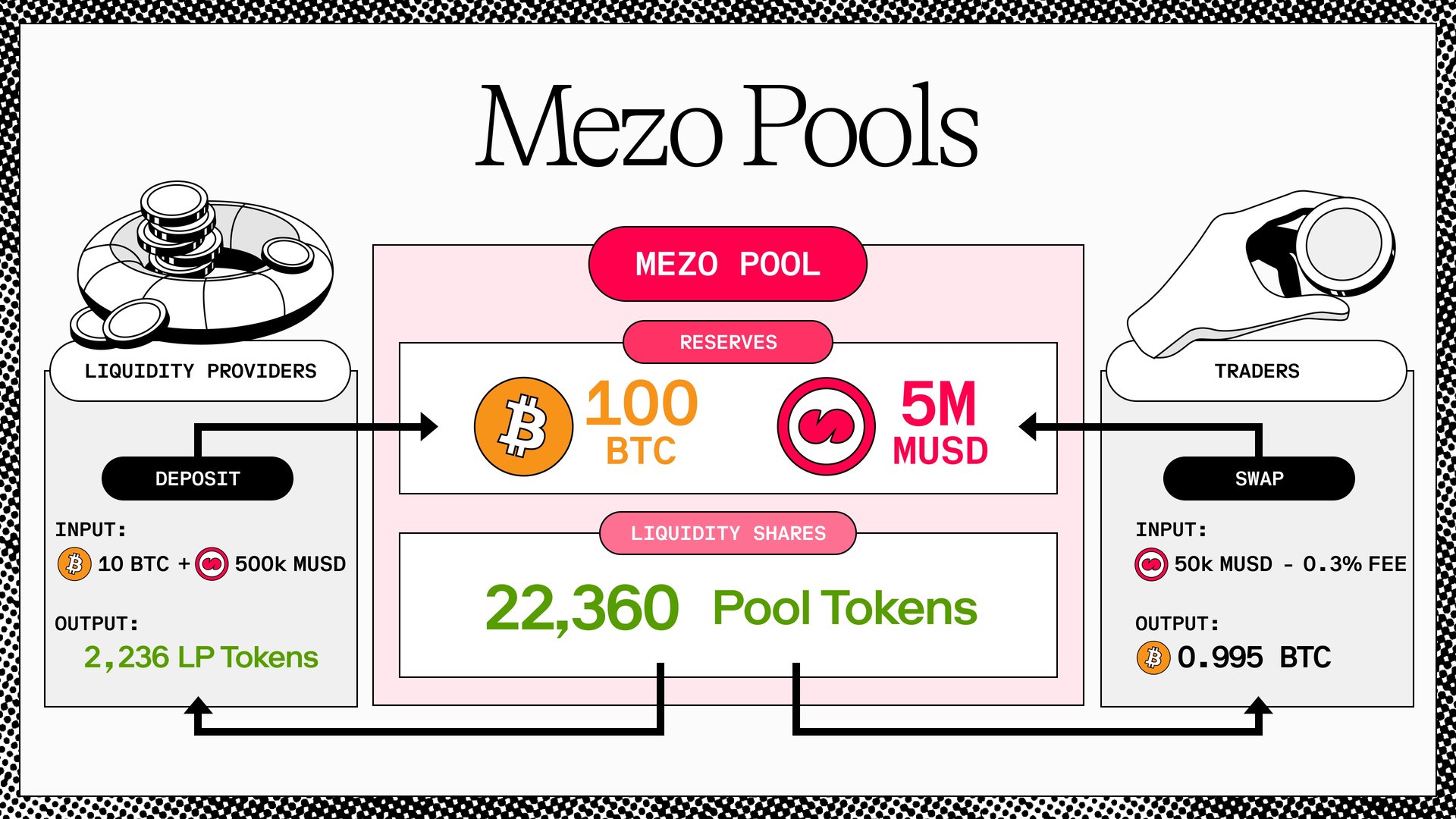
Mezo Pools are on-chain liquidity pools that enable decentralized trading between pairs of tokens without using an order book. Each pool holds reserves of two assets, allowing users to swap directly against the pool’s liquidity. Prices are determined algorithmically based on the pool's asset ratio. Users can supply equal-value amounts of both tokens to become liquidity providers (LPs). In return, they receive LP tokens representing their proportional share of the pool’s assets. These tokens entitle holders to a portion of the trading fees generated by swaps and can be redeemed to withdraw their share of the underlying assets.
The system includes different pool types designed for varying asset relationships: pools for uncorrelated assets, pools optimized for similarly priced assets to reduce slippage, and pools that allow liquidity to be concentrated within specific price ranges for greater capital efficiency. Some pool positions may be represented as NFTs rather than standard tokens. Fees are collected from each trade and distributed to liquidity providers based on their pool share. In addition to facilitating trading, these pools can provide price data and support advanced on-chain functions, forming a core component of the platform’s financial infrastructure. [8] [9]
Mezo Swap
Mezo Swap is a decentralized exchange within the Mezo ecosystem that allows users to trade between supported digital assets directly through smart contracts. Instead of using order books or intermediaries, trades are executed against liquidity pools, enabling continuous and automated asset exchange. The system uses an automated market maker (AMM) model, where prices are determined by the ratio of assets in each pool. Different pricing formulas are applied depending on the asset pair: one for assets with independent price movements and another optimized for similarly valued assets to reduce price impact. Liquidity providers supply assets to these pools and earn a share of the transaction fees generated from trades. Trades incur protocol fees and standard network transaction costs, and execution prices may vary slightly due to slippage, particularly in lower-liquidity or larger transactions. All activity, including trades and fees, is recorded on-chain and can be independently verified. [6]
Mezo Vaults
Mezo Vaults are on-chain investment mechanisms that allocate deposited assets into yield-generating strategies across decentralized finance. When users deposit assets into a vault, they receive a token representing their proportional share, while the underlying funds are actively managed according to a predefined strategy. Each vault follows a structured process: users select a strategy, deposit a supported asset, and receive a receipt token. The vault then deploys these assets to generate returns, which accrue to participants over time. Performance is typically measured by metrics such as total value locked and estimated annual yield, and rewards may be distributed in one or more tokens. Vaults can be managed either internally or by external protocols, with differing strategies and risk profiles. Risks include potential losses from the strategy itself, vulnerabilities in smart contracts, and reliance on third-party management in externally operated vaults. [10]
MEZO
MEZO is the native token of the Mezo network, used to influence how incentives and rewards are distributed within the system. It functions as a supplementary asset to Bitcoin, affecting governance outcomes and the allocation of value generated by network activity. When locked, MEZO is converted into a non-transferable voting-enhancement position (veMEZO), represented as an NFT. This position increases the voting power of Bitcoin-based governance positions (veBTC) but does not provide independent governance rights. The level of influence depends on the amount locked and the duration of the lock, with longer commitments providing greater weight that decreases over time. Holders of locked MEZO may also receive periodic token distributions intended to offset dilution from new issuance. Overall, MEZO serves to amplify governance participation and shape incentive flows rather than act as a primary source of collateral or standalone voting authority. [8] [15]
Tokenomics
MEZO has a total supply of 1B tokens and has the following distribution: [16]
- Community: 40%
- Investors & Partners: 30%
- Mezo Team: 20%
- Foundation: 10%
Governance
Mezo’s governance system is based on locking Bitcoin to obtain voting power, which is used to influence how the protocol distributes rewards and allocates resources. When Bitcoin is locked, users receive a tokenized voting position that allows them to assign their voting weight across different parts of the system, such as liquidity pools or savings mechanisms. The distribution of incentives within the network is determined by the allocation of voting power. Participants earn value from several sources tied to their voting decisions. These include a share of transaction fees generated by the parts of the system they support, as well as additional incentives offered by external participants seeking to attract votes. In addition, all voting participants receive a portion of the general network fees based on their overall voting weight, regardless of their level of active participation.
Voting power is determined by the amount of Bitcoin locked and can be increased through an additional token that amplifies influence but does not function independently in governance. The system operates in recurring time cycles, during which votes determine how rewards are distributed in the following period. Overall, governance combines voting-based control over resource allocation with fee-based rewards tied to participation and influence within the network. [11]
veBTC
veBTC is a tokenized representation of Bitcoin that has been locked in the Mezo network and issued as an NFT. It reflects both the amount of Bitcoin committed and the duration of the lock, and serves as the basis for governance participation and fee distribution. Voting power associated with veBTC depends on the quantity of Bitcoin locked and the length of time it remains locked, with influence decreasing linearly as the lock approaches expiration. Holders receive a share of network-generated fees automatically. At the same time, additional rewards can be earned by actively allocating voting power to specific parts of the system that generate fees or incentives. The system operates in fixed time cycles, during which voting activity determines the distribution of rewards. Locks are aligned to these cycles, and voting must be repeated in each period to qualify for active rewards. [12]
veMEZO
veMEZO is a tokenized representation of MEZO that has been locked within the Mezo network, issued as an NFT. Its primary function is to increase the voting power of Bitcoin-based governance positions (veBTC), rather than provide independent governance rights. The degree of influence it provides depends on the amount locked and the duration of the lock, with its weight decreasing linearly over time until expiration. veMEZO can amplify the voting strength of veBTC positions by a defined multiplier, which affects how rewards and fees are distributed within the system. In addition, holders receive periodic token distributions designed to offset dilution from new issuance, and can earn incentives by allocating their influence to support other participants seeking increased voting power. Unlike veBTC, veMEZO does not entitle holders to direct shares of core network fees. Its role is supplementary, functioning as a mechanism to enhance governance influence and facilitate incentive-driven interactions within the system. [13] [14]