0% read
Last updated:
Quant Network
Quant Network is an interoperability-focused infrastructure and programmable money platform designed to connect businesses and developers to multiple distributed ledger technologies (DLTs) at once. It is positioned as a blockchain-agnostic operating system that links public and permissioned ledgers without altering the fundamental properties of the underlying networks, and is used mainly by regulated financial institutions and other enterprises.[28][2]
Its core stack combines Overledger, an API-based DLT interoperability layer, with Quant Flow for programmable money workflows, QuantNet as a programmable settlement network, and Fusion, a multi-ledger execution environment. Together these components aim to provide infrastructure for tokenised deposits, digital currencies, and other tokenised assets across existing financial systems.[2][35]

Compare Cryptoassets
Select an asset to compare its price and other stats against Quant Network.
Overview
Quant Network was established in 2015 by Gilbert Verdian, with Colin Paterson and Paolo Tasca later joining as co‑founders. The project addresses blockchain interoperability by providing infrastructure that allows systems to connect to multiple DLTs without each integration being built separately.[10]
Quant’s platform is primarily targeted at regulated financial institutions and large enterprises that need to issue, move, and settle tokenised forms of money and securities in compliance with existing regulation. The network is powered by its native cryptocurrency, Quant (QNT), which is used as a utility token for access and licensing. Enterprises and developers can pay for licenses in fiat currency, which is then converted to QNT by Quant’s Treasury for use within the platform.[2][11]
The Quant Network operates through Overledger, a DLT operating system that acts as an API gateway for multiple blockchains. Overledger supports networks such as Bitcoin, Ethereum, Hyperledger Fabric, R3 Corda, and BNB Chain, enabling the creation of multi‑chain decentralized applications (mDApps).[10][11]
In addition to Overledger, the platform includes Quant Flow for programmable money and automated payment workflows, QuantNet as a programmable settlement network for institutional participants, and Fusion, a multi‑ledger rollup that provides a shared execution environment across multiple public and permissioned ledgers. These components are intended to work together to support digital currencies, tokenised deposits, and tokenised securities.[2][35]
The Quant Network operates using its native cryptocurrency, QNT, an ERC-20 token that is blockchain independent. QNT is required for developers and institutions to access Overledger services, with license and usage fees ultimately settled in QNT within the ecosystem.[10][11]

History
Quant was first announced and launched in 2018 by founders Gilbert Verdian, Colin Paterson and Paolo Tasca. Verdian’s background in cybersecurity and work with institutions such as the UK Financial Investments (UKFI) and the US Federal Reserve helped facilitate Quant Network’s early engagement with financial sector stakeholders.[9]
In April 2018, the team conducted a token sale that reached a hard cap of 36.9 million. Quant’s team burned the leftover tokens from the fundraising event, totaling over 9.5 million QNT.[7][8]
On 8 September 2021, a major update to Overledger, version 2.0.5, was released. The update enabled the bridging of multiple leading ecosystems, supporting various stablecoins, DeFi, NFT and ERC-20/ERC-721 assets.[20][21]
On 4 August 2022, Overledger 2.2.12 was released with a new Overledger Tokenise feature, making it easier for users to create, deploy and manage interoperable tokens and digital assets on supported networks.[22]
In 2024, Quant and R3 acted as technology partners in the United Kingdom’s Regulated Liability Network (RLN) experimentation phase, coordinated by UK Finance. Quant contributed orchestration and API capabilities via Overledger to a DLT-based tokenisation platform and orchestration layer designed to support regulated forms of money and tokenised assets across multiple ledgers and existing systems.[28]
In May 2025, the European Central Bank selected Quant as one of nearly 70 “pioneer partners” for the Digital Euro project’s preparation phase. Quant’s role focuses on programmability and conditional payments, including the use of multi‑party lock technology to support offline and peer‑to‑peer payment use cases as part of a broader innovation platform for testing digital euro scenarios.[25]
Later in May 2025, Quant announced Overledger Fusion, described as a “Layer 2.5” network that provides a shared execution environment across multiple public and permissioned ledgers for institutional and decentralized finance use cases. Fusion was introduced as an additional layer working alongside Overledger rather than replacing it and was presented as part of a broader stack that also includes QuantNet, a programmable settlement network through which institutions participate.[31][35]
Utility
With Quant tokens, users of Quant Network can access the services and use cases of the platform. They can only make use of Quant’s blockchain operating system (Overledger) after paying for licensing and platform fees using QNT. Developers, enterprises, partners, or financial institutions can leverage Overledger to build decentralized multi-chain applications (MApps). In return, they must stake a predetermined amount in QNT tokens for MApp solutions to run. [4]
Quant’s ecosystem typically handles user access fees by locking up the token in a smart contract or moving them into the Treasury. When a user buys access to any of the services on Quant Network, QNT is taken out of circulation, locked in a unique smart contract, and released on the subscription’s expiration. Or the cryptocurrencies may just be moved to the Treasury when a user buys a license to create anything on the network. [4]
Infrastructure
The Quant Network utilizes an infrastructure centered on Overledger, which operates as an API gateway that supports multiple distributed ledgers and allows developers to create mDApps. Overledger is complemented by Fusion, a multi‑ledger execution environment, QuantNet, a programmable settlement network for institutional participants, and Quant Flow, which provides programmable money and workflow automation for payments and digital assets. Together, these components are intended to integrate with existing financial systems while enabling interoperable tokenisation and settlement across multiple ledgers.[2][35]
Overledger
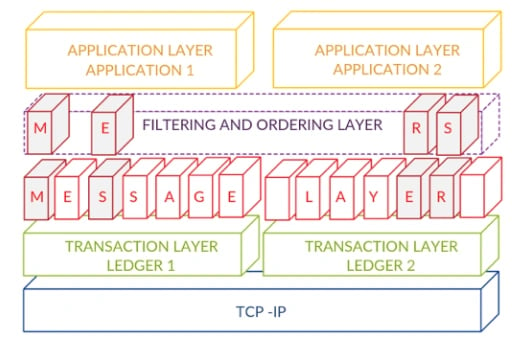
The Overledger is a solution to blockchain interoperability issues. The Overledger protocol architecture consists of four layers that work together to enable communication between multiple blockchains and DLT networks, making it possible for developers to create mDApps that can interact with assets and data across different ledgers.[10][12]
Transaction Layer
This layer is responsible for storing verified transactions using distributed ledger technology. The consolidation of all related activities onto a single layer simplifies the process of reaching consensus across different blockchain domains.[10][12][13]

Messaging Layer
The messaging layer serves as a shared channel where all transactions from multiple ledgers are recorded. The layer collects transaction-related information, including smart contract data and messaging digests, from each ledger in the transaction layer. This makes it possible to combine transactions from all ledgers by wrapping all transaction information.[10][12][13]
Filtering and Ordering Layer
This layer filters and orders messages from the messaging layer that are referred to in the digest of out-of-chain messages. It ensures that the messages comply with the requirements of the application, such as specifying a certain amount of coins to be moved for a transaction to be valid or only allowing transactions from a specific address.[10][12][13]
Application Layer
The application layer is the topmost layer and controls all other layers. It establishes the guidelines and methods for interacting with blockchains, with each multichain application isolated from others in this layer. To use Overledger, mDApps must establish a set of rules for communication with other programs, users, and the Overledger system. Applications can interact with each other through the messaging layer, with messages passing from the filtering and ordering layer to the application layer if they meet the filtering requirements.[10][12][13]
Use Cases
Quant has several use cases focused on enabling interoperable digital assets and programmable money across existing financial infrastructures.[2]
Capital Markets
The blockchain space is ever-changing and developing, with more asset tokenization expected. The Overledger operating system exposes these assets to newer liquidity pools, creating greater exposure to new markets and increased chances of portfolio diversification among investors.[14]
In March 2026, Quant and capital markets technology provider Murex announced a partnership to integrate Quant’s programmable money infrastructure into Murex’s MX.3 platform. The integration is intended to allow banks and capital markets firms to issue, settle, and manage tokenised deposits and digital bonds within existing MX.3 trading, risk, and post‑trade workflows, rather than through separate infrastructures.[36]
Payments
There are zero preferences for any specific blockchain with Quant, which creates a more flexible and secure payment channel for digital and fiat currencies. Transaction fees become cheaper because users do not have to move assets across multiple chains or swap assets to complete transactions.[6][15]
Digital Currencies
Central banks worldwide are exploring the adoption of digital currencies, and more stablecoins may debit in the future. Overledger makes it possible for a genuinely interoperable economy.[16]
Insurance
Go-betweens and intermediaries in the insurance industry make accessing policies challenging, expensive, and time-consuming, limiting the industry’s growth. Quant Network optimizes the superfluous insurance system to make its operations more effective.[17]
Supply Chain and Trade Finance
Trading and supply chains are complex, with several bottlenecks plaguing the system. Associated levels of logistics, payments, and customs are made more efficient with Quant Network.[18]
Compliance
Tracking payments across networks and blockchains can be problematic because the footprints are disruptive and not easily linked. Quant Network makes this information more relatable and trackable for humans and compliance operations.[19]
Quant Token (QNT)
QNT is an ERC-20 standard token on the Ethereum blockchain. Although the team initially built on Ethereum because of its existing support from wallets and exchanges, Quant is blockchain agnostic and can be adapted to other blockchain infrastructures using its own interoperability solutions.[6]
QNT is the native cryptocurrency of the Quant Network and functions as a fixed‑supply utility token used to access applications and services built on Overledger and related infrastructure. It is an ERC-20 token but blockchain independent, which means it can be migrated to other base chains if required. The Swiss Financial Market Supervisory Authority (FINMA) has classified QNT as a utility token intended to provide access to an application or service rather than to represent a financial instrument.[10][12]
Developers and enterprises require QNT tokens for network access and to build on the Overledger platform, although they may purchase licenses using fiat currency, which is then converted to QNT by the Quant Treasury. Additionally, payments for read‑and‑write operations to Overledger must be made in QNT. End-users also need QNT tokens to access mDApps and the Overledger ecosystem, including renewing license keys.[10][12]

QNT Tokenomics
QNT has a fixed maximum supply of 14,612,493 tokens, allocated as follows:
- 9,964,259 — amount sold to the public during the ICO;
- 2,649,493 — company reserve used for research and development, facilities, infrastructure, legal/IP, marketing, and exchanges;
- 1,347,988 — allocation for the company founders;
- 650,753 — allocation for company advisors.[1]
Quant Tokenise
Overledger Tokenise is a premium API offered by the company that enables users to create, deploy, and manage digital assets, including next-generation tokens, on supported networks such as Ethereum, Polygon, and XDC. This API is user-friendly and can be accessed through Quant Connect. The company recently added a new token type called QRC-721, which is a non-fungible token that can be deployed on multiple networks and is ideal for digitalizing collectibles or artwork. Users can interact with their tokens via Quant Connect and mDApps can read data and initiate transactions through the QRC smart contract. This addition to Overledger Tokenise makes it easier for users to create, deploy, and manage secure, interoperable tokens and digital assets on supported networks.[23]
Team
- Gilbert Verdian: Founder and Chief Executive Officer
- Martin Hargreaves: Chief Product Officer
- Lara Verdian: Chief Operating Officer
- Peter Marirosans: Chief Technology Officer
- Andrew Carrier: Chief Marketing Officer
- Helen Kemmit: General Counsel
- Gagik Alaverdian: Chief Operating Officer of Americas
- Dr. Luke Riley: Head of Innovation
- Christopher Harrison: Head of Engineering
- Andy Nelson: Head of Systems and Architecture
[24]
Board of Directors
- Guy Dietrich
- Neil Smit
[24]
Participation in the UK Regulated Liability Network (RLN)
In September 2024, Quant Network took part in the United Kingdom’s Regulated Liability Network (RLN) Experimentation Phase, an initiative coordinated by UK Finance. The RLN initiative examined the technical and operational considerations of a shared infrastructure that could support the issuance, transfer, and settlement of regulated digital assets, including tokenized commercial bank deposits and central bank money (CBDCs).
Quant, in collaboration with the enterprise software firm R3, contributed to the technical development and assessment of the proof‑of‑concept. The experimentation involved over 35 participating organizations from both the private and public sectors, including financial institutions and infrastructure providers. The core focus was on evaluating how a unified ledger architecture might facilitate real‑time transactions involving multiple asset types within a regulated environment.
As part of the experimentation, Quant provided programmability and interoperability capabilities through its Overledger technology, which was used to connect distributed ledger systems and existing financial infrastructures via an orchestration and API layer. The work concentrated on the issuance and lifecycle management of regulated liabilities in a framework aligned with compliance and security standards.[28]
A report issued by UK Finance in September 2024 outlined the outcomes of the initiative. It presented the technical structure tested during the phase and highlighted the collaborative approach adopted by the participants. The document also listed areas for further exploration, such as the role of digital identity, programmability, legal considerations, and the potential integration of central bank digital currencies.
Quant Network’s involvement in this phase formed part of broader efforts by participating entities to explore how digital infrastructures may be designed to meet regulatory requirements while maintaining interoperability across different platforms and systems.[29]
European Central Bank’s Digital Euro Project
On 5 May 2025, the European Central Bank (ECB) confirmed that Quant Network was among a group of approximately 70 organizations selected to participate in the ongoing Digital Euro crypto initiative. The group comprises a range of entities, including financial institutions, payment service providers, fintech firms, merchants, and technology companies. This activity is part of the ECB’s broader effort to explore technical and operational aspects of a potential digital euro under its Preparation Phase.[25]
As part of the project, Quant Network is contributing to the offline payments stream in cooperation with the Banque de France and Giesecke+Devrient. This stream focuses on developing mechanisms that would allow transactions to occur without real‑time network connectivity, with the aim of replicating certain attributes of physical cash, particularly in terms of usability and accessibility in disconnected environments. Key areas under examination include transaction security, data protection, and system reliability.
Quant's involvement centers on embedding its programmability capabilities and designing components of an offline digital payments framework. One area of technical focus includes the use of multi‑party lock arrangements, a method by which digital funds are conditionally reserved and transferred upon confirmation of agreed criteria—such as the completion of a transaction in a peer-to-peer exchange.[25]
The Digital Euro project remains in the assessment phase and is scheduled to continue throughout 2025. Its progress is linked to parallel legislative developments within the European Union. A final decision regarding the issuance of a digital euro will depend on the outcomes of both the technical evaluations and the legislative process.[25]
Overledger Fusion Launch (May 2025)
In May 2025, Quant Network introduced Overledger Fusion, described as a multi‑ledger “Layer 2.5” rollup designed to facilitate interoperability between permissioned and permissionless blockchain systems. The announcement was made by the company's CEO, Gilbert Verdian, through an official social media post on May 14, 2025.[31]
Fusion retains the security model of a rollup but, instead of linking to a single base chain, provides a shared execution environment that connects to multiple ledgers at once, including public blockchains, permissioned enterprise networks, and other distributed ledgers. Within this environment, assets native to different ledgers can be referenced and acted on in the same atomic execution, with outcomes written back to the originating ledgers while preserving each network’s trust and finality properties.[35]
The platform architecture is designed to integrate with financial institutions’ current systems and to enable interaction between ISO 20022-based financial messaging standards and blockchain-based smart contracts. This approach aims to support asset issuance, cross‑chain transaction processing, and programmable payment workflows in a way that aligns with regulatory and operational requirements.[32]
Fusion introduces a Trusted Node Program in which participating institutions use KYC‑verified nodes and can specify jurisdictions and operators for transaction processing, reflecting regulatory expectations around third‑party risk and operational resilience. Its privacy model allows smart contracts to be configured with public, permissioned, or private visibility according to use‑case requirements, rather than adopting a single network‑wide privacy setting.[35]
Fusion is intended to work in conjunction with other components of the Quant stack: Overledger provides the interoperability layer that connects heterogeneous ledgers and enterprise systems; QuantNet functions as the programmable settlement network through which institutions participate; and Fusion serves as the execution environment where multi‑chain assets and contracts run under controlled access. It therefore extends the existing infrastructure rather than replacing Overledger or QuantNet.[35]
See something wrong?