0% read
Last updated:
0G Labs
0G Labs is a technology company developing a decentralized Layer 1 blockchain and modular infrastructure designed to support artificial intelligence (AI) and Web3 applications. It was founded in 2023 by co-founders Michael Heinrich, Ming Wu, Fan Long, and Thomas Yao.[14][15] The project aims to provide scalable and cost-efficient resources to address challenges related to data storage, computational power, and latency when integrating AI with blockchain technology.[1]
Overview
0G Labs develops a decentralized Layer 1 blockchain designed to support artificial intelligence applications. The project addresses challenges in combining AI and blockchain, including the high costs of storing large datasets, the significant computing power required for training and inference, and the need for low-latency systems for real-time use. In September 2025, 0G’s Aristotle Mainnet and $0G token generation event went live, moving the protocol into full production for AI-native applications.[10][11]
Its infrastructure includes four independent services: 0G Chain (a modular blockchain for AI-related transactions), 0G Storage (decentralized storage for large models and datasets), 0G Compute (resources for AI model training and execution), and 0G Data Availability (ensuring reliable access to data). These components can operate together or independently, and integrate with both EVM-based and non-EVM blockchains. By 2026, the 0G network reported processing over 250 million transactions and serving more than 20 million accounts, with a partner ecosystem exceeding 350 organizations, according to its public documentation dashboard.[21]
0G’s modular approach is intended to make AI workloads more accessible across decentralized environments, with potential applications in areas such as AI agents, decentralized knowledge tools, finance, healthcare, and large-scale machine learning.[2]
History
The idea for 0G emerged from discussions between Stanford classmates Michael Heinrich and Thomas Yao about how to overcome infrastructure bottlenecks holding back Web3, particularly data availability and scalability for AI-driven applications.[16] They later brought in Ming Wu and Fan Long as co-founders, forming a team focused on building a modular AI-focused blockchain and data availability layer. 0G Labs was founded in 2023 in San Francisco to address data availability and infrastructure constraints for on-chain AI workloads.[14][15]
In March 2024, the company publicly introduced the 0G protocol and announced a US$35 million pre-seed funding round to build a modular AI blockchain and supporting infrastructure.[15] Early technical milestones included the Newton (V2) testnet and subsequent iterations of the protocol’s storage, compute, and data availability components, aimed at scaling AI workloads on-chain.[17]
In May 2025, 0G launched the Galileo (V3) testnet as the next major evolution after Newton, designed to support larger-scale AI applications and ecosystem experimentation.[17] By mid-2025, the Galileo testnet had processed more than 92 million transactions alongside growing developer adoption, reflecting an expansion of activity beyond the earlier Newton phase.[17] Community initiatives on Galileo included AIverse, a marketplace for minting and trading intelligent NFTs (iNFTs) that package AI agents as on-chain assets, providing an early venue for developers and users to test intelligent NFT concepts on the network.[18]
Technology
0G Chain
0G Chain is a modular, EVM-compatible Layer 1 blockchain designed as the execution and settlement layer for AI-related transactions. It is engineered to address the high costs and low throughput of general-purpose blockchains. The chain's architecture separates the Execution Layer, which handles smart contract processing, from the Consensus Layer, which manages validator coordination and network security. This separation enables independent upgrades, allowing the execution layer to adopt new EVM features without altering the core consensus mechanism.
The network operates on a Proof-of-Stake (PoS) model and utilizes a highly optimized version of the CometBFT (formerly Tendermint) for its consensus mechanism. This configuration allows the chain to support over 2,500 transactions per second (TPS) with sub-second finality. Validators stake the native 0G token to secure the network and are compensated through block rewards, transaction fees, and staking yields. To ensure fairness and prevent collusion, the system employs a Verifiable Random Function (VRF) for validator selection. The project's roadmap includes a future transition to a DAG-based consensus model, which will enable parallel transaction processing and further enhance scalability.[4] Galileo serves as the current public testnet for 0G Chain, using Chain ID 16602 with public RPC endpoints offered by infrastructure providers such as QuickNode, ThirdWeb, Ankr, and NodeCloud.[22]
0G Storage
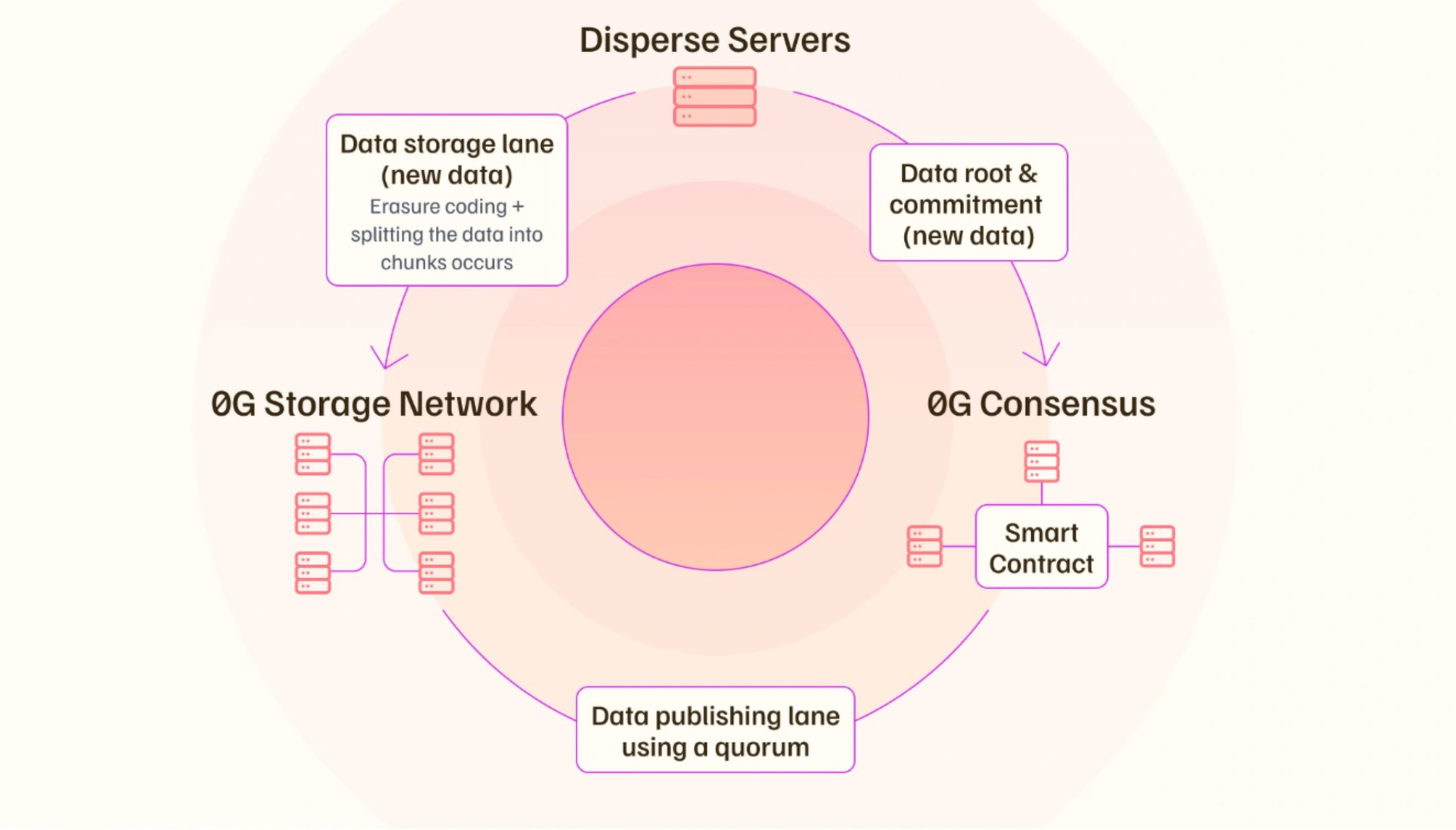
0G Storage is a decentralized storage system designed for large-scale AI datasets and models, offering high-speed data retrieval. It aims to provide a cost-effective alternative to both centralized cloud storage and slower decentralized options. The architecture is divided into two distinct lanes: a Publishing Lane that manages metadata and availability proofs on the consensus network, a Storage Lane that handles the actual data using erasure coding, replication for redundancy, and fault tolerance.
The system offers two storage tiers to accommodate different use cases. An Immutable Log Layer is designed for archival data and large AI training sets, while a Key-Value Layer supports dynamic data required by real-time applications. The network's consensus mechanism is known as Proof of Random Access (PoRA), where storage nodes must prove they can retrieve stored data segments quickly to earn rewards. This mechanism incentivizes both storage and rapid accessibility.[9]
0G Compute Network
The 0G Compute Network is a decentralized marketplace that connects developers requiring AI computing power with GPU providers. It operates as a decentralized marketplace connecting developers with independent GPU providers, with the aim of reducing the high costs, vendor lock-in, and complex setup associated with traditional cloud providers. The network operates on a pay-per-use model, allowing users to access on-demand GPU power for tasks such as model inference and training without incurring fixed commitments.
Transactions on the network are managed through smart contracts that hold payments in escrow, releasing funds only after service delivery is confirmed. To minimize transaction costs, the system employs compressed zero-knowledge proofs (ZK-proofs) for settlement. It also supports verifiable computation proofs, allowing users to confirm the results of their AI workloads without the provider retaining any user data. The network is accessible to developers through direct blockchain connections as well as traditional REST APIs and SDKs. It features built-in redundancy with automatic failover to other providers in its global network.[5]
0G Data Availability (DA)
0G DA is a data availability layer designed to ensure that blockchain data remains accessible, verifiable, and secure while scaling to meet the demands of AI and decentralized applications. Traditional DA systems face limitations, including bottlenecks caused by slow nodes, reliance on external storage, and weaker security mechanisms compared to Ethereum. 0G DA integrates built-in storage, a horizontally scalable consensus model, and inherits Ethereum’s economic security through shared staking, and is designed to provide robust and scalable data availability. Its architecture separates storage, availability, and consensus, enabling each to be optimized independently, while redundancy and cryptographic proofs are used to guarantee data integrity.
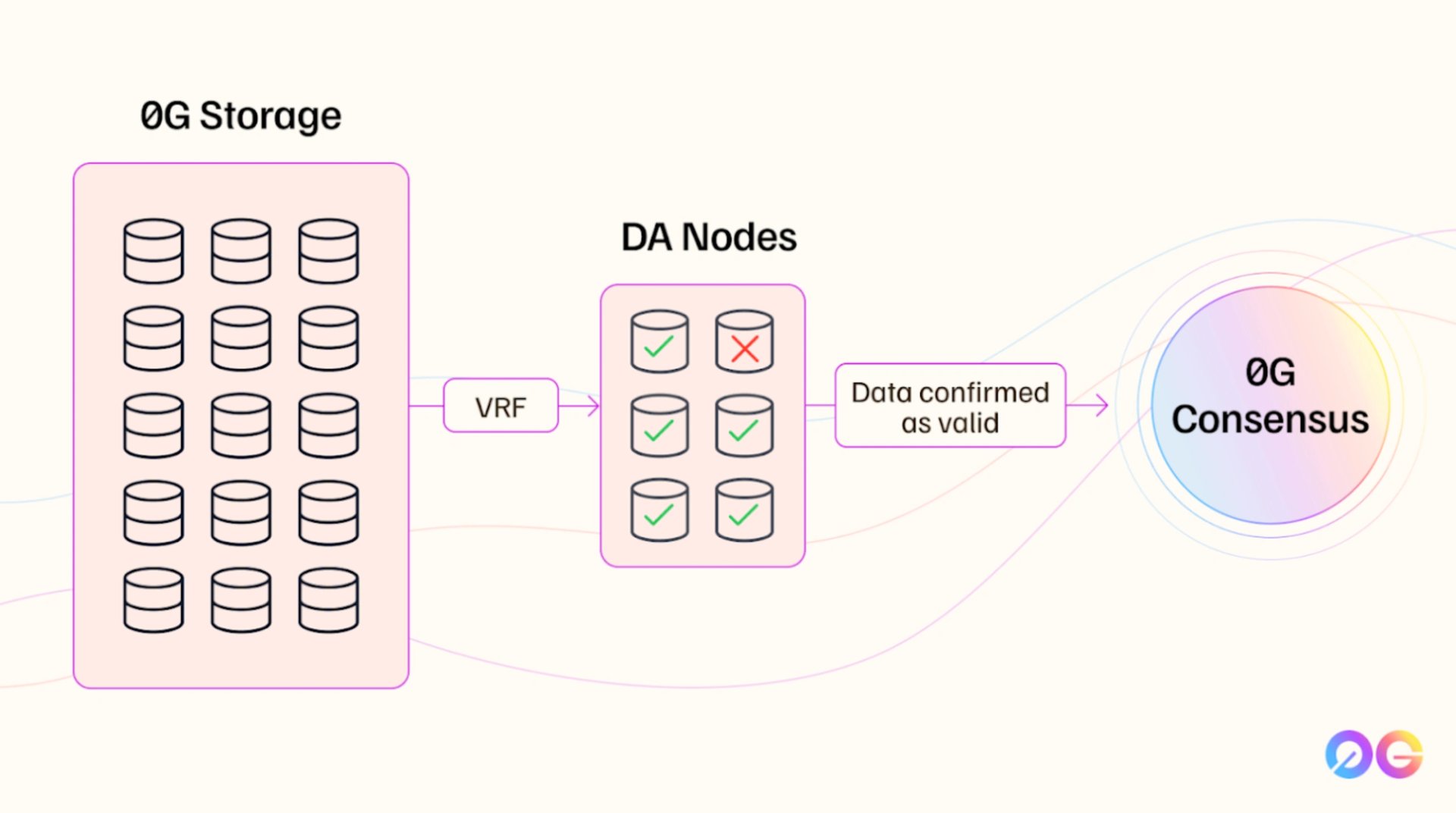
The system uses erasure coding to split and distribute data across nodes, with availability confirmed through randomly selected DA nodes using verifiable random functions. These nodes validate data in small quorums and submit availability proofs, which are finalized by validators in the 0G consensus network. This sample-based verification process significantly reduces overhead while maintaining strong guarantees of security and availability. With demonstrated throughput of 50 Gbps in testing, parallel data processing, and scalability through expandable consensus networks, 0G DA is intended to serve as an infrastructure layer for workloads such as training large language models and managing AI agents in decentralized AI environments.[6]
AI Alignment Nodes
AI Alignment Nodes are specialized participants in the 0G ecosystem designed to oversee the safe and reliable functioning of decentralized AI systems. They address key challenges associated with centralized AI—such as lack of transparency, limited accountability, and potential misalignment—by providing distributed monitoring and oversight. Their role includes tracking model drift, verifying AI outputs, monitoring performance, and flagging anomalies to ensure that AI behavior remains consistent with intended objectives and community standards.
Beyond AI monitoring, these nodes contribute to network integrity by detecting protocol violations, reporting malicious activity, and supporting governance processes with data-driven insights. They represent a scalable framework for decentralized AI safety, combining automated monitoring with distributed governance to help provide transparency and accountability. By embedding ethical oversight directly into the network, AI Alignment Nodes are intended to offer ongoing monitoring, reporting, and input into governance processes to support risk management and responsible AI deployment within the ecosystem.[7]
Intelligent NFTs (INFT)
INFTs are a token standard designed to encapsulate an entire AI agent, including its models and data, within a single token. This contrasts with traditional NFTs, which typically only link to off-chain metadata. Built on ERC-7857, an extension of the ERC-721 standard, INFTs enable true ownership of a functional AI. When an INFT is transferred, the complete, encrypted AI agent is securely moved to the new owner.
This standard prioritizes privacy by using encrypted metadata storage and secure re-encryption for ownership transfers, protecting proprietary models and sensitive data. The persistence of the AI agent is ensured by leveraging 0G's decentralized storage system. Potential use cases for INFTs include AI-powered trading bots, personalized AI assistants, intelligent game characters, and specialized research tools.[8]
0G Token
The native token of the 0G ecosystem is 0G. The total supply is fixed at 1 billion tokens. The allocation is structured to support long-term development and community growth.
The distribution of the 1 billion 0G tokens is as follows:[3]
- Community & Ecosystem Growth (56%):
- Ecosystem: 28%
- AI Alignment Node: 15%
- Community Rewards: 13%
- Core Team & Early Backers (44%):
- 0G Team, Contributors & Advisors: 22%
- Backers: 22%
The $0G token generation event (TGE) took place on 18 September 2025. At TGE, 21.32% of the total token supply unlocked from community allocations, specifically the AI Alignment Node, Ecosystem Growth, and Community Rewards categories. Team and backer allocations are subject to a 12‑month lock-up after TGE, followed by 36 months of linear vesting, so that these allocations fully unlock 48 months after the TGE.[12][13]
On the 0G Mainnet, the 0G token functions as the native gas token used to pay for transactions and smart-contract execution.[19][20] Validators and delegators stake 0G to help secure the network and earn protocol rewards, and the token can be used to pay for services such as storage and compute within the 0G ecosystem.[2] As protocol-level governance mechanisms are introduced, 0G is also intended to serve as a means for token holders and community participants to take part in decision-making about the network’s evolution.[14]
Governance
0G Labs acts as the core development company for the 0G protocol, serving as a primary contributor responsible for building and maintaining the underlying infrastructure and core software components.[14] The company focuses on protocol engineering, performance optimization, and the integration of compute, storage, and data availability services into a modular decentralized AI layer.[16]
The 0G Foundation is a separate, independent entity dedicated to advancing decentralized AI as a public good and guiding the network’s long-term decentralization.[14] Its responsibilities include administering ecosystem grants, coordinating node and token programs, and supporting initiatives that broaden participation in the protocol. As part of these ecosystem programs, the Foundation announced an $88.88 million ecosystem growth fund in early 2025 to support decentralized AI applications and AI-native DeFi projects.[10] Over time, governance of the 0G protocol is expected to evolve toward greater token-holder and community participation, with the Foundation aiming to facilitate mechanisms through which stakeholders can help shape network parameters, resource allocation, and decentralization policies, without predetermining specific governance outcomes.[14]
Funding
0G Labs has completed multiple funding rounds to support the development of its decentralized AI infrastructure. In November 2024, the company announced $290 million in new funding, consisting of a $40 million seed round raised by 0G Labs and a $250 million token purchase commitment secured by the 0G Foundation, the governance body for the protocol. The funding involved a range of investors, including Hack VC, Delphi Digital, OKX Ventures, Samsung Next, Bankless Ventures, Animoca Brands and co-founder Yat Siu, Polygon and co-founder Sandeep Nailwal, Stanford Blockchain Fund, Abstract VC, Alchemy, Blockdaemon, and Foresight Ventures. The token commitment is structured to become accessible once the 0G token is launched and traded on exchanges.[13]
In January 2025, the 0G Foundation conducted a large-scale public and private node sale, raising $30.6 million. The sale involved around 85,000 nodes purchased by up to 8,500 participants. The process was supported by launchpads such as Second Lane, SwissBorg, and CoinList, and was extended over six weeks to meet demand. Subsequent to the initial seed round, 0G Labs raised additional equity capital, and the 0G Foundation conducted further AI node and token subscription sales, bringing total funding commitments for the ecosystem to more than $350 million, including at least $35 million from node and subscription sales.[10][11]
Partnerships
By the launch of the Aristotle Mainnet in September 2025, 0G announced more than 100 launch partners across the decentralized AI stack, including validators, wallets, custodians, DeFi protocols, bridges, RPC and indexing providers, oracles, and developer tooling platforms. This ecosystem featured major providers such as Chainlink for oracle services and cross-chain interoperability (CCIP), as well as Google Cloud for compute and AI integration, with production-ready integrations across core infrastructure layers.[10]
Within this broader ecosystem, 0G has highlighted partnerships with decentralized compute and AI infrastructure projects such as io.net, Aethir, ai16z, Virtuals, Netmind AI, and Ankr, as well as cross-chain and Layer 2 networks like Manta Network, Arbitrum, Polygon, IoTeX, and Movement Labs. The project also collaborates with data, infrastructure, and ecosystem partners including OpenLedger, Alchemy, Galxe, Bitget, Euclid, Fog Works, Hemera, OKX, and Phala Network.
See something wrong?