Balancer
Balancer is an open-source automated market maker and liquidity protocol for trading tokens and providing liquidity. Founded in 2018 by Fernando Martinelli, Nikolai Mushegian, and Mike McDonald, it is distinguished by customizable weighted pools that can hold multiple tokens in independently specified proportions. Liquidity providers may earn trading fees when traders swap tokens in their pools.[36][1][2][10]
Balancer Labs ceased operations in March 2026, while the Balancer protocol remained in a DAO-approved, ongoing wind-down as of October 27, 2026.[32][56] Under BIP-928, applicable pools were scheduled to move to withdrawals-only on October 30, 2026, and the final V3 Vault pause was scheduled for November 30, 2026.[56]
Overview
Balancer is a protocol for multi-token pools founded in 2018 by Fernando Martinelli, Nikolai Mushegian, and Mike McDonald. Pantera Capital’s account says Mushegian and McDonald joined Martinelli to actualize the idea.[36] The name was derived from the platform's self-rebalancing liquidity pools. It enables portfolio owners to create Balancer Pools, and traders to trade against them. Balancer Pools contain two or more tokens, each with an independent weight representing its proportion of the total pool value. The pools provide the Balancer Protocol with liquidity and charge traders a fee for access to it. Pools can be considered automated market-makers, since anyone can swap any two tokens, in any pool. Balancer V2 is live on Ethereum, Polygon, Arbitrum, and specific testnets.[10][15]
History
Balancer announced its Arbitrum deployment on August 31, 2021, enabling users to trade through the Balancer app on the Arbitrum Layer 2 network.[37]
In June 2022, Balancer launched on Layer 2 rollup network Optimism in collaboration with Beethoven X. The expansion offered additional scaling, smart-wallet EOAs with no “approves” and gas payments in any token, and decentralization of transaction sequencing.[16]
Balancer Labs Shutdown and Protocol Wind-down
Balancer Labs’ shutdown was announced in March 2026 following financial pressure after the November 2025 exploit.[32]
BIP-928, the DAO-approved orderly wind-down plan, passed on September 29, 2026. Under its schedule, applicable pools were set to transition to withdrawals-only on October 30, 2026, while partner-requested V3 pools could remain live until November 30, 2026. Withdrawals from non-custodial pool contracts do not depend on Balancer continuing to operate.[56][33]
BIP-936 is a separate on-chain execution specification. It sets out proposed actions including disabling official V2 and V3 pool factories where supported; setting protocol fee defaults to zero on October 30, 2026; pausing eligible pools and enabling recovery mode on that date, excluding partner-extended pools; and, on November 30, 2026, pausing partner pools, the V3 Vault and buffers, and setting V3 global fees to zero. The specification applies governance actions to Ethereum, with analogous actions on other chains to be performed by the core team via multisigs.[42]
The Snapshot record retrieved for October 27, 2026 listed BIP-936 as active and scheduled to end at 18:00 UTC that day.[54][41]
Automated Market-Maker Protocol
Balancer serves as an automated market maker (AMM). Its liquidity pools can contain several assets rather than just two, as is standard for many AMMs. Pools can be programmed via smart contracts, enabling custom rules and strategies.[4][5]
Liquidity Pools and Rebalancing
Users can create or contribute to liquidity pools, which consist of weighted assets and a trading fee set by the creator. This allows anyone to own a self-balancing index fund or invest in someone else’s and earn fees as other users trade against the portfolio. Smart Order Routing (SOR) routes trades across pools.[4]
The creator of the liquidity pool defines each asset’s percentage weight as a pool parameter. During a swap, balances change while weights remain fixed; the pool’s formula-derived price changes with those balances.[38]
If a pool’s price drifts from external market prices, arbitrage can bring the prices closer together. No external price oracle updates the pool price in the absence of transactions.[38][5]
The described core-pool implementation supports up to eight tokens with custom percentage-weight distributions; this limit does not describe every Balancer pool type.[15] For example, a pool could be 30% BAT, 30% DAI, 30% USDC, and 10% LINK, while another pool is 80% WETH and 20% ZRX.
Pool Types
- Weighted Pools use custom token weights and weighted math, including for assets without a fixed price correlation.[43]
- Composable Stable Pools use Stable Math for assets expected to trade near parity or at a known exchange rate. Their Balancer Pool Token (BPT) can be traded or nested in other pools.[44]
- Boosted Pools place some or all pool liquidity in yield-bearing tokens and use buffers and batch routing to preserve swap access to base assets.[45]
- Linear Pools exchange an asset and its wrapped yield-bearing counterpart around a target range.[46]
- Liquidity Bootstrapping Pools (LBPs) use time-varying weights selected by the pool owner, who can pause swaps.[47]
- Managed Pools let owners change weights, manage tokens, set fees and allowlists, and pause swaps.[48]
- Protocol Pools refers to custom AMMs built on the Vault rather than a single pool contract type.[49]
Introduced on July 6, 2023, the 8020 initiative described a two-asset pool with 80% of one asset and 20% of another. It proposed using the pool’s BPT as a governance token, pairing a protocol’s native token with its chain’s base token or a liquid stablecoin. Its authors described claimed benefits including liquidity depth, asymmetric upside, reduced impermanent loss, incentives, and hedging or price appreciation.[17][18]
Balancer’s May 2023 post claimed its technology had helped facilitate 20-fold growth in $rETH liquidity on Ethereum in less than a year.[19]
Composable Stable pools use rate providers that query the blockchain and update the token ratio to account for yield accrual. Without rate-provider technology, two assets can trade at 1:1, allowing appreciation from staking yield to accrue to arbitrage traders.[20]
Introduced on April 26, 2023, Boosted Pools combine a liquidity-pool position with a single-sided yield market. They redirect idle liquidity into external yield-generating protocols. Balancer’s announcement described the design as combining a liquidity pool with Aave V3 integration.[20][21]
An example is Balancer Boosted Aave V3 USD on Ethereum, a Tri-Stable Boosted USDC/USDT/DAI pool described as providing swap paths across USD tokens.[21]
Technology and Architecture
In February 2021, the Balancer team announced Balancer V2, describing its design goals as security, flexibility, capital efficiency, and gas efficiency. The announcement described a protocol Vault for pool assets, customizable AMM logic, asset managers, oracle designs, and community-governed protocol fees.[4]
Balancer V3 retains the Vault model but shifts more pool requirements and design patterns into the Vault. Its transient accounting tracks token credits and debts during a Vault operation and requires settlement before the operation closes. V3 formalizes hooks as standalone contracts that add logic at pool lifecycle points, including swaps and liquidity operations.[59][60][61]
Security Reviews
Balancer’s V2 security documentation lists external audits by OpenZeppelin, Trail of Bits, Certora, and ABDK from March 2021 through October 2022, with dated reports covering specified contracts including the Vault, weighted and stable pools, MultiRewards, linear and stable phantom pools, Timelock Authorizer, Batch Relayer, Composable Stable Pool, and Managed Pool. These audits cover their documented reports and code scopes, not every protocol version.[51]
The V3 audit repository records dated reviews by Certora, Trail of Bits, Spearbit, and Cantina beginning in September 2024, with reports covering the Vault, pools, hooks, oracles, router, and Gyroscope pools, including a Certora comprehensive assessment dated January 26, 2026. The repository notes that some contracts changed after review and that audits do not guarantee correctness.[52]
Protocol Vault
The main architectural change between Balancer V1 and Balancer V2 is the transition to a single vault that holds and manages all the assets added by all Balancer pools. Balancer V2 separates the Automated Market Maker (AMM) logic from the token management and accounting. Token management/accounting is done by the vault while the AMM logic is individual to each pool. Because pools are contracts external to the vault, they can implement any arbitrary, customized AMM logic.[4]
Gas Efficiency
In Balancer V1, trading with two or more pools is gas inefficient because users have to send and receive ERC20 tokens from all pools. With Balancer's new Protocol Vault, even though trades are carried out in batches against multiple pools, only the final net token amounts are transferred from and to the vault, saving gas. Since only final net amounts are transferred, arbitrage trades are also easier. An arber who has no tokens but detects a price asymmetry between Balancer pools could trade DAI for MKR in pool 1, MKR for BAL in pool 2 then BAL for DAI in pool 3 and end up making a profit in DAI.[4]
Balancer V2 allows users to hold internal token balances. For example, if a user trades token A for token B but knows that they will trade back B for A in a few hours, then they probably don’t need to take delivery of B after the first trade. Balancer can keep both tokens in the vault which may be used for the next trades, avoiding any ERC20 transactions altogether.[4]
Customizable AMM Logic
Balancer V2 supports customizable AMM logic, allowing teams to develop different AMM strategies without handling low-level token transfers, balance accounting, security checks, and smart order routing. At launch, Balancer V2 offered weighted pools (constant-weight, index-fund-style pools like those in Balancer V1) and stable pools for tokens that are soft-pegged to each other, building on work by the Curve Finance team. The announcement anticipated smart pools that would allow ongoing parameter changes and other pool types built by partners. All pools provide trading liquidity through the smart order router.[4]
Balancer’s infrastructure has also been used by developers building on the protocol. For example, Gyroscope built an E-CLP concentrated-liquidity model using Balancer technology; Balancer reported that the pool facilitated $4,100,262 in concentrated swaps in its first two weeks.[22]
Balancer V2 Asset Manager
In Balancer V2, asset managers are external smart contracts nominated by pools that have full power over the underlying tokens the pool has deposited in the vault. The asset manager can lend tokens to a lending protocol to improve the pool’s yield. A buffer must always be kept in the vault, or else trades could fail: the vault cannot trade out assets it does not currently hold on behalf of a pool.[5][6]
Low Gas Cost and Resilient Oracles
On February 2, 2021, the team described an accumulator-based oracle design and proposed instant and resilient price views with different freshness and manipulation-resistance tradeoffs. The announcement described instant prices as more up to date but less resistant to manipulation, and resilient prices as less up to date but more resistant.[5]
Governable Protocol Fees
The February 2021 Balancer V2 proposal specified three governance-controlled protocol-level fees:
- Trading fees: a small percentage of the trading fees paid by traders to pool LPs.
- Withdrawal fees: a small percentage of any tokens withdrawn from the Balancer Protocol Vault, excluding trades. Moving liquidity between Balancer pools would not incur this fee.
- Flash Loan fees: a small percentage of assets used for flash loans from Balancer’s vault.
The proposal specified that trading and withdrawal fees would be off at inception, while the flash-loan fee would start at a small value. It proposed initially keeping all protocol fees in the vault, with governance to decide how they would be used.[4]
Stable Pools
In July 2021, Balancer launched Stable Pools on Balancer V2. Stable Pools are designed for assets that trade at similar prices.[13]
MetaStable Pools Launch | Lido Partnership
In August 2021, Balancer announced the launch of MetaStable Pools alongside a partnership with Lido with joint pool incentives. MetaStable Pools are well suited to handle pegged tokens that gradually accumulate fees.[14]
A use case for MetaStable Pools is “nesting” other pools by holding their Balancer Pool Tokens (BPTs), thereby facilitating cheap swaps between their constituent tokens and those of the nested pool — as though all the component tokens were in a single pool. While Stable Pools are well suited for tokens with 1:1 exchange rates, MetaStable Pools work well for tokens that gradually diverge in value.[14]

With the MetaStable Pool launch, liquid staking protocol Lido launched a pool to facilitate trades between Ether and Staked Ether to offer liquidity for stakers securing the Ethereum Network. The number of liquidity pools was also increased for the Ethereum staking community and to support growing liquidity conditions for Lido’s stETH token.[14]
BAL Governance Token
BAL is Balancer’s protocol governance token. Its enforced maximum supply is 100 million BAL; governance may determine how tokens are distributed and emissions are allocated.[57][58]
Initial Allocation and Liquidity Mining
The original allocation included up to 65 million BAL for liquidity providers, 25 million for founders, options, advisors and investors subject to vesting, 5 million for the Ecosystem Fund, and 5 million for the Fundraising Fund. The 25 million allocation included a 2.5 million employee-options reserve; the initial distribution table separately listed 22.5 million for founders, options, advisors and investors and 2.5 million for contributor incentives.[57]
Liquidity mining began on June 1, 2020, at 145,000 BAL per week. BAL went live on June 23, 2020. Of the 22.5 million distributed to founders, advisors and investors, 25% was initially unlocked and the remaining 75% vested over three years. These are historical initial allocation figures; later governance decisions changed emissions and tokenomics.[58]
veBAL
veBAL (vote-escrow BAL) is a vesting system based on Curve's veCRV mechanism, using locked 80/20 BAL/WETH Balancer Pool Tokens for a maximum of one year. veBAL went live in March 2022.[12]
Historically, veBAL provided BAL holders and liquidity providers with long-term alignment incentives, proportional distribution of 75% of protocol fees, compatibility with Curve’s ecosystem, and predictability.[12]
Governance changes approved in April 2026 halted BAL emissions, discontinued veBAL’s economic benefits—including fee distribution and directing emissions—and routed all protocol fees to the DAO Treasury. The changes reduced V3’s protocol swap-fee share from 50% to 25%; V2 swap fees remained at 50%, and yield fees at 10%. Existing veBAL locks remain until expiry, but no longer earn protocol fees or confer an enhanced voting multiplier. A one-time 500,000 USDC compensation distribution to veBAL holders was approved and paid in May 2026. BAL voting was reconfigured to use raw BAL across supported chains; on Ethereum, underlying BAL in 80/20 BAL/WETH BPT counts at face value.[34][35][33]

Historical Emissions Schedule
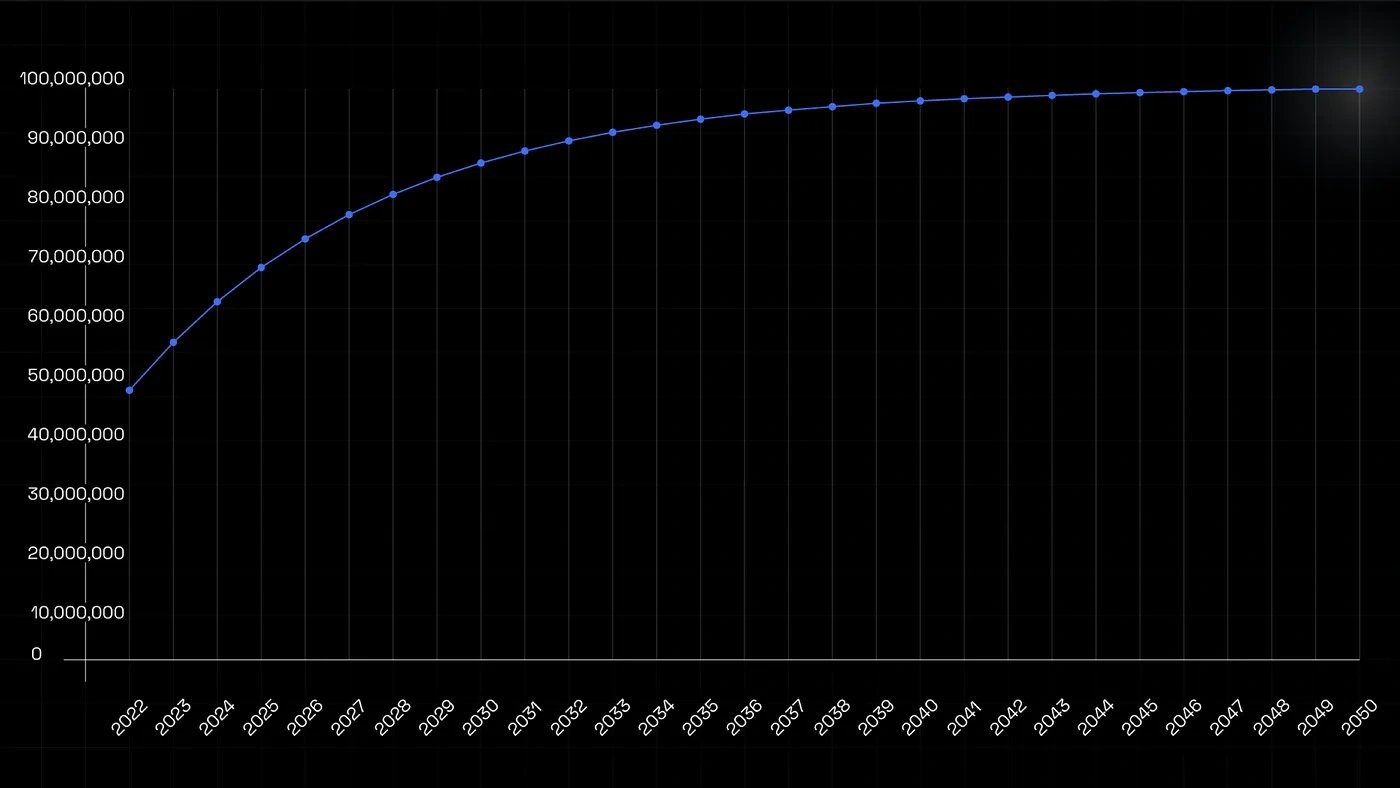
Under the historic veBAL-era schedule, weekly emissions were to decline by about 15.9% each year, with four successive annual reductions yielding an approximately halved emission rate over each four-year cycle. The first reduction, on March 28, 2023, lowered issuance from 145,000 to approximately 122,000 BAL per week.[24]
Partnerships
Balancer and NEAR
In October 2020, Balancer partnered with a NEAR protocol. The Balancer team said it would remain primarily focused on the Ethereum implementation, while Balancer Head of Growth Jeremy Musighi said the work with NEAR would help the team assess how Balancer performed on a more scalable chain.[9]
Balancer and NEAR also offered two grants worth up to $10,000 to incentivize development of a Balancer front end for NEAR and integration into the NEAR wallet. Rewards were to be paid in NEAR and BAL tokens.[9]
Balancer and Aave
On February 23, 2021, Balancer announced a partnership with Aave ($AAVE) to build the first Balancer V2 Asset Manager, allowing idle assets in V2 pools to earn yield through Aave.[6]
As prices shift, the token becoming more expensive can become scarcer in the pool as users buy it, reducing its balance. If its available cash balance runs out, swaps seeking to buy it can fail. The Aave-Balancer Asset Manager was designed to replenish that balance by redeeming some invested tokens from Aave and sending them back to the Balancer Vault. It could also send more of the token becoming more abundant in the pool to Aave for lending.[6]
Balancer and Gnosis
On April 28, 2021, Balancer announced Balancer-Gnosis-Protocol (BGP), combining Balancer V2’s Vault, liquidity pools, and asset managers with Gnosis Protocol V2’s price-finding mechanism and MEV protection.[62]
Balancer and Certora
In October 2022, Balancer partnered with security auditor Certora to launch the Balancer Certora Security Accelerator. It offered code reviews and access to Certora’s formal verification Prover for projects building on Balancer.[11]
Balancer Labs CEO and co-founder Fernando Martinelli said the accelerator aimed to support security reviews and provide tooling to projects in the Balancer builder ecosystem.[11]
Balancer and Polygon zkEVM
In June 2023, Polygon Labs launched its zkEVM Mainnet Beta, an EVM-equivalent Layer 2 using zero-knowledge proofs. Balancer announced its deployment on the network to support liquidity and ecosystem development.[23]
Balancer and Avalanche
Balancer’s deployment on Avalanche included a collaboration with BENQI, Ankr, Yield Yak, and GoGoPool on liquidity for sAVAX, ankrAVAX, yyAVAX, and ggAVAX, respectively.[53]
Balancer and Base
On August 3, 2023, Balancer announced its deployment on Base, an Ethereum Layer 2 platform powered by Coinbase. The announcement described intended work across Boosted Pools, liquid staking tokens, ve8020, and lending markets.[25][26] Balancer’s report said the deployment was part of an expansion facilitated through governance votes and that Base was open mostly to developers ahead of its full release.[27]
Funding
In March 2020, Balancer Labs secured $3 million in funding through a seed round led by Accomplice and Placeholder, with participation from CoinFund and Inflection.[7]
On November 9, 2020, Balancer Labs announced that both Pantera Capital and Alameda Research invested in Balancer Labs through the direct purchase of BAL tokens from the company's treasury. Beyond just providing capital as BAL token holders, both of these organizations provide additional value by being end-users of the protocol.[3]
On May 27, 2021, Balancer Labs announced that investors extended $24.25 million in capital by purchasing BAL tokens directly from the Balancer Labs treasury. Investors included Blockchain Capital, Continue Capital, Fenbushi Capital, FinTech Collective, Kain Warwick, LongHash Ventures, and Jordan Momtazi.[55]
June 2020 Pool Exploit
At least two Balancer multi-token pools containing STA and STONK lost approximately $452,000 on June 28, 2020, in attacks exploiting a vulnerability involving automated market makers and deflationary tokens. Contemporary outlets sometimes rounded the loss to about $500,000. Reported drained assets were 601.3 ETH, 11.36 WBTC, 22,593 LINK, and 60,915 SNX.[8][50]
The attacker deployed a smart contract to automate multiple actions in a single transaction. It started with a FlashLoan of 104,000 WETH from dYdX. That FlashLoan was used to swap WETH to STATERA (STA) token back and forth 24 times which drained the STA balance from the pool and it became 1 weiSTA, (0.000000000000000001 STA).[8]
This worked because token balances are tracked in the Balancer Pool and STA token had a deflationary model with a transfer fee of 1% charged from a recipient, which resulted in transfer() and transferFrom() misbehavior. Every time the attacker swapped WETH to STA, the Balancer Pool received 1% less STA than was expected. The attacker then swapped 1 weiSTA to WETH multiple times. Due to STA token transfer fee implementation, WETH was released even though the pool never received STA. The attacker then did the same thing to drain Wrapped Bitcoin (WBTC), SNX, and Link token balances from the pool.[8]
To finish the attack, the hacker repaid their FlashLoan of 104,000 WETH to dYdX and rapidly increased their share in the Balancer Pool by depositing a few weiSTAs. Finally, the attacker swapped their Balancer Pool token to 136,000 STA through Uniswap V2, they then swapped 136,000 STA to 109 WETH again. The attacker had extensive knowledge of smart contracts and used Tornado Cash to get initial funds and obscure the source of their Ethereum.[8]
In a June 30, 2020 incident response, Balancer said it had received a bug-bounty report from Hex_Capital on May 6 about risks involving deflationary tokens, but its team underestimated the feasibility of the attack. The response said Balancer would award the maximum bounty, revise its review process, and commission a planned OpenZeppelin audit.[50]
August 2023 Vulnerability Response
Balancer’s August 22, 2023 post reported a critical vulnerability affecting V2 pools, emergency mitigation, and about 4% of TVL still at risk.[28]
In its August 23 update, Balancer reported that over 97% of initially vulnerable liquidity had been secured, the vulnerability had not been exploited, and 0.89% of total TVL—about $5.6 million—remained at risk.[29]
September 2023 Phishing Attack
Cointelegraph reported that a September 2023 DNS phishing incident resulted in approximately $238,000 being stolen.[30]
November 2025 Exploit
On November 3, 2025, an ongoing Balancer V2 exploit involved more than $116 million in estimated digital assets transferred to a newly created wallet. Balancer’s team acknowledged the attack and initiated an investigation and bounty response.[30][31]
August 2026 Balancer V1 Exploit
On August 31, 2026, a rounding deficiency in the legacy, immutable Balancer V1 single-sided join flow enabled attackers to drain assets from affected pools. BIP-930 identified 120 affected pools and approximately $1,393,694.67 in tokens drained at attack-time prices.[39]
The exploit involved low-decimal-token reserves being reduced to dust. The calculated join input could then round down to a negligible amount while full pool tokens were minted, which could be redeemed against the pools’ remaining reserves. By the September 2026 proposal, approximately 296.4 ETH had been returned to the DAO multisig. BIP-930 proposed reimbursing affected liquidity providers pro rata based on their pool-token holdings at the block before the first exploit transaction, with reimbursement paid in ETH.[39]
BIP-930 passed on October 6, 2026, approving a proportional allocation framework for 296.401711 ETH in recovered funds for LPs in the 120 affected pools. The framework allocates recovered ETH among pools according to each pool’s share of total attack-time losses, then distributes each pool’s allocation pro rata among LPs based on their pool-token holdings at Ethereum block 25,872,248, immediately before the first exploit transaction. Payments are to be made in ETH. The approved proposal terms provide for a claim mechanism and claim period for eligible LPs.[40][39]